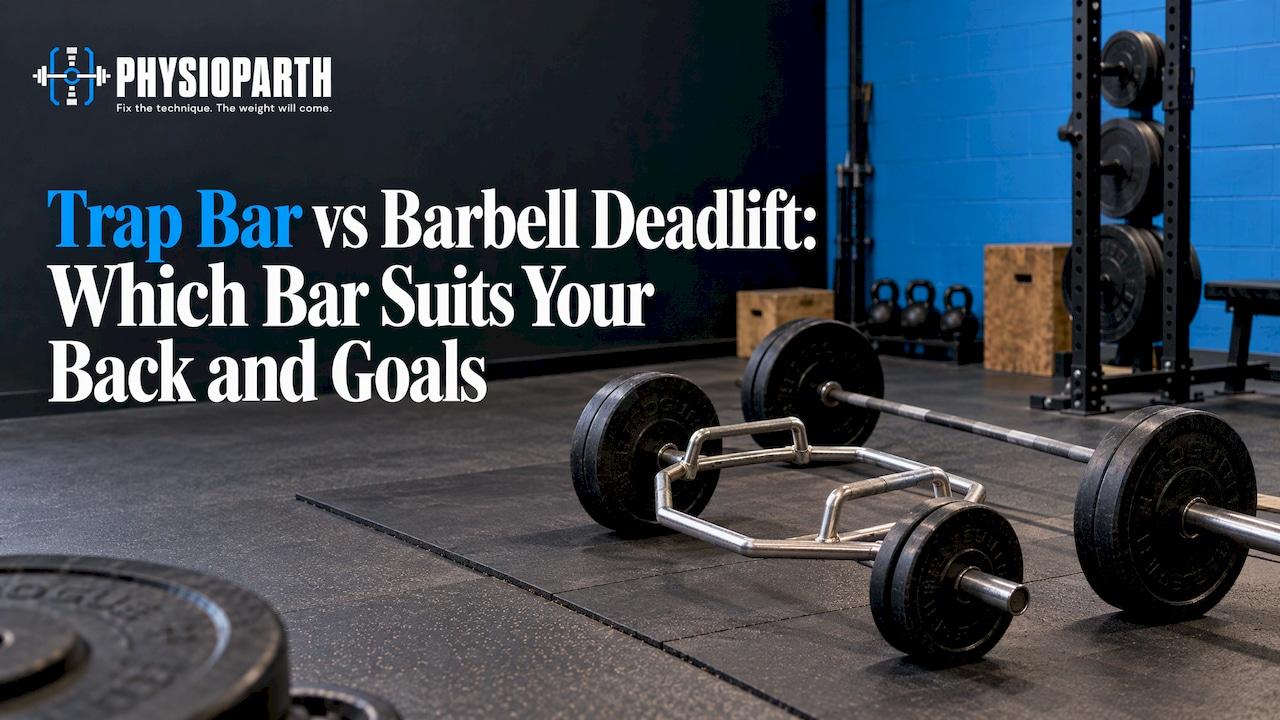
The trap bar (also called a hex bar) usually lets you lift more weight with lower demands on your lower back and hips. The straight barbell asks more of your hinge and your posterior chain, and it is the bar you will pull on a powerlifting platform. For most lifters with pain, the useful answer is not one bar or the other: it is using each at the stage where it fits, and moving between them by criteria rather than by calendar. I am Parth Suthar, a registered physiotherapist in Ontario and a former competitive powerlifter, and this is how I would think it through with you.
TL;DR
- The trap bar puts the load beside your body, so the lift is more upright and more knee-dominant. The straight bar sits in front of you and asks for more hip hinge.
- In a 2011 study of 19 powerlifters, the hex bar 1RM was heavier and lower-back, hip and ankle moments were lower, while the knee moment was higher.
- If you compete in a straight-bar sport, the straight bar stays your specific lift. The trap bar can be a useful variation when pain or a technique fault limits it.
- Move between bars by symptom response and movement quality, not by weeks on a calendar.
- Pain that travels, numbness, weakness or night pain needs in-person or medical assessment first.
Table of Contents
- How the two bars differ
- What the research shows
- Technique causes and load causes: sort them before you swap bars
- Which structures may be involved, and how to tell them apart
- Choosing your bar
- A criteria-based return-to-lifting progression
- Red flags: get in-person or medical assessment
- Where a physiotherapist who lifts fits in
- My view
- FAQ
- Book with me
- Sources
How the two bars differ
With a straight bar, you stand behind it and grip it in front of your legs. The bar has to travel around your knees, so your hips go back and your torso leans forward. With a trap bar, you stand inside the frame with the handles beside you. The trap bar was first trapezoidal and later became hexagonal, giving more room and stability, and it aligns the resistance with your centre of mass rather than holding it out in front.
In practical terms:
| Straight bar | Trap bar | |
|---|---|---|
| Bar position | In front of the legs | Beside the body |
| Torso angle | More forward lean | More upright |
| Dominant demand | Hip and posterior chain | Knee extensors plus hips |
| Skill to learn | Higher (bar path, tension, set-up) | Usually lower |
| Sport specificity | Powerlifting, strongman bar events | Variation or training tool |
| Handle options | Fixed bar height | Often high and low handles |
What the research shows
The numbers are small-sample studies, mostly on trained men, so read them as trends.
- Load. Swinton and colleagues found hex bar 1RM was 265 kg vs 245 kg for the straight bar in powerlifters. Lake et al. (2017) found about 6% heavier loads with the hex bar and 28% greater mean power.
- Joint demands. Swinton et al. reported lower peak moments at the lumbar spine, hip and ankle with the hex bar, and a higher knee moment. A 2025 study in strength-trained women also found greater knee moments with the hex bar and larger hip moments near lockout with conventional and sumo pulls.
- Muscles. At 90% of 1RM, a 2025 study found greater quadriceps and erector spinae activity with the hex bar, and greater biceps femoris activity with the conventional pull.
- Range of motion. Lockie and Lazar summarised that the hex bar shortens lift distance and duration by roughly 22% and 25%, which helps explain higher power outputs.
- Learning. A 2011 BYU thesis reported that most novice athletes picked up trap bar technique sooner than the back squat.
- Training outcomes. In an eight-week trial comparing barbell half squats and trap bar deadlifts, sprint, jump and lean mass changes did not differ between groups. When heavy loads and relevant movement patterns are trained, exercise choice may matter less than consistency.
A fair reading: the trap bar changes where the work lands. It does not remove effort, and it does not make a lift automatically suitable for every painful back.
Technique causes and load causes: sort them before you swap bars
A bar change helps most when you know what is driving the problem.
Technique causes are about how you pull: set-up (hips too low or too high), bar drifting away from the legs, loss of bracing, grip and stance width, and depth of the start position. The trap bar can reduce some of these demands because the bar cannot drift in front of you, but it adds its own: squatting the pull, shrugging at the top, and leaning back at lockout.
Load-management causes are about how much and how often: a jump in volume, many near-max singles, frequent heavy pulling, or poor recovery between sessions. Changing the bar does not fix a weekly load that your tissues have not adapted to. If your pain started after a block of higher volume, reducing the dose may matter more than the bar.
Which structures may be involved, and how to tell them apart
I can't diagnose you from an article, but these patterns may indicate where to look.
- Lumbar erector spinae and surrounding muscle: a broad ache across the low back, often worse with the bar in front and with flexion under load, easing with movement. It may indicate a muscle or tendon overload.
- Lumbar discs and joints: pain that is sharper with sustained bending or sitting, or that is provoked by specific end-range positions. It may indicate a more irritable spinal segment.
- Hamstring origin and glute tendons: deep sitting-bone or buttock pain, worse at the start of the pull or in a long hinge. It may indicate proximal hamstring tendon irritation. My guide on piriformis pain from deadlifts covers deep-buttock clues.
- Hip joint and groin: pinching at the front of the hip in deep flexion, which is why start position matters. See groin pain with deadlifts.
- Knee (patellofemoral and quadriceps tendon): front-of-knee pain. Because the trap bar raises knee demand, this is the area to watch when you switch.
- Upper back and mid-back: pain around the shoulder blades from holding tension. See upper back pain from deadlifts.
A useful comparison test: note which bar, which handle height and which phase (floor, knee, lockout) reproduces the pain. Pain at the floor in one bar and not the other is information about position, not a verdict on the tissue. For a fuller tissue breakdown, read my deadlift back pain guide.
Choosing your bar
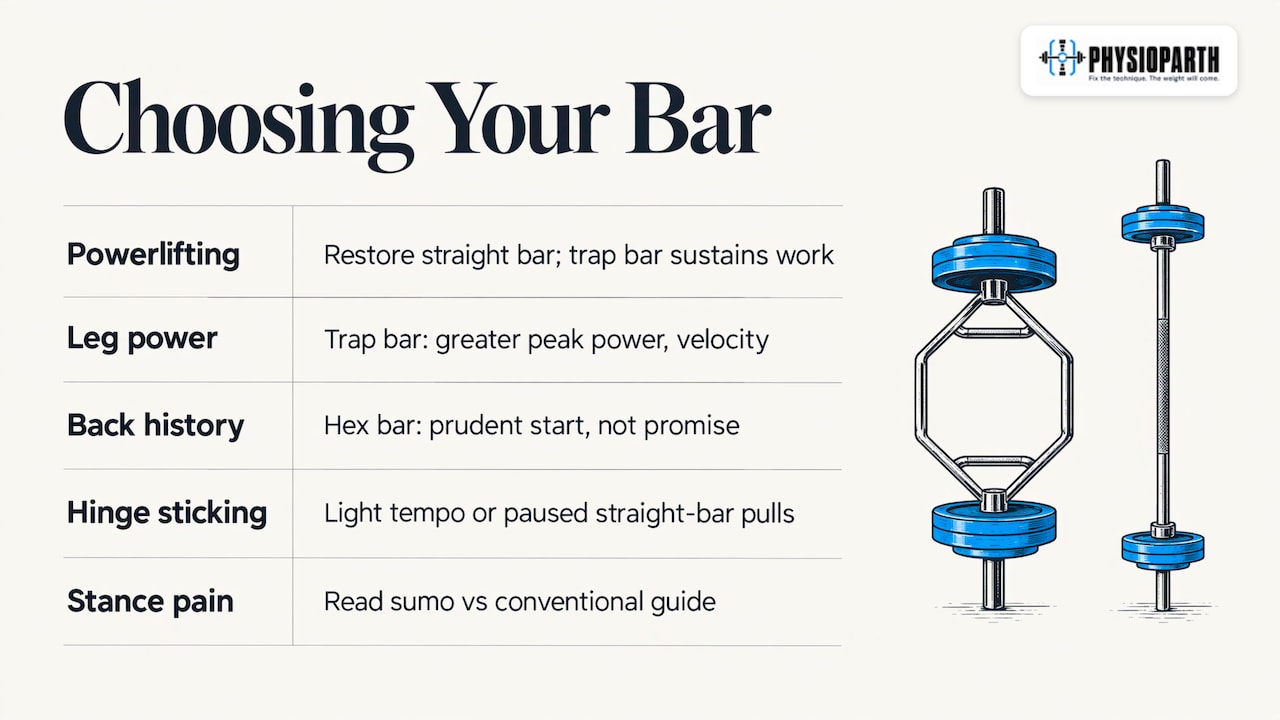
If you compete in powerlifting: the straight bar remains your specific lift, so it should come back into the plan. The trap bar is a variation to keep leg and back training going while you rebuild tolerance.
If you want leg drive and power with less hinge demand: the trap bar suits it, given the greater peak power and velocity reported in the research above.
If you have a history of low back pain: Swinton et al. suggested the hex bar may be a more prudent strategy than the straight bar for people with a history of low back pain or in the final stages of rehabilitation. It is a reasonable starting point, not a promise.
If your sticking point is the hinge itself: keep the straight bar in the plan in lighter, controlled forms, such as tempo or paused pulls, since that is the pattern you need to own.
If your pain shows up mostly in the sumo or conventional stance question, sumo vs conventional for back pain is the next read.
A criteria-based return-to-lifting progression
The NSCA's Personal Training Quarterly describes grading low back irritability by pain level and loading tolerance: low (0 to 3 out of 10), moderate (4 to 6) and high (7 to 10). It places the trap bar deadlift as a moderate-difficulty hinge, between bridges and thrusts (easiest) and the barbell deadlift (hardest), and suggests tracking symptoms over 24 hours. I use that logic as a frame. Move up a stage only when you meet every criterion for the stage you are in.
Stage 1: calm the area and keep a pattern. Use isometrics (for example a mid-thigh pull against pins, submaximal) and light bridges or thrusts. Criteria to move on: pain is settling and stays low during and after the session, and the next morning is no worse.
Stage 2: trap bar, controlled. Use the trap bar from blocks or with high handles, then a tempo trap bar pull with a slow lowering phase. Criteria: you can do your working sets with stable bracing and a consistent start position, with symptoms at or below your agreed ceiling and settled within 24 hours.
Stage 3: build the range and load. Lower the start height (low handles, then floor), use paused trap bar pulls, and add load gradually. A Safety Squat Bar squat or a trap bar pull can carry leg and trunk work in the same period. Criteria: floor pulls feel repeatable across two sessions without a symptom flare.
Stage 4: bring the straight bar back. Start with block pulls or pin pulls, with the bar at knee height, then tempo and paused pulls from the floor at submaximal loads. Criteria: tolerates the hinge at moderate loads with the same bracing quality you had on the trap bar.
Stage 5: competition pattern. Floor pulls with the straight bar, then heavier work and your usual frequency. Bench-pressing pain follows the same logic with floor press, pin press and paused variations. Criteria: heavy sets are repeatable and recovery between sessions is stable.
If symptoms flare, step back one stage rather than stopping altogether. Complete rest is not usually the goal; the NSCA article notes that resting during acute low back pain may worsen outcomes.
Red flags: get in-person or medical assessment
Stop and get assessed in person, or see a physician or emergency care, if you have any of these:
- Numbness around the groin or saddle area, or new trouble controlling your bladder or bowels (go to emergency care).
- Leg weakness that is progressing, or foot drop.
- Pain that is constant, unrelenting at night or at rest, or comes with fever, unexplained weight loss or a history of cancer.
- Pain after a significant fall, a car crash or a pop with immediate swelling or deformity.
- Pain, numbness or tingling that travels down the leg and is worsening, which may indicate nerve involvement. My sciatica and deadlifts guide covers what to do next.
A physiotherapist in Ontario can see you without a doctor's referral, though some insurers require one for reimbursement.
Where a physiotherapist who lifts fits in
If you are choosing between bars because of pain, the real question is which variation your tissues tolerate now and what the criteria are for the next step. Clinicians writing about hinge progressions describe it as symptom-guided progression with exercise difficulty in mind, which matches how I work through it.
My Initial Assessment is $130 and includes a full subjective and objective assessment and a movement screen, plus a lift analysis if you send videos beforehand. It aims to explain what tissue may be irritated and to build a criteria-based return-to-lifting plan, using modified variations where appropriate rather than complete rest. A Follow-Up Session is $100. You can see the assessment and follow-up options and book directly. Receipts are provided for insurance reimbursement, and many extended-health plans cover physiotherapy.

For self-guided work, the free guides at physioparth.com/squat, /bench, /deadlift, /toolkit, /resources and /audit are a good place to start.
My view
I came to physiotherapy from the platform, so I treat the bar question as a training question first. The trap bar is not a lesser deadlift, and the straight bar is not a test of toughness. They load you differently, and the right one is the one your current tissue capacity can handle with repeatable technique.
When a lifter comes to me in pain, I want to know the position, the phase of the lift and the weekly load before I pick a variation. My assessment aims to explain what may be irritated in lifter terms and to build a criteria-based plan that uses modified variations where appropriate, so that you keep moving rather than sit out.
The goal is the lift you actually want to do. The weight tends to follow once the technique does.
Parth
FAQ
Is a trap bar deadlift easier than a barbell deadlift?
For most lifters it allows heavier loads and is quicker to learn. In Lake et al., lifters moved about 6% more with the hex bar. Easier does not mean easy: the demand moves toward the knees and quadriceps.
Does the trap bar count for powerlifting?
No. Powerlifting meets use a straight bar, so the trap bar is a training variation. It can build leg drive and strength that you carry over to the straight-bar pull.
Can I use the trap bar if my back hurts?
It is often a sensible option, because lower-back moments were lower in the research above. Whether it suits you depends on what is irritated and how your symptoms respond within 24 hours. Check the red flags before training through pain.
Should I stop deadlifting with a straight bar completely?
Not necessarily. Many lifters step back to block pulls, tempo or paused work and return by criteria. A modified variation is usually a better plan than complete rest.
Book with me
If you want a plan built around your lifts, book with me for a free 15-minute consult at physioparth.com. It is a fit check, not an assessment or treatment.
Sources
- Biomechanical and Neuromuscular Insights into Deadlift Variations (KSEP, 2024)
- Swinton et al., JSCR, 2011
- Lake et al., Sports (Basel), 2017
- Gundersen et al., JSCR, 2025
- Fletcher, Maddams and Charalambous, 2025
- Lockie and Lazar, NSCA SCJ, 2017
- BMC Sports Science, Medicine and Rehabilitation, 2024
- BYU thesis, 2011
- NSCA Personal Training Quarterly, Issue 10.1
Recommended
- Rounded Back Deadlift: When It Matters and How to Progress
- Sumo vs Conventional Deadlift for Back Pain: How to Choose
- Deadlift Form Analysis: How to Film, Review and Act on Your Pull
- Deadlift Back Pain: Ontario Lifters’ Tissue Clues and Return Criteria
This article is general education for strength athletes and is not a substitute for an individual assessment. Pain that is severe, worsening, or accompanied by numbness, weakness or loss of function needs prompt in-person or medical assessment. Author: Parth Suthar, Registered Physiotherapist (Ontario).