
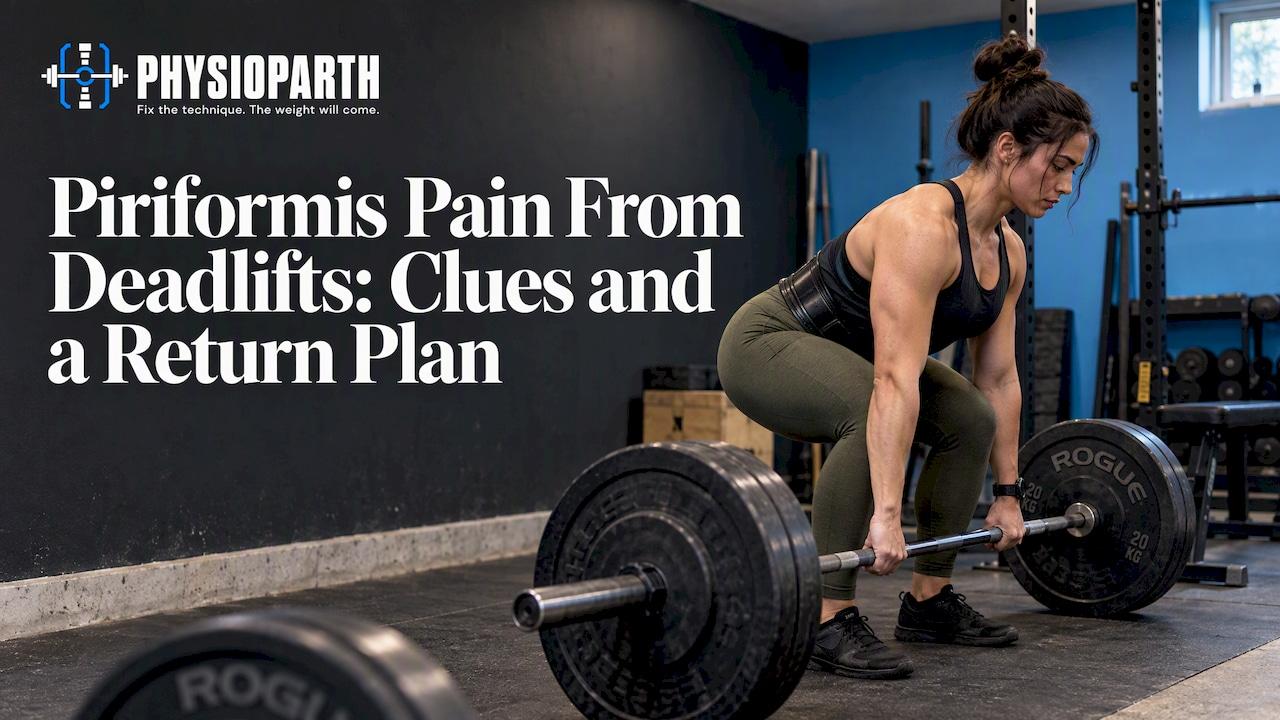
Deep buttock or posterior hip pain when you pull may come from the piriformis, but it may also come from the lower back, the SI joint, the hamstring attachment or the hip joint itself. The useful question is not "is it my piriformis?" but "which structure is irritated, and what load does it tolerate right now?" Below I lay out the likely candidates, how to tell them apart by symptoms, what to change in technique and training load, and how I would progress deadlifting back in by criteria rather than by calendar. This is general education, not a diagnosis of your pain.
TL;DR
- Pain deep in the buttock during or after deadlifts may involve the piriformis, other deep hip rotators, the proximal hamstring tendon, the SI joint or the lumbar spine. Several of these overlap.
- Where it hurts, what it does when you sit, and whether it travels down the leg are the best clues for separating them.
- Sort your causes into technique (set-up, bracing, bar path, stance, depth) and load management (volume, intensity, frequency, recovery). Most lifters have a bit of both.
- Return by criteria: modified variations such as rack pulls, trap bar, tempo, paused and isometric work, moving on only when the next-day response settles.
- Numbness, weakness, pins and needles, night pain, fever or inability to bear weight need in-person or medical assessment.
Table of Contents
- Why the deadlift loads the back of the hip
- Which structures are likely involved
- How to tell them apart
- Technique causes
- Load-management causes
- My perspective
- Red flags: when you need in-person or medical assessment
- A criteria-based return to deadlifting
- Working with me
- FAQ
- Sources
Why the deadlift loads the back of the hip
The deadlift asks the glutes, hamstrings and spinal erectors to extend the hip against a heavy load from a deep hinge position. Soreness in the glutes is expected, especially when you start pulling or add weight. Hospital for Special Surgery notes that temporary soreness in the back, quads, hamstrings and glutes is common when you begin or increase load, and is consistent with delayed-onset muscle soreness rather than injury.
That soreness usually shows up 24 to 48 hours after a new or harder session and can last up to five days. A Canadian health-and-fitness report adds that localized pain, swelling, bruising or soreness that does not ease may signal something more than ordinary muscle soreness.
So the line is not "glutes felt it" versus "glutes did not." The line is the quality of the symptom: dull, diffuse, both sides and settling within a few days is usually training soreness. Sharp, focal, one-sided, persistent or travelling pain is worth taking seriously.

Which structures are likely involved
A review of posterior hip pain in athletes lists lumbar referred pain, SI joint dysfunction, hip extensor and rotator muscle pain, proximal hamstring rupture and piriformis syndrome among the possible sources. It also notes that piriformis syndrome may account for up to 5% of cases of low back, buttock and leg pain, so it is a real but not dominant cause.
The main candidates for a lifter:
- Piriformis and the other deep external rotators. They sit under the gluteus maximus and stabilize the hip as you pull. Overload may give a deep, aching buttock pain. The sciatic nerve runs close by, so irritation here may send symptoms down the back of the thigh.
- Sciatic nerve in the deep gluteal space. Pain may be buttock-centred with a burning or tingling quality. The same review says piriformis-type symptoms can be worse with stooping or lifting, and that presentations are often vague, with few validated tests, so the diagnosis is frequently reached by exclusion.
- Proximal hamstring tendon. Typically a deep, localized spot at the sit bone (ischial tuberosity), often aggravated by sitting and by hinging deep with load.
- SI joint and surrounding ligaments. Pain usually sits to one side of the lower spine, around the dimples of the lower back, and may be provoked by asymmetrical loading or the first rep off the floor. I cover this in detail in SI joint pain with deadlifts.
- Lumbar spine. Disc or joint irritation can refer pain into the buttock and leg. If this sounds like you, see deadlift back pain and return criteria and sciatica and deadlifts.
- Hip joint. Deep pain in the groin or front of the hip, pinching at the bottom of the hinge or in deep flexion, may point away from the piriformis and toward the joint itself.
An assessment of a powerlifter's hips and lumbar spine typically covers symptom-provoking movements, pain intensity and left-right differences. That is the same logic I use below.
How to tell them apart
None of these clues proves anything on its own. They help you describe your pain accurately, which is what makes an assessment faster and more useful.
| Clue | Piriformis / deep rotators may be involved | Hamstring tendon may be involved | SI joint may be involved | Lumbar spine may be involved |
|---|---|---|---|---|
| Where it is felt | Deep in the middle of the buttock | Small, localized spot at the sit bone | Beside the lower spine, one side | Low back, often with buttock or leg referral |
| Sitting | Often worse after prolonged sitting | Worse on hard surfaces and sitting | Variable, often worse rolling or standing from sitting | Often worse with flexion or prolonged sitting |
| Pulling | Worse with deep hinge, rotation, or the lockout squeeze | Worse at the bottom, with long hamstring stretch under load | Worse off the floor or with asymmetry | Worse with rounding, bracing loss or heavy axial load |
| Travelling symptoms | May go down the back of the thigh | Usually stays local | Rarely below the knee | May go below the knee with tingling or numbness |
| Tender point | Deep, broad buttock tenderness | Pinpoint at the ischial tuberosity | Over the joint line | Often not tender locally |
The review of posterior hip pain describes a proximal hamstring tendon problem as deep, localized pain at the sit bone and notes that distinguishing causes needs a history and physical exam of both the hips and lumbosacral spine. A table cannot replace that.
Two quick self-observations are useful to bring to an assessment:
- Does the pain change with position and load, or is it constant? Mechanical pain that changes with movement is a very different picture from constant pain that does not.
- Does it stay in the buttock, or does it travel past the knee? Symptoms that travel, or come with numbness or tingling, need a closer look at the nerve and the spine.
Technique causes
Technique faults often explain why one side of the hip takes more load than it can tolerate. Look at these first:
- Set-up and hip height. Starting with the hips too low turns the pull into a squat and demands deep hip flexion. Starting too high turns it into a stiff-leg pull that loads the hamstring attachment. Dr Alison Grimaldi's clinical guidance on modifying deadlifts for hip pain suggests reducing hip-flexion range and trunk inclination, for example by lifting from a rack.
- Bar path. If the bar drifts away from your shins, the lever arm grows and the posterior hip works harder. Keep the bar in contact with your legs.
- Bracing and pelvic position. Losing the brace and tipping the pelvis forward under load shifts stress to the lumbar spine and deep hip structures. Grimaldi's article also points to reducing excessive lumbar lordosis and anterior pelvic tilt.
- Lockout. A hard hip thrust and glute squeeze at the top may bother a sensitive posterior hip. Finish tall, without leaning back or ramming the hips forward.
- Stance and foot angle. A sumo or wide stance with a lot of turn-out loads the deep rotators differently from conventional. If one stance bothers you and the other does not, that is a useful clue.
- Grip and asymmetry. A mixed grip or a bar that twists you can create a side-to-side difference that shows up as one-sided buttock pain.
Filming your pulls from the side and from 45 degrees behind is the cheapest way to spot these. My free deadlift guide walks through the set-up checkpoints, and the toolkit and audit are there if you want a structured way to review your own lifts.
Load-management causes
Sometimes the technique is fine and the tissue just got more than it was ready for. Check:
- Volume. A jump in weekly sets or reps of deadlifts, or adding a second heavy hinge day, is a common trigger.
- Intensity. A run of heavy singles close to maximum, or a new peaking block, loads the posterior hip hard.
- Frequency. Back-to-back hinge sessions without recovery leave less time for tissue to adapt.
- Recovery. Poor sleep, a stressful stretch of work and a high total training load all reduce tolerance.
- Everything else you do. Long sitting stretches, hard squatting and running add to the same posterior hip structures.
The Canadian Forces Health Services point out that a previous injury is a major predictor of future injury and that recovery should be complete before returning to high physical demands. In practice that means a gradual, structured return rather than testing a max to see if it is "better." Approaches such as muscle activation therapy are also used by some athletes alongside load reduction and gradual loading, with the next-day response guiding progression.
My perspective

I was a competitive powerlifter before I was a physiotherapist, and posterior hip pain on the deadlift is a complaint I recognize from both sides. The usual instinct is to stretch the piriformis and rest completely. I do not think either is a good primary plan. Stretching alone may feel relieving but does not build the tolerance your hip needs for a heavy pull, and complete rest may reduce the load your tissue can handle later.
What I aim to do in an assessment is work out which tissue may be irritated, look at your lift on video if you send it, and build a plan around what you can still do. That usually means changing the variation, the range or the volume of the deadlift instead of removing it. I would rather you pull a rack deadlift at a load that settles by the next morning than sit out for six weeks and return with less capacity.
— Parth
Red flags: when you need in-person or medical assessment
Virtual physiotherapy is a good fit for many lifters, but some symptoms need hands-on or medical assessment first. Seek in-person care promptly if you notice any of these:
- Inability to bear weight, severe pain that does not ease, or a visibly deformed hip or leg. Health Canada's musculoskeletal guidance lists these, along with new numbness, weakness or pins and needles in the leg, as reasons for urgent assessment.
- Constant pain, night pain, fever, unexplained weight loss, fatigue or a history of cancer. The same guidance links these features to neoplastic or infectious causes, and the posterior hip review says systemic symptoms like these warrant a workup.
- Trauma. A fall or a sudden pop while pulling, followed by bruising at the back of the thigh, may indicate a hamstring tendon tear and calls for assessment. Fracture has to be ruled out after significant trauma.
- Changes in bladder or bowel control, numbness in the saddle area, or progressive leg weakness. Go to an emergency department.
- Severe muscle pain and weakness with dark urine after an unusually intense session. Canada's Department of National Defence says this combination may indicate exertional rhabdomyolysis and needs immediate medical attention.
In Ontario you do not need a doctor's referral to see a physiotherapist, though some insurers ask for one before they reimburse you. If symptoms are persistent or worsening and none of the above applies, a registered physiotherapist is a sensible first step. If a red flag applies, an in-person or medical assessment comes first, and I can help plan the return afterwards.
A criteria-based return to deadlifting
Progress by how you respond, not by the date. Move to the next stage only when you meet the criteria for the current one. These stages are a general framework, not a prescription, and the right variation depends on which tissue is irritated.
Stage 1: calm things down and keep loading
Remove the exact movement that provokes your pain, but keep training the pattern.
- Isometrics: a mid-shin isometric pull against pins, or a bridge hold, built from easy to moderate effort.
- Trap bar or rack pulls from above the knee, with lighter loads and controlled reps.
- Lower volume, fewer weekly hinge sets and no grinding reps.
Move on when: pain during the session stays low and settles, your symptoms are no worse the next morning, and your walking, sitting and sleep are not affected. Rehabilitation guidance for tendon problems treats the 24-hour response as a primary indicator of tolerance, and I use the same principle for the posterior hip.
Stage 2: rebuild range and tolerance
- Pin pulls or blocks lowered gradually, so the bar starts closer to the floor.
- Trap bar deadlifts from the floor, which reduces trunk lean and keeps the load near your centre of mass.
- Tempo deadlifts, for example a three-second lowering phase, to improve control at light to moderate loads.
- Paused deadlifts just off the floor or at the knee, to practise position and bracing.
- Heavy, slow single-leg and glute work, as described in my heavy slow resistance guide for tendon-type problems.
Move on when: you can complete your sets with no more than mild, short-lived discomfort, with no travelling symptoms, and the next day is no worse than baseline across two or three consecutive sessions.
Stage 3: return the floor pull
- Block pulls from lower and lower heights until you reach the floor.
- Conventional or sumo from the floor at submaximal loads, using the stance that has bothered you less.
- Controlled lockout without a hard hip thrust.
- Increase one variable at a time: load, reps or frequency, never all three.
Move on when: floor pulls at roughly your working loads are tolerated, symptoms stay quiet during and after, and your technique holds on video.
Stage 4: rebuild intensity
- Return to heavier sets and your competition stance, still watching the next-day response.
- Add back accessory hinge work, such as Romanian deadlifts, only when the main lift is calm.
- Consider a Safety Squat Bar squat or other lower-demand variations to keep leg work going if squatting depth also irritates your hip. I cover squat-side causes in hip pain squatting.
Individualized return-to-activity treatment for hip-related pain should reflect your goals and build the ability to tolerate the loads your sport requires. If pain flares, step back one stage, reduce volume, and reassess technique before pushing again.
A note on the floor press and overhead press: if hinge work is limited, keeping upper-body pressing going, including a floor press if shoulder or back position is a problem, helps you avoid global detraining while the hip settles.
Working with me
If you want help working out which tissue may be involved and how to progress, I offer virtual physiotherapy for strength athletes in Ontario. The Initial Assessment is $130 and includes a full subjective and objective assessment and a movement screen, plus a lift analysis if you send videos beforehand. It aims to explain what tissue may be irritated and to build a criteria-based return-to-lifting plan using modified variations where appropriate rather than complete rest. Follow-up sessions are $100.

If you are not sure whether virtual care suits you, the free 15-minute consult is a fit check, not an assessment or treatment. Many extended-health plans cover physiotherapy, and I provide receipts for reimbursement.
FAQ
Am I supposed to feel deadlifts in my glutes?
Yes, the glutes, hamstrings and spinal erectors all work during a deadlift, so some glute fatigue and soreness is normal, especially after adding weight. Pain that is sharp, burning, focal or one-sided, or that you feel during the lift, may indicate more than soreness. Stop the set if pain appears while lifting.
Why do I have pain at the back of the hip or sacrum after deadlifts?
The cause may be muscular, such as the piriformis or hamstring attachment, or it may come from the SI joint or lumbar spine. Technique drift under fatigue and a sudden jump in volume are common contributors. A physiotherapist can sort these out with a history and a physical exam of your hips and lower back.
How long does soreness last before I should worry?
Delayed-onset muscle soreness usually starts 24 to 48 hours after a harder session and can last up to five days. If pain is localized, getting worse, or not easing after that window, or if it comes with swelling, bruising or leg symptoms, get it assessed.
Should I stop deadlifting completely?
Not necessarily. Complete rest may ease symptoms but can reduce the tissue tolerance you need later. Modifying the range, stance, load or volume often lets you keep training the pattern while the area settles. If you have a red flag, such as numbness, weakness or an inability to bear weight, stop and get assessed first.
Can I book with you without a referral?
Yes. In Ontario you do not need a doctor's referral to see a physiotherapist, although some insurers require one for reimbursement. Book with me for a free 15-minute consult at physioparth.com and we can check whether virtual physiotherapy fits your situation.
Sources
- Posterior Hip Pain in an Athletic Population: Differential Diagnosis (PMC)
- Lower Back Pain After Deadlifts? Here's How to Do Them Right (Hospital for Special Surgery)
- How to spot the difference between muscle soreness and injury (The Globe and Mail)
- Development of a comprehensive clinical assessment protocol for powerlifters (PMC)
- Modifying Deadlifts for Hip Pain (Dr Alison Grimaldi)
- Top injury prevention tips (Government of Canada)
- Chapter 7, Musculoskeletal System (Health Canada)
- Exertional Rhabdomyolysis (Department of National Defence)
- Hip-related pain return to activity (British Journal of Sports Medicine)
- Tendinopathy Rehabilitation (Physiopedia)
Recommended
- Sciatica and Deadlifts: How to Train Around Leg Pain
- SI Joint Pain With Deadlifts: Tell It Apart and Return
- Deadlift Back Pain: Ontario Lifters’ Tissue Clues and Return Criteria
This article is general education for strength athletes and is not a substitute for an individual assessment. Pain that is severe, worsening, or accompanied by numbness, weakness or loss of function needs prompt in-person or medical assessment. Author: Parth Suthar, Registered Physiotherapist (Ontario).