
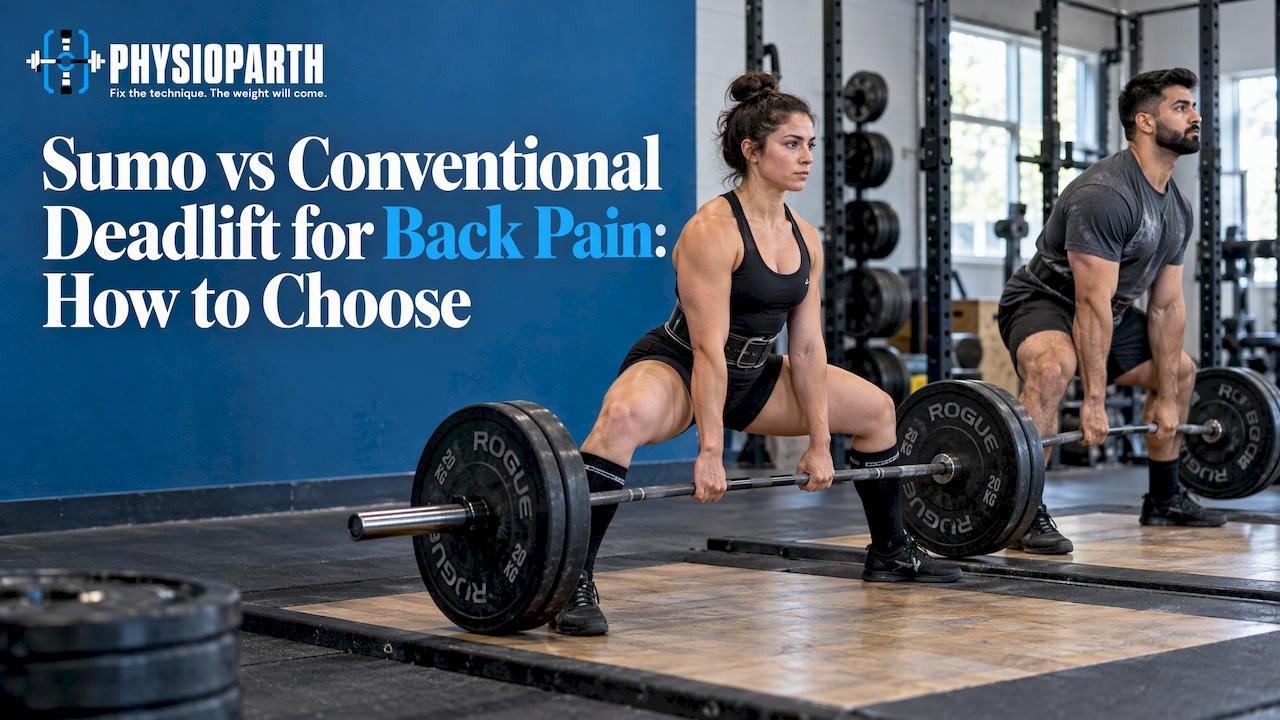
Neither style is automatically easier on your back. Sumo tends to put the trunk in a more upright position, which may suit some lifters with back pain, but the research does not show that it is better for everyone. The better choice is the variation you can repeat without symptoms building, and that depends on your hips, limb lengths, injury history and training load. I'm Parth Suthar, a registered physiotherapist in Ontario and a former competitive powerlifter, and in a virtual Initial Assessment I aim to work through exactly this comparison with you using your own lift videos.
TL;DR
- Sumo usually has a more upright trunk and a shorter pull. Conventional usually asks for more trunk lean and more hamstring and back-extensor work. Both load the lumbar spine heavily.
- Published research supports choosing by anthropometrics, hip mobility and injury history. It does not establish that sumo prevents or resolves back pain.
- Pick the style you can repeat without pain or discomfort, and raise load gradually. Progress by criteria, not by calendar dates.
- Intermediate options such as the trap bar, block pulls, paused and tempo work can bridge a return to the floor.
- Numbness around the groin, new bladder or bowel changes, or fast-worsening leg weakness need urgent medical care, not a technique change.
Table of Contents
- What actually differs between the two pulls
- Sumo vs conventional vs bridging options
- Why "sumo is easier on the back" is only half an answer
- Technique causes vs load-management causes
- Which structures may be involved, and how to tell them apart
- How to choose your style when your back is sore
- A criteria-based return to the floor
- Red flags: when to get in-person or medical care
- Where I come in
- Perspective
- FAQ
- Sources
What actually differs between the two pulls
The two styles move the same bar off the same floor, but the body arranges itself differently. A three-dimensional analysis from 2000 found sumo lifters used a much wider stance (about 70 cm versus 32 cm), turned their feet out further (about 42° versus 14°) and held a more vertical trunk and thigh than conventional lifters. Conventional lifting needed roughly 25 to 40% more bar travel and mechanical work in that study.

A review of repetitive deadlift biomechanics puts numbers on trunk position: sumo trunk angles of about 57° to 65.5° versus 66.7° to 73.4° for conventional. The same review reports heavy-deadlift spinal loads of 5 to 18 kN of compression and 1.3 to 3.2 kN of shear. It also notes the cited study found no difference in paraspinal activation at L3 or T12 between styles, and that it found no studies of low-back mechanics during repetitive deadlifts.
That last point matters for you. A more upright trunk may reduce shear on paper, but your back also has to survive sets, weeks and fatigue, and the evidence on that is thin.
Muscle demands: where the work goes
An electromyographic study from 2002 found greater vastus medialis, vastus lateralis and tibialis anterior activity in sumo, and greater medial gastrocnemius activity in conventional. A 2025 Frontiers study reported higher biceps femoris activation and more hip flexion in conventional, and larger frontal- and transverse-plane hip and knee moments in sumo.
In practical terms:
- Sumo shifts more of the job to the quads and asks more of the hips in rotation and abduction.
- Conventional leans on the hamstrings, glutes and spinal extensors to hold a longer lever.
- If a hip or groin structure is already irritated, sumo can load it more, which is why a back-pain choice should not ignore the hips.
Sumo vs conventional vs bridging options
| Factor | Sumo | Conventional | Trap bar or elevated pull (bridge) |
|---|---|---|---|
| Trunk position | More vertical | More forward lean | Usually more upright than conventional |
| Hip demand | More mobility and rotation needed | Less abduction and rotation | Less hip flexion needed |
| Dominant muscle emphasis | Quads, adductors | Hamstrings, spinal extensors | Quads and hips |
| Bar travel | Shorter | Longer | Shorter than a floor bar for most lifters |
| May suit | Shorter arms, good hip mobility, previous spine issues | Longer arms, limited hip mobility, knee or hip history | Early return when floor-bar position is not tolerated |
| Watch for | Groin, hip or knee irritation | Back symptoms with fatigue or rounding | Hyperextension at lockout |
The suitability row follows the 2017 Strength & Conditioning Journal review, which says sumo may suit athletes with shorter arms, above-average hip mobility or previous vertebral injuries, while conventional may suit longer arms, limited hip mobility or earlier knee and hip problems. The same review says more data are needed before claiming a practical low-back benefit for sumo. The trap bar column follows a phased rehabilitation protocol that describes it as a possible intermediate step, with higher handles, less hip flexion and more quadriceps contribution, and warns against excessive lumbar hyperextension at lockout.
Why "sumo is easier on the back" is only half an answer
Most pages that rank for this question stop at trunk angle. A lower shear estimate is a reasonable starting point, but it leaves out three things.
- Your anatomy decides the fit. If your hips do not tolerate a wide, turned-out stance, you may compensate with pelvic tilt, knee collapse or a rushed start, and the back can end up paying for it anyway.
- Pain behaviour matters more than averages. An ACSM Health & Fitness article frames comfort as the critical selection factor: choose a variation you can perform repeatedly without pain or discomfort, use sound technique, and avoid raising load too quickly because deadlifting produces substantial compressive and shear forces.
- Load is often the real variable. Switching styles can hide a volume or recovery problem for a few weeks, then the symptoms return.
Technique causes vs load-management causes
When back pain shows up in a deadlift, I sort the contributors into two groups, because the fixes differ.
Technique causes
- Set-up: hips starting too low or too high, which changes where your back has to work.
- Bar path: the bar drifting away from the mid-foot lengthens the lever on your spine.
- Bracing: losing trunk pressure off the floor or at the knees.
- Grip: a grip that gives out can make you yank and round to finish the rep.
- Stance: in sumo, a stance too wide or too turned out for your hips; in conventional, a stance that forces excessive lean.
- Depth of start position: a start you cannot reach without spinal flexion under load.
The low back pain review in weight lifters lists technique correction, mobility work, correcting muscular imbalances and activity modification as management components for athletes who want to keep lifting. If you want to look at your own pull first, my guide to filming and reviewing your deadlift shows what angles to capture, and rounded back deadlift covers when flexion matters and when it may not.
Load-management causes
- Volume: a jump in weekly sets or reps, especially off the floor.
- Intensity: frequent near-maximal singles without enough submaximal work.
- Frequency: deadlifting heavy on back-to-back days, or stacking it with heavy squats or good mornings.
- Recovery: poor sleep, a hard training block, or a return from time off that restarts at the old numbers.
If your pain started after a change in load, switching from conventional to sumo may feel better for two weeks and then stop helping. Look at the training log first.
Which structures may be involved, and how to tell them apart
I can't diagnose you through an article, and pain location alone is not conclusive. These are the structures most commonly implicated in deadlift-related pain, with clues that may help you describe it to a clinician.
| Structure | Typical clues | May behave differently with |
|---|---|---|
| Lumbar spinal extensors (muscle and fascia) | Dull, band-like ache beside the spine, often after high-volume pulling; tender to press | Often settles with load reduction and variation changes |
| Lumbar discs and endplates | Pain that is sensitive to repeated forward bending or sitting, sometimes with morning stiffness | May tolerate a more upright start better; may flare with rounded positions |
| Facet joints | Sharper, one-sided pain, often with extension or twisting, pinching at lockout | May tolerate flexion better than extension; lockout and arching can provoke it |
| Sacroiliac joint | Pain low and to one side near the dimple, may refer to the buttock or groin | Often provoked by asymmetrical stance or the start of a pull; see SI joint pain with deadlifts |
| Deep hip rotators and piriformis | Deep buttock ache, worse with turned-out stances | Sumo may load it more; see piriformis pain from deadlifts |
| Hip joint and adductors | Groin or front-of-hip pain, pinching at the bottom of the start position | Sumo's wide stance may provoke it; see groin pain with deadlifts |
| Nerve root irritation | Leg symptoms such as tingling or shooting pain below the knee | May change with spinal position; see sciatica and deadlifts |
A useful way to tell them apart is to note three things after each session: where the pain sits, which position or rep provokes it, and how long it takes to settle. Pain that is local, repeatable and eases with a change in position or load behaves differently from pain that spreads down the leg or arrives with numbness. For a fuller walk-through, my article on deadlift back pain tissue clues and return criteria goes deeper.
To put numbers on how common this is: the weight-lifter review above reports that low back pain accounts for 23% to 59% of reported weight-lifting injuries in the literature it cites, and that it commonly involves the squat or deadlift. You are not unusual, and it does not have to mean you stop lifting.
How to choose your style when your back is sore
Use these four checks together. No single one decides it.
- Anthropometrics. Long arms relative to your torso usually shorten the range a conventional pull has to cover. Shorter arms may favour sumo.
- Hip mobility and tolerance. Can you sit into a wide stance with turned-out feet without pinching, cramping or your pelvis tucking? If not, sumo may be asking for range your hips don't have yet.
- Injury history. The 2017 review links earlier vertebral problems with sumo, and earlier knee or hip problems with conventional. Treat it as a starting hypothesis, not a rule.
- Symptom response. Do three or four submaximal reps of each style, rest properly, and note symptoms during the set, right after and the next morning.
If both styles provoke symptoms, the problem may be load, position or the tissue's current tolerance rather than the style, which is where a modified variation comes in.
A criteria-based return to the floor
Progress when you meet the criteria, not when a date arrives. The sequence below follows the principle in the phased protocol: reintroduce the deadlift from an elevated start, teach a hip hinge rather than lumbar flexion, keep bracing and lat engagement, and progress toward the floor as control improves.
Stage 1: isometrics and hinge control
- Isometric holds: mid-shin or knee-height pulls into pins or straps, building tension without moving.
- Light hinge patterns (kettlebell or dumbbell from an elevated surface).
- Move on when: the holds are tolerated with symptoms at or below your baseline, settle within about an hour, and do not worsen the next morning.
Stage 2: elevated and tempo work
- Block pulls or rack pulls from just below the knee, in your chosen style.
- Trap bar deadlifts from raised handles, avoiding hyperextension at lockout.
- Tempo pulls with a slow lowering phase to build control.
- Move on when: you can complete your planned sets with consistent bracing, a stable bar path and no symptom escalation across two or three sessions.
Stage 3: lowering the start
- Block height drops step by step toward the floor.
- Paused deadlifts (pause just off the floor or at the knee) to expose and clean up the weak position.
- Standard-height trap bar pulls.
- Move on when: the lower start position is repeatable at the same loads without compensation, such as pelvic shift, early hip rise or rounding that wasn't there before.
Stage 4: floor pulls in your chosen style
- Floor deadlift in sumo or conventional, starting well below your previous working weights.
- Add load in small steps and keep an easier week when symptoms spike.
- Move on when: you can repeat a session at a given load, with symptoms settling in a normal window, before adding more.
Stage 5: rebuild intensity
- Reintroduce heavier singles and your competition or training style only after the volume work is steady.
- Keep one lighter pull day in the week while you do it.
Throughout, the same rule from the ACSM article applies: avoid raising load too quickly. If a stage keeps provoking symptoms, step back one stage and change one variable, such as stance, height or volume, not three at once. The squat equivalent of this approach is in my free Lifter's Hip & Lower Back Toolkit.
Red flags: when to get in-person or medical care
Some symptoms are not a technique problem. Get in-person medical assessment promptly, and go to an emergency department for the first group.
- Urgent: new numbness in the saddle area (groin, inner thighs, buttocks), new trouble passing urine or loss of bladder or bowel control, or rapidly worsening leg weakness. A spine surgeon's guide to cauda equina warning signs lists these as the symptoms not to ignore.
- Same-day or next-day assessment: back pain after a fall or heavy impact, a sudden sharp pain with a pop, fever or unexplained weight loss alongside back pain, or pain that is severe at night and does not ease in any position.
- Book an in-person exam: persistent numbness, pins and needles or weakness in one leg, or pain that is clearly worsening over several sessions despite lighter loads.
Ontario residents don't need a doctor's referral to see a physiotherapist, but a physician or in-person clinician is the right first step in these situations, and I will tell you so if your history points that way.
Where I come in
A comparison article can tell you what the averages look like. It can't watch your pull. In a virtual Initial Assessment ($130), I aim to take a full history, an objective assessment and a movement screen, and, if you send videos beforehand, a lift analysis of your sumo and conventional pulls. The aim is to explain in lifter terms what tissue may be irritated and to build a criteria-based plan that uses modified variations where appropriate rather than complete rest. Follow-up sessions are $100. Many extended-health plans cover physiotherapy, and I provide receipts for reimbursement; some insurers require a referral, so check yours.

If you're not sure the fit is right, the free 15-minute consult is a fit check, not an assessment or treatment. You can also start with the free lift audit, or see everything on physioparth.com.
Perspective
When I was competing, I assumed the style that looked better on paper was the style I should pull. The questions I now ask lifters are different: which start position can you repeat, what does the bar do as it leaves the floor, and what has changed in your training recently?
I think the sumo vs conventional debate is often a proxy for a bigger question, which is whether you have to stop lifting to get better. My approach aims to keep the barbell in your week through modified variations, such as tempo, paused, pin or trap bar pulls, with clear criteria for the next step.
A style switch can be a useful part of that plan. It works best when it comes from your anatomy and your response to loading, and when your plan names what you're checking before you add weight.
Parth
FAQ
Is sumo deadlift better for lower back pain?
Sumo has a more upright trunk, which may reduce shear loading at the spine for some lifters. The 2017 Strength & Conditioning Journal review, however, says more data are needed to support a practical low-back benefit. The better test is whether you can repeat the lift without symptoms building.
Can I switch to sumo while my back is sore?
You can try it with light loads, and it may suit you if you have shorter arms and good hip mobility. A sudden switch can load the hips and groin differently, so keep the weight low and track symptoms during, after and the next morning. If either style keeps flaring symptoms, a movement assessment may help.
Why does my lower back hurt in sumo deadlifts?
Common technique contributors include hips starting too low, the bar drifting away from the legs, and losing bracing off the floor. A stance too wide for your hips may also push you into compensations. A video review of set-up and bar path is a sensible first step.
Do I have to stop deadlifting if my back hurts?
Not always. Many lifters can keep training with modified variations such as elevated pulls, trap bar work or isometrics, as long as there are no red flags and symptoms settle between sessions. If you have numbness, weakness or bladder or bowel changes, stop and get medical care.
Sources
- A three-dimensional biomechanical analysis of sumo and conventional style deadlifts (PubMed, 2000)
- An electromyographic analysis of sumo and conventional style deadlifts (PubMed, 2002)
- Low Back Biomechanics during Repetitive Deadlifts (PMC)
- Biomechanical analysis of conventional and sumo deadlifts (Frontiers, 2025)
- The Sumo Deadlift (Strength & Conditioning Journal, 2017)
- Understanding the Deadlift and Its Variations (ACSM Health & Fitness Journal, 2020)
- Chronic Lower Back Pain in Weight Lifters (PubMed, 2023)
- A Phased Rehabilitation Protocol for Athletes with Lumbar Intervertebral Disc Herniation (PMC)
- Cauda Equina Syndrome: The Back-Pain Warning Signs You Must Not Ignore
If you want a plan built around your own pull, book with me for a free 15-minute consult at physioparth.com.
Recommended
- Sciatica and Deadlifts: How to Train Around Leg Pain
- Deadlift Back Pain: Ontario Lifters’ Tissue Clues and Return Criteria
- Groin Pain With Deadlifts: Causes, Modifications, Return
- SI Joint Pain With Deadlifts: Tell It Apart and Return
This article is general education for strength athletes and is not a substitute for an individual assessment. Pain that is severe, worsening, or accompanied by numbness, weakness or loss of function needs prompt in-person or medical assessment. Author: Parth Suthar, Registered Physiotherapist (Ontario).