
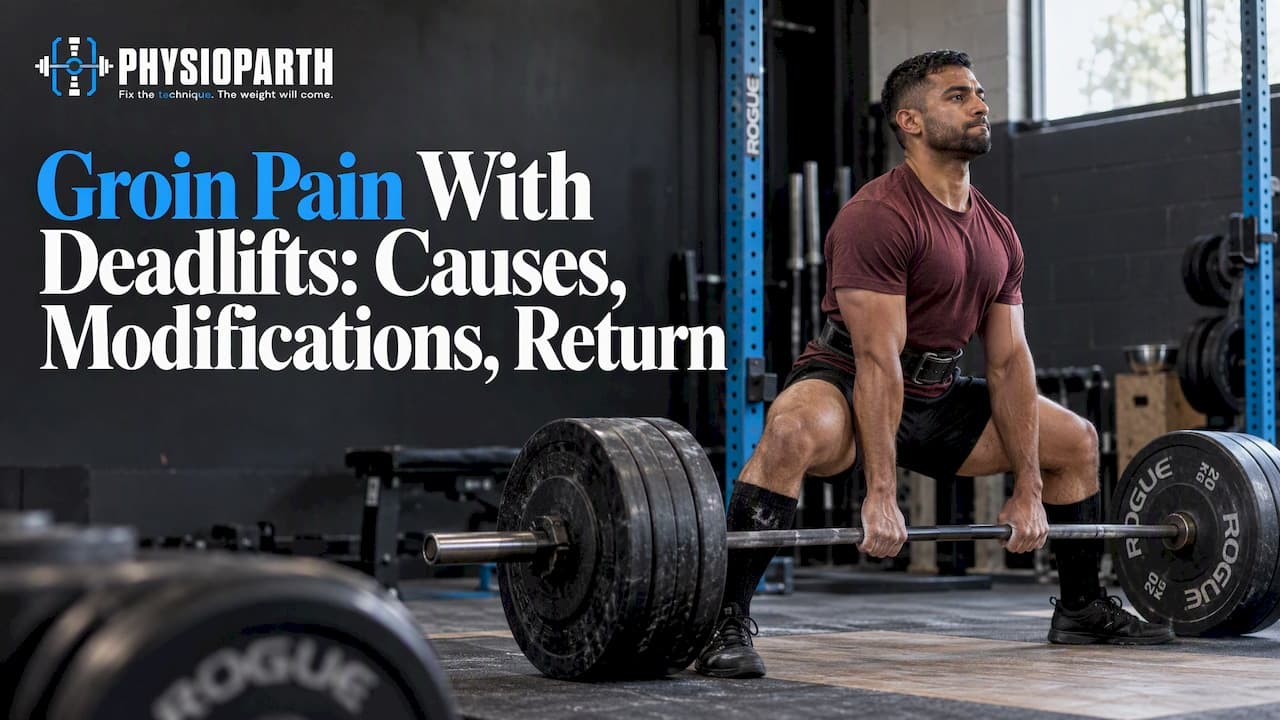
Groin pain during or after deadlifts most often involves the adductors (inner thigh) or the hip flexors, but the hip joint, the abdominal wall and the pubic area can produce similar symptoms. The useful question is not "how do I stop it" but "which structure is irritated, what in my set-up or training load is feeding it, and what can I still pull while it settles?" This article walks through that, as a physiotherapist who used to compete in powerlifting.
TL;DR
- Inner-thigh or groin pain on a pull may indicate an adductor problem, but it can also come from the hip joint, hip flexors, abdominal wall or pubic region. Location and what reproduces it help tell them apart.
- Sumo and wide-stance pulling, sudden jumps in volume, and poor bracing are common contributors. Separate technique causes from load-management causes before changing anything.
- You rarely need complete rest. Modified variations (tempo, paused, trap bar, block pulls, isometrics) can be used while pain stays at 3 to 4 out of 10 or lower.
- Return by criteria (strength, movement quality, load tolerance), not by calendar dates.
- Numbness, a bulge, severe pain or pain that is not settling needs in-person assessment. See the red flags below.
Table of Contents
- What is probably hurting: the structures involved
- Why the deadlift loads the groin
- Technique causes
- Load-management causes
- Should you stop deadlifting?
- Modified variations and a criteria-based progression
- How long can it take?
- Red flags: when you need in-person or medical assessment
- My perspective
- Getting it assessed virtually
- FAQ
- Sources
What is probably hurting: the structures involved
I will not diagnose you from an article, and nobody can from a Reddit thread either. What I can do is name the structures that most often sit behind groin pain in lifters and show how they tend to behave differently.
The Doha agreement on groin pain in athletes, a consensus paper published in the British Journal of Sports Medicine, defined four main clinical entities: adductor-related, iliopsoas-related, inguinal-related and pubic-related groin pain. Hip-joint problems sit alongside those as a separate category. In practical terms:
| Structure | Where you feel it | What tends to reproduce it | What may point away from it |
|---|---|---|---|
| Adductors (longus, magnus, others) | Inner thigh, sometimes up to the pubic bone | Squeezing the knees together against resistance, sumo or wide-stance pulls, stretching the leg out to the side | Pain mostly with coughing or abdominal bracing |
| Hip flexors (iliopsoas, rectus femoris) | Front crease of the hip, high into the groin | Resisted hip lift, the start of the pull from a deep, rounded position, stretching the front of the hip | Pain with knee squeeze but not with hip lift |
| Hip joint (femoro-acetabular impingement, early osteoarthritis) | Deep, often "C-shaped" pain around the hip crease, sometimes with pinching | Deep hip flexion, the bottom of a conventional pull with the hips low, hip rotation | Clear tenderness along a muscle belly |
| Inguinal region (abdominal wall, possible hernia) | Lower abdomen and upper groin | Valsalva, coughing, sneezing, heavy bracing | Pain only with leg movements |
| Pubic region | Centre, right over the pubic bone | Single-leg loading, pressing on the bone | Pain that moves well down the inner thigh |
The Doha paper's working rule for the adductors is tenderness over the muscle plus pain on resisted adduction. For the iliopsoas it is tenderness plus pain on resisted hip flexion or hip flexor stretch. Inguinal-related pain is more likely when it is aggravated by abdominal resistance, coughing or a Valsalva manoeuvre.
Other academic reviews support the same split. One review of groin pain syndromes notes that deep groin or lower abdominal pain worsening with Valsalva may be a different problem from a muscle strain. A rehabilitation paper on hip soft-tissue injuries lists hip osteoarthritis and femoro-acetabular impingement among conditions to distinguish from groin strains. Cleveland Clinic adds that urologic conditions, inguinal hernias, hip osteoarthritis or nervous system conditions can also produce groin pain, which is why location alone is not enough.
A simple self-observation exercise
These are observations to bring to an assessment, not a diagnosis:
- Squeeze test. Lying on your back with knees bent, squeeze a pillow or your fist between your knees at about half effort. Reproduction of your inner-thigh pain may indicate adductor involvement.
- Hip lift test. Sitting, lift your knee against light resistance from your hand. Front-of-hip pain may indicate hip flexor involvement.
- Cough and brace test. Does a cough, sneeze or hard brace bring on lower-abdominal or groin pain? That may indicate an inguinal-region cause and calls for in-person assessment.
- Deep-flexion pinch. Pull one knee toward the chest. A sharp pinch at the front of the hip may indicate a joint-related cause rather than a muscle.
If several light tests hurt, or you are unsure, that is a reason for a proper assessment rather than more guessing.
Why the deadlift loads the groin
The adductors and hip flexors help stabilize the pelvis and hips under heavy load. The adductor magnus in particular works as a hip extensor and so contributes to the pull itself, especially from the floor in a wide stance. If those muscles are underprepared or overworked, they can become irritated. A UK NHS patient guide on adductor-related groin pain notes that it may be caused by reduced hip muscle strength or an imbalance between the abdominal and inner-thigh muscles.
That is the physiology. What matters for you is which of the two buckets below is driving it, because the fix for each is different.
Technique causes
These are about how the rep is performed. They tend to show up as pain on specific reps or at a specific point in the pull.
- Stance width (sumo especially). A stance wider than your hips and knees tolerate forces the adductors to work at long length under load. If you recently widened your stance, that change is a prime suspect.
- Toe angle and knee tracking. Knees caving in as you break the floor can load the adductors and the front of the hip differently than knees tracking over the feet.
- Set-up depth. Starting with hips lower than your mobility allows may push the hip into end-range flexion, a typical position for impingement-type pinching.
- Bracing. Losing intra-abdominal pressure at the floor can shift stabilizing work onto the hip flexors and adductors. If your pain is more abdominal or inguinal, bracing is worth a closer look. My piece on bracing for the squat covers the same pressure-management ideas.
- Bar path and bar distance. A bar drifting forward of the midfoot makes the hips shoot up early. The result is a rushed, uneven pull, often with one leg doing more.
- Grip and symmetry. An uneven grip or a hip shift to one side during the pull may explain why only one groin hurts.
Load-management causes
These are about how much, how hard and how often, regardless of how clean the rep looks.
- Volume spikes. Adding a block of sumo pulls, deficit work or high-rep sets in a week or two.
- Intensity spikes. Jumping from submaximal work to heavy singles without a ramp.
- Frequency. Squatting wide, pulling sumo and doing adductor-heavy accessories within the same couple of days.
- Recovery. Poor sleep, a heavy work stretch or a high-stress period. Muscle strains often follow overuse, sudden movements or an inadequate warm-up, as one general guide puts it, though I would treat that as background rather than proof.
- Cross-over from other sport or training. Hockey, soccer, sprinting or CrossFit skill work with lots of lateral movement adds adductor load that never shows up in your deadlift log.
A quick check: if the pain began after a technique change (new stance, new bar, new cue), start with technique. If it began after a block that simply got heavier, busier or less well-recovered, start with load management. Often it is both.
Should you stop deadlifting?
Usually not completely, but you should stop pulling in the way that provokes it. The NHS guide gives a practical ceiling: exercise should stay within a pain score of 3 or 4 out of 10, and if pain goes above 4 you reduce repetitions or return to an earlier stage. Rowing or cycling can help maintain fitness in the meantime.
I would add the lifter's version of this rule:
- Pain that is mild, local and settles within a day may be an acceptable trade-off while you modify.
- Pain that is sharp, rises during the set, lingers into the next day, or changes how you move is a signal to drop to an earlier stage.
- Pain at rest, at night or with coughing is a signal to get assessed, not to test it with another set.
Stopping all loading is rarely helpful for a muscle problem. Progressive adductor strengthening is described as central to treatment by an Edmonton clinic, and that matches the wider rehabilitation literature.
Modified variations and a criteria-based progression
The table below is a template, not a prescription for your particular injury. Move to the next stage only when you meet every criterion for the current one, and step back a stage if pain climbs above 4 out of 10 or lingers.
| Stage | What you train | Movement options | Criteria to move on |
|---|---|---|---|
| 1. Calm it down | Isometrics and gentle loading | Isometric adductor squeezes (ball or pillow), isometric mid-thigh pulls against pins, light hip hinge patterns, bike or rowing | Daily activities and the squeeze test are at or below 3 out of 10, and no next-day flare |
| 2. Rebuild the pattern | Controlled, submaximal pulling | Tempo deadlifts (slow lowering), paused deadlifts just off the floor, block pulls or pin pulls from a height that does not provoke symptoms, trap bar deadlifts with a stance inside your pain-free width | Sets of your working reps stay at 3 to 4 out of 10 or lower, bar speed and symmetry look consistent on video, and pain settles within 24 hours |
| 3. Rebuild capacity | Heavier, longer-range work | Lower block heights, trap bar from the floor, conventional deadlifts with a moderate stance, Romanian deadlifts, Copenhagen-style adductor work if tolerated, Safety Squat Bar squats to keep a frequent hip-loading stimulus with a more upright torso | You can complete your planned volume at moderate loads with symptoms within your 3 to 4 out of 10 limit, and adduction strength is approaching your other side |
| 4. Return to your lift | Specific lift, rising intensity | Floor pulls in your competition stance, building from submaximal weights to heavier sets, then wider stance work last | Strength and movement quality are close to your uninvolved side, heavy sets are tolerated without next-day symptoms |
A few notes on why these variations help:
- Tempo and paused pulls reduce rushed reps and let you check bar path and bracing at the points where groin pain usually appears.
- Block or pin pulls shorten the range of motion, which may reduce end-range hip flexion or adductor stretch while you keep loading the posterior chain.
- Trap bar deadlifts let you stand in a more neutral stance and keep the load closer to your centre of mass. Some lifters find this reduces adductor demand compared with sumo.
- Safety Squat Bar work can maintain leg training and bracing practice when barbell back squats irritate the same area.
- Isometrics are a way to load a sensitive tissue without moving through the painful range. They are often a starting point, not the finish.
For research-based benchmarks: an IJSPT clinical commentary on adductor-related athletic groin pain says return to lifting should follow a criteria-based approach, including hip adduction strength within 10% of the uninvolved side and sport-specific movements without pain. It also says clearance should consider movement quality, tolerance to sport-specific demands and patient-reported outcomes. A 2023 PMC paper on clinical concepts in exercise and load management suggests adductor-strengthening programs be maintained at least 3 days per week until preinjury levels are reached. If you do not have a dynamometer, a physiotherapist can estimate side-to-side adduction strength with hand-held testing.
How long can it take?
The honest range is wide. The IJSPT commentary describes recovery as taking weeks to months, with milder strains often needing 3 to 6 weeks and more severe cases taking three months or longer. A clinic handout using the same grading offers Grade I at 3 to 6 weeks, Grade II at 6 to 12 weeks and Grade III at 3 to 6 months or longer. These are population estimates for adductor strains, not a promise for your groin, and a hip-joint or inguinal cause would follow a different course. Use the criteria above, not the calendar, to decide when you progress.
If your problem sits more at the front of the hip, hip flexor strain grades and return by criteria may be the better guide. If the pain is deeper in the hip when you squat as well, hip pain when squatting covers that overlap.

Red flags: when you need in-person or medical assessment
Stop testing it with the barbell and get examined in person if you notice any of the following:
- A visible or palpable bulge in the groin or lower abdomen, or pain that is clearly worse with coughing, sneezing or straining. This may indicate a hernia or another inguinal-region problem.
- Severe pain, a sudden pop with immediate loss of function, or major bruising down the inner thigh.
- Pain that is not improving after a few days of rest and self-care.
- New or worsening numbness, tingling, leg weakness, or cool or pale skin in the leg. HealthLink BC advises calling a doctor if numbness, tingling, cool or pale skin or decreased strength develops or worsens during self-care.
- Testicular pain or swelling, blood in the urine, fever, or pain with urinating.
- Night pain, pain at rest, or unexplained weight loss.
- Deep hip pain with catching, locking or a steadily reduced range of motion, which may call for imaging and an in-person hip examination.
In Ontario you do not need a referral to see a physiotherapist, though some insurers require one for reimbursement. For anything on the list above, see a family doctor, a walk-in clinic or an emergency department depending on severity. Where it is a suspected hernia, urologic or neurological problem, in-person assessment comes first and training decisions come second.
My perspective
The most common mistake I see in the way lifters talk about groin pain is treating it as one thing. A lifter with sumo-stance adductor irritation, a lifter with a deep-flexion hip pinch and a lifter with a bracing-related inguinal pain can all say "my groin hurts", and each needs a different plan. Stretching alone, which is the usual advice, rarely matches the load the tissue actually has to handle on a heavy pull.
Here is how I approach it. I look for the structure that is most likely irritated, and I look at the lift itself, because stance, bar path and bracing often show what the pain is reacting to. Then I build a plan that aims to keep you loading the pattern with modified variations where appropriate, and progress by criteria instead of the calendar. Rest is a tool, not a strategy. The goal is to understand what you can do today so that you have a way back to your heavier work.
If you want more on how I think about the pull and what else may be going on, my post on low back pain after deadlifts and the one on SI joint pain with deadlifts cover the neighbouring regions that often get confused with the groin.
— Parth
Getting it assessed virtually
If you are in Ontario and want someone to look at your pull, I offer virtual physiotherapy built for strength athletes. The Initial Assessment costs $130 and includes a full subjective and objective assessment and a movement screen, plus a lift analysis if you send videos beforehand. It aims to explain what tissue may be irritated and to build a criteria-based return-to-lifting plan using modified variations where appropriate. Follow-Up Sessions are $100. Many extended-health plans cover physiotherapy, and I provide receipts for reimbursement.

Film your pull from the side and from the front or back at your working weight, with your usual stance, and a few reps from the floor. Those clips tell me far more than a description of the pain.
FAQ
Why do my inner thighs hurt after deadlifts?
The adductors work hard to stabilize the hips and, in the case of adductor magnus, to help extend the hip. Wide stances, a sudden jump in volume or poor recovery can irritate them. If the pain reproduces with a knee squeeze and settles with modified loading, an adductor cause may be likely. If it is deep in the hip or comes with a bulge or cough-related pain, get it examined.
Is sumo or conventional better when my groin hurts?
Neither is automatically better. Sumo places the adductors at greater length under load, so many lifters find a narrower stance or a conventional or trap bar pull more comfortable while they recover. If conventional causes deep hip pinching, a slightly wider stance or a raised start may help. Test both in a modified, submaximal setting and watch the pain score.
Can I keep training legs with groin pain?
Often yes, within limits. Keep exercise at 3 to 4 out of 10 or lower, and choose options that do not provoke the pain, such as Safety Squat Bar work, tempo variations, bike or rowing. Reduce reps or go back a stage if pain rises above 4 or lingers into the next day.
Do I need a referral to see a physiotherapist in Ontario?
No. You can book directly. Some insurers require a physician referral before they reimburse, so check your plan. If you are unsure whether the pain is a muscle problem, book with me for the free 15-minute consult at physioparth.com. It is a fit check, not an assessment or treatment, and we can decide whether an Initial Assessment makes sense.
Sources
- Doha agreement meeting on terminology and definitions in groin pain in athletes
- Evaluation and treatment of groin pain syndromes
- Rehabilitation of soft tissue injuries of the hip and pelvis
- Groin Pain: Causes and How To Find Relief, Cleveland Clinic
- Adductor Related Groin Pain, Oxford University Hospitals
- Why Does My Groin Hurt When I Deadlift?
- Groin pain and adductor strain treatment, Vertex Physiotherapy
- Adductor-Related Athletic Groin Pain: A Clinical Commentary
- Current Clinical Concepts: Exercise and Load Management
- Adductor strain exercises handout
- Leg Injuries, HealthLink BC
Recommended
- Sciatica and Deadlifts: How to Train Around Leg Pain
- Deadlift Back Pain: Ontario Lifters’ Tissue Clues and Return Criteria
- SI Joint Pain With Deadlifts: Tell It Apart and Return
- Hip Pain Squatting: Causes, Fixes and Return Criteria
This article is general education for strength athletes and is not a substitute for an individual assessment. Pain that is severe, worsening, or accompanied by numbness, weakness or loss of function needs prompt in-person or medical assessment. Author: Parth Suthar, Registered Physiotherapist (Ontario).