
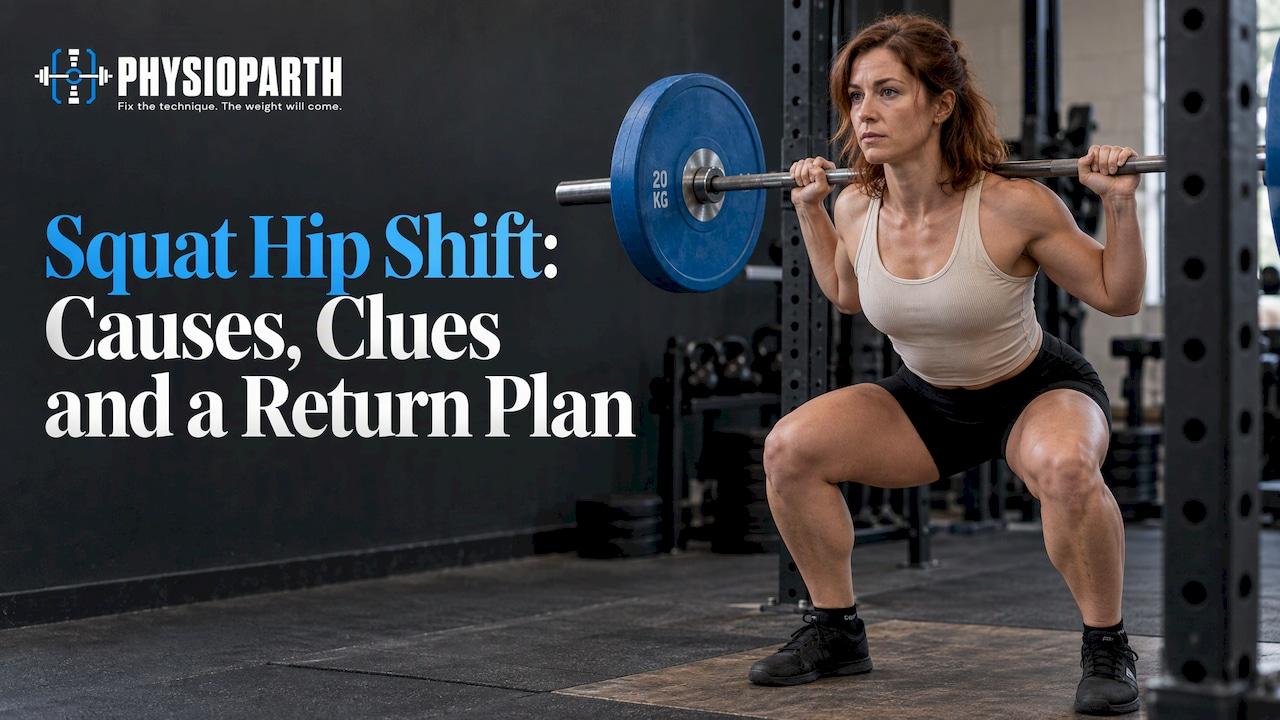
A hip shift is when your pelvis slides to one side as you descend or drive up, so the bar and your weight drift toward one leg. It may come from a mobility difference between sides, a set-up or stance habit, a strength or control difference, or training load that has outpaced recovery. Often it is a mix. Below I separate technique causes from load-management causes, show you how to check yourself on video, and give you a progression you move through by criteria, not dates.
I'm Parth Suthar, a registered physiotherapist in Ontario (PT Reg. Ont.) and a former competitive powerlifter. This article is general education for strength athletes. It can't diagnose you, and it isn't a substitute for an assessment of your own squat.
TL;DR
- A hip shift may indicate a side-to-side difference in hip or ankle range, in how the pelvis is positioned, or in muscle control. It can also show up when fatigue or load rises.
- Film your squat from behind and the front at a working weight and at a lighter one. If the shift only appears as the bar gets heavy, load and bracing are worth looking at first.
- Separate technique causes (stance, set-up, bar path, bracing, grip, depth) from load-management causes (volume, intensity, frequency, recovery) before you change anything.
- Move through the progression by criteria: tempo, paused and pin squats, a Safety Squat Bar, then back to your competition squat, with trap bar and block pulls and floor press keeping other training going.
- Pain that is worsening, numbness, tingling or weakness needs in-person or medical assessment. See the red flags below.
Table of Contents
- What a hip shift looks like, and how to check yours
- Structures most likely involved, and how to tell them apart
- Technique causes
- Load-management causes
- Return to squatting by criteria, not dates
- My perspective on hip shifts in lifters
- How I can help
- Red flags: when you need in-person or medical assessment
- FAQ
- Book with me
- Sources
What a hip shift looks like, and how to check yours
The shift can happen at the bottom of the squat, on the way down, or in the first few inches of the drive up. Some lifters shift toward one side at depth and straighten out as they stand. Others stay shifted the whole rep. Where it happens matters, because it points your attention at different things.
The cleanest way to look is video:
- Film from directly behind at hip height, with the full bar path and both feet in frame.
- Film a warm-up set and a set at a working weight. Compare them.
- Look at the belt line or the back of the pelvis relative to the bar. Does the pelvis drift to one side while the bar stays roughly centred? Does one heel lift or one foot turn out more at the bottom?
- Repeat with a front-loaded squat such as a goblet squat, or a bodyweight squat. If the shift disappears, bar position, bracing or load may be part of the picture.
Movement screens use a similar logic. The overhead squat assessment, for example, looks for deviations at the hips and uses a heel elevation to see whether the ankles are involved when other patterns improve, as NASM's step-by-step guide describes. Clinical guidance for hip pain also suggests using a task such as a squat or step-down and noting both symptom response and movement strategy, and it states that a restricted range is not diagnostic by itself, according to the Canadian Chiropractic Guidelines Initiative. A shift on video is a clue, not a verdict.
Structures most likely involved, and how to tell them apart
I can't tell you which of these applies to you without assessing you. What I can do is name the usual suspects and the clues that may separate them.
Hip joint range of motion
In a 2015 study of overhead squats, lifters who shifted had less hip abduction and ankle dorsiflexion range on the side they shifted toward, and more hip internal rotation on that side. The same study suggested possible differences in gluteus medius activation. These are associations in one group, not a rule for every lifter.
How to tell: lying on your back or sitting, compare how far each hip rotates and how far each knee drops out to the side. A clear side-to-side difference, or a pinching feeling at the front of one hip when you squat deep, may indicate a joint-range or hip-position contribution. If you also have groin or front-of-hip pain, my article on hip pain when squatting goes through the tissue clues.

Ankle dorsiflexion
Ankle range is easy to overlook. In a 2020 Journal of Strength and Conditioning Research experiment, a 10° forefoot wedge used to restrict one ankle changed vertical-force asymmetry in every phase of a bodyweight squat, and the unrestricted leg produced more vertical force. Separately, people with limited weight-bearing dorsiflexion showed less knee flexion and ankle dorsiflexion during squatting.
How to tell: from a standing knee-to-wall test, compare how far each knee travels over the toes with the heel down. Then squat with a small plate under both heels. If the shift calms down, the ankle may be contributing. If it doesn't change, look elsewhere.
Gluteus medius, adductors and surrounding muscles
NASM's overhead-squat guidance associates an asymmetrical shift with probable overactivity in some muscles and underactivity in others, including the gluteus medius, adductors, TFL, calves, piriformis and hamstrings, per their overhead squat write-up. That is a screening model, and it is a hypothesis to test rather than a diagnosis.
How to tell: a single-leg task such as a step-down or split squat is useful. If one side wobbles, drops the pelvis or feels clearly weaker, a control or strength difference may be part of it. If a deep, tight pinch in the buttock shows up, my piece on piriformis pain from deadlifts covers how to think about it.
Pelvic position and the low back
Some lifters shift because they can't easily get the pelvis into the position that suits their anatomy, and the body finds room by moving sideways. If your shift comes with a rounding of the low back at depth, butt wink in the squat is the related read.
A quick comparison
| Clue | May indicate | Quick check |
|---|---|---|
| Shift disappears with heels raised | Ankle range contribution | Squat with plates under heels |
| One knee drops out less, pinch at front of hip | Hip range or joint position | Compare hip rotation side to side |
| Wobble or pelvic drop in split squat | Control or strength difference | Step-downs on video |
| Shift only on heavy sets | Load, fatigue or bracing | Compare light and heavy set video |
| Shift with pain on one side | Irritated tissue | Stop provoking it and get assessed |
Technique causes
Technique causes are things you can see and change in how you set up and perform the lift. A biomechanical review of the squat notes that stance width, foot rotation, trunk and shin position and depth all affect squat mechanics, so a stance that works for one hip may load the other differently.
- Stance and foot angle: an uneven foot flare, or a stance set up by feel and not by landmarks, can send one hip into a different position than the other. Mark your foot placement and compare.
- Set-up and unracking: stepping back with one foot more than the other, or walking out unevenly, starts the rep already off-centre.
- Bar position and bar path: a bar that sits slightly to one side or a path that drifts as you descend may pull your pelvis along with it.
- Bracing: if you lose trunk pressure at the bottom, the pelvis may find stability by moving sideways. My article on squat bracing for Ontario lifters goes into this.
- Grip and upper back: an uneven hand position or one shoulder that sits higher changes how the bar loads you.
- Depth: shifting often appears at the last few inches. Squatting just above that point and building down is one way to work with it.
The free Lifter's Hip & Lower Back Toolkit is a useful companion while you check these.
Load-management causes
If the shift is new, or it appears only in certain weeks, the cause may sit in your training load, not your technique.
- Volume: a jump in weekly squat sets or reps, especially at higher intensity, may show up as a shift because fatigue changes how you control the pelvis.
- Intensity: if the shift appears above a certain percentage of your max, the weight may be outpacing your current control at that depth.
- Frequency: adding a second or third squat day without dropping something else leaves less time between exposures.
- Recovery: poor sleep, a heavy block, or a return from a layoff can all change how you move under load.
A useful test: compare video from a rested week and a heavy week. If the shift is only visible late in the block, adjust volume and intensity before you spend weeks on drills.
Return to squatting by criteria, not dates
You don't need complete rest for a typical hip shift without red flags. What you need is a ladder of variations and clear criteria for moving up it. Move up only when you meet the criteria for your stage; stay a stage if you don't. Calendar weeks don't tell you whether a tissue is ready.
| Stage | Variations | Criteria to move on |
|---|---|---|
| 1. Calm it down | Isometric squat holds (mid-range, in a pain-free-enough position you can tolerate), tempo squats with a 3-second descent at lighter loads, split squats | Daily activity and the squat set-up feel comfortable. Pain, if present, settles back to your baseline by the next day. Your video shows a smaller shift at the stage-1 load. |
| 2. Own the position | Paused squats (2 to 3 seconds at the bottom), box squats with a pause, single-leg work such as step-downs | You can hold the same position on both sides for the pause. Reps look alike on video from behind. No symptom increase afterwards. |
| 3. Load it | Pin squats from a mid-range height, Safety Squat Bar squats, tempo squats at working weights | You complete your planned sets with matching video and no lingering pain. Rate of perceived effort is where you expect it for the load. |
| 4. Return to your competition squat | Low-bar or high-bar squat at reduced volume, then build intensity | The shift, if present, stays minimal across sets, including the last one. Pain is absent or stable. You tolerate the volume across two or more sessions. |
Keep the rest of your training moving while you do this:
- Deadlifts: trap bar deadlifts and block pulls reduce the range your hips have to travel and may be a sensible way to keep pulling if your squat is the problem.
- Bench: floor press keeps pressing volume going when you want to cut total load on the legs and trunk.
- Single-leg work: in a study of 18 healthy young women, single-leg squats produced the highest gluteus medius and gluteus maximus activation of the exercises tested, so they are a reasonable inclusion. It's a small study in a different population from yours, so treat it as supportive and not as proof.
Drills such as a 90/90 hip rotation or banded squats can sit in your warm-up. Use them to prepare the position, then squat in it. Stretching on its own rarely changes how you move under a bar, so pair any mobility work with controlled loaded reps in the range you've gained.
If you want a structured look at your own squat, the audit page is where I start.
Pro tip: change one variable at a time. If you alter stance, bar position and volume in the same week, you won't know which one helped.
My perspective on hip shifts in lifters
I see a hip shift as information. It tells me the body is finding a way to do the rep, and my job is to work out why that route is being chosen. For a strength athlete, the answer might be a stance habit, a range difference between sides, or a training block that outran recovery. Often it is more than one.
What I don't want is for you to stop lifting by default. My approach aims to build a criteria-based plan using modified variations where appropriate, such as tempo and paused squats, pin squats or the Safety Squat Bar, so you have a clear next step instead of a countdown.
I also don't want you to chase symmetry for its own sake. Plenty of lifters have small differences between sides and squat well. It becomes a conversation when it comes with pain, a change in how the bar feels, or a shift that grows as you load up.
Parth
How I can help
If you'd like someone to look at your squat with you, my virtual Initial Assessment is $130. It includes a full subjective and objective assessment and a movement screen, plus a lift analysis if you send videos beforehand. It aims to explain what tissue may be irritated and to build a criteria-based return-to-lifting plan. Follow-up sessions are $100. No doctor's referral is needed to see a physiotherapist in Ontario, though some insurers require one for reimbursement, and many extended-health plans cover physiotherapy. You can see the details on the PhysioParth home page.

Not sure whether an assessment fits? The free 15-minute consult is a fit check only. It's not an assessment or treatment.
Red flags: when you need in-person or medical assessment
Virtual physiotherapy has limits, and some situations need a hands-on or medical assessment first. Seek in-person care if you have:
- Pain that is getting worse, or that interferes with walking. Alberta Health's hip guidance lists worsening symptoms, trouble walking, and new numbness, tingling or weakness as reasons to be assessed, and its triage tool may direct an appointment within one to two weeks.
- Numbness, tingling or weakness in the leg or groin that is new.
- Hip pain after a fall, a heavy drop of the bar, or a sudden pop, particularly if you can't put weight through the leg.
- Fever, unexplained weight loss, or night pain that doesn't change with position.
- Loss of bladder or bowel control or numbness in the saddle area. This needs emergency care right away.
Imaging is not routine for every hip complaint. Canadian guidance describes it as something used to support a diagnosis or clarify suspected pathology when the findings call for it, per the Canadian Chiropractic Guidelines Initiative. A family doctor, nurse practitioner, or in-person physiotherapist can decide whether it's needed. In Ontario you can book a physiotherapist directly without a referral.
FAQ
What causes a hip shift when squatting?
There is rarely one cause. Research has associated a shift with differences in hip and ankle range between sides and possibly with gluteus medius activation, and stance, bracing and training load can all contribute. A video of your own squat, light and heavy, is the best starting point for narrowing it down.
Should I stop squatting if I have a hip shift?
Not necessarily. If there are no red flags and no worsening pain, many lifters can work with modified variations such as tempo, paused or pin squats and a Safety Squat Bar, and progress by criteria. If the shift comes with pain that climbs or lingers, get it assessed.
Can a hip shift be corrected with stretching alone?
Stretching on its own is unlikely to be enough, because the shift happens under load and with control demands. Mobility work is more useful when you follow it with controlled squats, split squats or step-downs in the range you've gained.
Is a hip shift always a problem?
No. Small side-to-side differences are common, and a shift that doesn't hurt and doesn't grow with load may be something to monitor. It deserves attention when it is painful, repeated, grows as the weight rises, or comes with a clear range difference between sides.
Book with me
If your squat shifts and you want a plan built around your lifts, book with me for a free 15-minute consult at physioparth.com.
Sources
- Presence of a Lateral Hip Shift During Squatting is Associated with Altered Mobility and Neuromuscular Control
- Restricted Unilateral Ankle Dorsiflexion Movement Increases Asymmetry During Squatting (JSCR, 2020)
- Altered Knee and Ankle Kinematics During Squatting in Those With Limited Weight-Bearing Dorsiflexion
- A Biomechanical Review of the Squat Exercise
- Hip Muscle Activation and Knee Frontal Plane Motion During Weight Bearing Therapeutic Exercises
- The Overhead Squat Assessment: A Step-by-Step Guide (NASM)
- Hip Shift: Fix Compensations With The Overhead Squat Assessment (NASM)
- Nonarthritic Hip Joint Pain (Canadian Chiropractic Guidelines Initiative)
- Hip Problems, Age 12 and Older (MyHealth.Alberta.ca)
Recommended
- Hip Pain Squatting: Causes, Fixes and Return Criteria
- Knee Pain When Squatting: Causes, Tissue Clues and a Return Plan
- Patellar Tendonitis and Squats: A Lifter's Return Plan
- Butt Wink in the Squat: Causes, Fixes and When It Matters
This article is general education for strength athletes and is not a substitute for an individual assessment. Pain that is severe, worsening, or accompanied by numbness, weakness or loss of function needs prompt in-person or medical assessment. Author: Parth Suthar, Registered Physiotherapist (Ontario).