
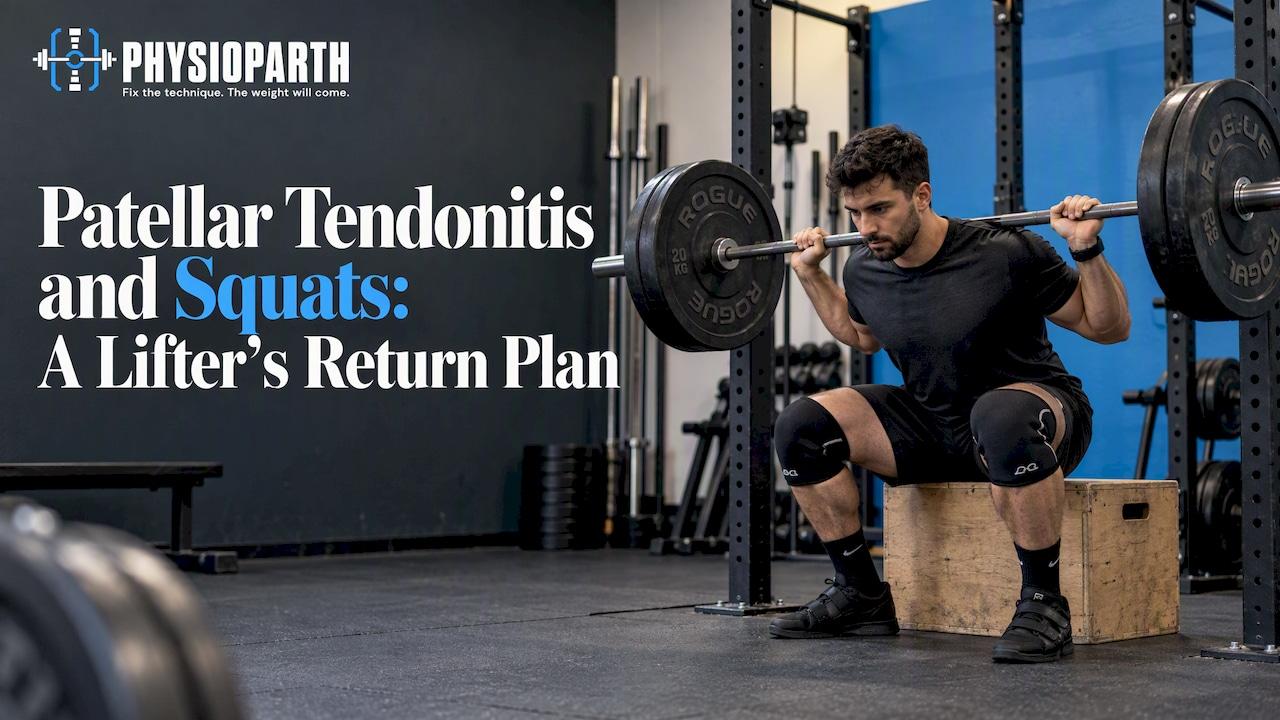
Pain just below the kneecap that shows up when you squat may indicate an irritated patellar tendon. For most lifters the answer is not complete rest. It is to change how much load the tendon sees, add the right kind of loading, and move back toward your normal squat when specific criteria are met, not when a date arrives. I’m Parth Suthar, a registered physiotherapist in Ontario and a former competitive powerlifter, and this is how I approach it with barbell athletes.
A note on words: “tendonitis” is what most people type, but “tendinopathy” is the term clinicians generally use for this problem. I’ll use both. This article is general education, not a diagnosis of your knee.
TL;DR
-
Pain at the lower tip of the kneecap that is worst with squatting, jumping or stairs may indicate patellar tendinopathy, though other structures can mimic it.
-
Total rest tends to leave the tendon less prepared. Adjust depth, volume and variations, and keep loading the tendon in a controlled way.
-
Sort your causes into two piles: technique (set-up, stance, depth, bracing) and load management (volume, intensity, frequency, recovery).
-
Progress by criteria: isometrics, then slow heavy loading, then paused, box or pin squats, then your competition-style squat.
-
Sudden giving way, a gap or swelling above or below the kneecap, or a knee you cannot straighten needs in-person assessment.
Table of Contents
What the patellar tendon does under the bar
The patellar tendon connects the bottom of your kneecap (the patella) to the shin bone (the tibial tuberosity). Every time you stand out of the hole, your quadriceps pulls through it. The deeper and faster the squat, and the more you lean on the quads, the more demand lands there.

Clinical descriptions of patellar tendinopathy typically include focal tenderness at the inferior pole of the patella, pain with squatting or jumping, and reduced tolerance to load. Public health guidance describes sharp, localized pain at the front of the knee that can fade to a dull ache and is aggravated by squatting, stairs, jumping or sitting.
Lifters often describe it the same way: a warm-up that eases the pain, a working set that brings it back, and a stiff, achy knee the next morning or after a long drive.
Which structure is it? How to tell them apart
I can’t diagnose you through an article, and the front of the knee has several candidates. These are the structures most often involved, with the clues I’d pay attention to. Treat them as questions to bring to an assessment, not a self-diagnosis.
| Structure | Where it tends to hurt | What tends to provoke it | Clue that separates it |
|---|---|---|---|
| Patellar tendon | A thumb-sized spot just below the kneecap | Squat drive out of the bottom, jumping, stairs, lunges | Tender to press at the tip of the patella; warms up, then flares after load |
| Quadriceps tendon | Just above the kneecap | Deep squats, heavy leg extensions | Tenderness above, not below, the patella |
| Infrapatellar fat pad | Behind and either side of the tendon | Full knee lock-out, standing in extension, long sitting | Pain with straightening more than with deep bend |
| Patellofemoral joint | Behind or around the kneecap, more diffuse | Deep flexion, stairs, prolonged sitting | Hard to point to one spot; grinding or achy quality |
| Tibial tuberosity region | Bony bump on the shin | Jumping, fast quad loading | Common in adolescents; bone tender rather than tendon |
A useful pattern: pain you can cover with one fingertip, sitting right at the bottom of the kneecap, that is reproduced when you load the quads (for example holding a mid-range wall sit or a single-leg decline squat), may indicate the patellar tendon. Pain that is vague, behind the kneecap, and driven by depth or sitting leans toward the patellofemoral joint. Pain that only appears when you lock your knees out at the top may point toward the fat pad.
If you want these sorted properly, that is exactly what the movement screen and objective assessment in a virtual visit aim to do.
Technique causes to look at
Technique doesn’t cause tendon pain on its own, but it changes where the load goes. These are the details I’d check first on squat video:
-
Stance and foot position. A narrow stance with knees travelling far forward shifts demand toward the knee. A slightly wider stance with more hip involvement can reduce it for some lifters, but not all.
-
Depth. The deepest part of the range usually loads the tendon most. If depth reproduces your pain, capping it temporarily is a technique tool, not a failure.
-
Bar position and torso angle. A low-bar squat tends to use more hip and less knee travel than a high-bar squat. A lifter who is very upright and quad-dominant may notice more tendon irritation.
-
Bracing and rib position. Losing tension in the bottom changes how you rebound out of the hole. My piece on squat bracing and progressing by criteria covers this in detail.
-
Bounce out of the bottom. A fast, springy reversal spikes tendon demand. Controlled descents and a deliberate pause let you check whether that is a factor.
-
Heel lift or ankle restriction. Limited ankle motion pushes the knees forward early. Squat shoes or a small plate under the heels can be used as a short-term experiment, not a permanent crutch.
If you want to check your own set-up, my free squat guide walks through the checkpoints, and the Lifter’s Hip & Lower Back Toolkit covers the surrounding hip and trunk work.
Load-management causes to look at
This is the other pile, and in my view it explains more flare-ups than form does. Tendons tolerate load they have adapted to and complain when load climbs faster than they can adapt. Common patterns:
-
A volume jump. A new block with extra back-off sets, or adding high-rep squats, pause work or lunges on top of your usual training.
-
Intensity spikes. Testing a heavy single after weeks of lighter work.
-
Frequency changes. Moving from two squat days to three, or stacking squats, leg press and jumping in the same week.
-
Added knee-dominant work. Sports practice, running, box jumps or CrossFit workouts with many reps of wall balls or lunges.
-
Recovery. Poor sleep, a heavy work week, or a quick return after time off.
Soreness after a hard session is not the same as tendon pain. If you want a primer on normal post-session soreness and how to think about it, this explanation of post-workout inflammation is a reasonable place to start. The difference that matters for the tendon is localized pain at the kneecap that keeps recurring at the same load.
Should you keep squatting?
General guidance for this condition is to modify activity according to pain, avoid deep squats if they aggravate symptoms, and stay active rather than resting completely. I agree with that direction. Complete rest tends to leave the tendon with less capacity, and then the first heavy session back is a bigger jump than it needed to be.
What that looks like in practice depends on your pain, your meet or training calendar, and what your knee tolerates. It might be a squat variation that stays inside a comfortable range, lower volume, or a temporary swap to another lower-body pattern.
A criteria-based return-to-lifting progression

There is no calendar here. You move to the next stage when you meet the criteria for the current one. If you can’t, you stay put or step back one stage.
How to judge symptoms
One clinical review of patellar tendinopathy management describes pain up to 5 out of 10 during and after exercise is acceptable if it settles below 5 the next day, and advises reducing activity if pain increases from week to week. I’d use that as a working framework, tightened for lifters: aim for pain that stays low, doesn’t climb across the session, and is back to your baseline by the next morning.
Stage 1: calm the tendon and keep it loaded
Variations: isometric holds (for example mid-range leg extension or a wall sit at a depth that is tolerable), plus other training that doesn’t load the knee, such as upper-body work. For bench, a floor press is a reasonable way to keep pressing while your lower body is restricted.
Isometrics have some support for short-term symptom relief. In a study of in-season athletes with patellar tendinopathy, isometric contractions produced greater immediate pain relief than isotonic ones, and both reduced pain. That is short-term relief, not a cure, so I treat isometrics as an entry point, not the whole plan.
Move on when: isometrics are tolerable at a moderate effort, pain is stable from session to session, and next-morning stiffness is not worsening.
Stage 2: build capacity with slow, heavy work
Variations: tempo squats (for example three seconds down, three seconds up), leg press, split squats and Safety Squat Bar squats to a comfortable depth. Exercise reviews of rehabilitation describe heavy slow resistance (HSR) as a well-supported option, and the rehabilitation review by Muaidi also recommends addressing strength imbalances, with hip exercises and calf raises included. I’ve written up the approach for lifters in Heavy Slow Resistance for Lifters.
The Safety Squat Bar can help because its camber changes how the load sits and often lets you stay more upright with less demand on the shoulders and wrists while you manage the knee. Whether it reduces knee pain varies from lifter to lifter, so test it by pain response, not assumption.
Move on when: you can complete your planned sets with controlled tempo, pain stays within your limit, the next day is at baseline, and load has gone up for a couple of consecutive weeks without a flare.
Stage 3: reintroduce barbell squats with controlled variables
Variations: paused squats, box squats and pin squats working from a comfortable range, then gradually deeper. Pause and pin work remove the bounce and let you control exactly where the load is applied. Deadlift variations can also help you keep pulling: a trap bar deadlift or block pulls generally ask for less knee bend than a conventional pull from the floor, but again the test is your response.
Move on when: paused or pin squats at the target depth feel stable, you can handle your usual working weights without pain climbing across sets, and next-day symptoms are no worse than baseline.
Stage 4: competition-style squat
Variations: your competition squat, with volume deliberately capped, then built back. Reintroduce depth, then intensity, then frequency, one variable at a time. Don’t change all three in one week.
You’re back when: you can complete a normal training week, including heavy sets, with symptoms staying low and settling within a day, and you aren’t needing to hide volume or depth to get through it.
Why patience matters
Tendon adaptation is slow. A treatment review recommends progressive exercise as the first-line approach and suggests it be continued for at least 12 weeks. That figure describes how long the underlying tissue process can take, not a schedule for you. You still progress by criteria, and some lifters need more time and some less.
Massage and stretching alone are not a plan for this problem. They may feel good, but they don’t provide the progressive loading the tendon generally needs. If you want a second set of eyes on what you are doing, that is where an assessment can help.
Perspective: how I’d approach your knee
When a lifter comes to me with front-of-knee pain, my first aim is to understand what the tendon is being asked to do each week and what changed recently. Most of the time I’m looking at two lists at once: the technique list and the load list. People tend to fix only the one they find more interesting, so I try to look at both.
I also try to explain the pain in lifter terms. “Tendonitis” can sound like a tissue that needs to be shut down, when the more useful question is how much load it currently tolerates and how to build that. I don’t want you to feel your only options are to grind through it or stop lifting.
Because care is by video, I can look at your squat footage from the front, side and back, check a few movement tests live, and build a plan with modified variations where appropriate. The plan aims to give you clear criteria so you know why you are progressing or holding. I can’t promise a result, and some knees need hands-on or imaging work I can’t provide remotely. When that’s the case, I’ll tell you.
— Parth
Red flags: when you need in-person or medical assessment
See a physician or get assessed in person promptly if you have any of the following:
-
A sudden pop or tearing sensation, or you can’t straighten the knee or lift your leg after a heavy rep. This may indicate a tendon rupture.
-
A visible gap or dent above or below the kneecap.
-
Significant swelling, redness, heat, or fever alongside knee pain.
-
The knee locking, catching or giving way.
-
Pain at rest or at night that does not change with position, or that keeps worsening despite lower load.
-
Numbness, tingling or weakness in the leg.
-
Knee pain after a fall or direct impact.
-
Pain that has not changed at all after several weeks of sensible load adjustment.
In Ontario you can see a physiotherapist without a doctor’s referral, though some insurers require one for reimbursement. For urgent symptoms, go to an urgent care centre or emergency department. If you are considering an injection, talk it through with your physician first, because injections near a tendon carry risks that deserve a proper conversation.
If you want a broader look at how knee pain sits alongside other lifting issues, my pages on hip pain when squatting and lower back pain in the squat cover neighbouring problems, and the free audit is a quick way to see where your training might need a closer look.
Working with me
My Initial Assessment is $130 and includes a full subjective and objective assessment and a movement screen, plus a lift analysis if you send videos beforehand. It aims to explain what tissue may be irritated and to build a criteria-based return-to-lifting plan with modified variations where appropriate rather than complete rest. Follow-Up Sessions are $100. Many extended-health plans cover physiotherapy, and I provide receipts for reimbursement. You can see the full details on the PhysioParth home page.
The free 15-minute call is a fit check, not an assessment or treatment. It’s a chance to tell me what is going on and see whether virtual care suits you.
FAQ
Can squats cause patellar tendonitis?
Squatting can aggravate the patellar tendon, especially when volume, depth or frequency rise faster than the tendon has adapted. It is rarely the squat itself, more often how much and how quickly. Looking at both technique and training load usually gives a clearer picture than blaming the lift.
Are isometrics good for patellar tendonitis?
They may help with short-term pain relief, and research in athletes found isometric contractions were more analgesic than isotonic ones immediately afterwards. They work best as a starting point before slow, heavy loading, not as the only treatment.
Does massaging the patellar tendon help?
It may feel soothing in the short term, but I wouldn’t rely on it as your main strategy. The tendon generally needs progressive loading to build capacity. Deep pressure directly on a very sensitive tendon can also aggravate it for some people.
Do I have to stop squatting completely?
Not necessarily. General guidance favours modifying activity and avoiding deep squats if they aggravate symptoms, not complete rest. Box, pin or tempo variations within a comfortable range are common starting points, but the right choice depends on your pain and your history.
If your knee is limiting your squat and you’d like a plan built around your lifts, book with me for a free 15-minute consult at physioparth.com.
Sources
Recommended
This article is general education for strength athletes and is not a substitute for an individual assessment. Pain that is severe, worsening, or accompanied by numbness, weakness or loss of function needs prompt in-person or medical assessment. Author: Parth Suthar, Registered Physiotherapist (Ontario).