
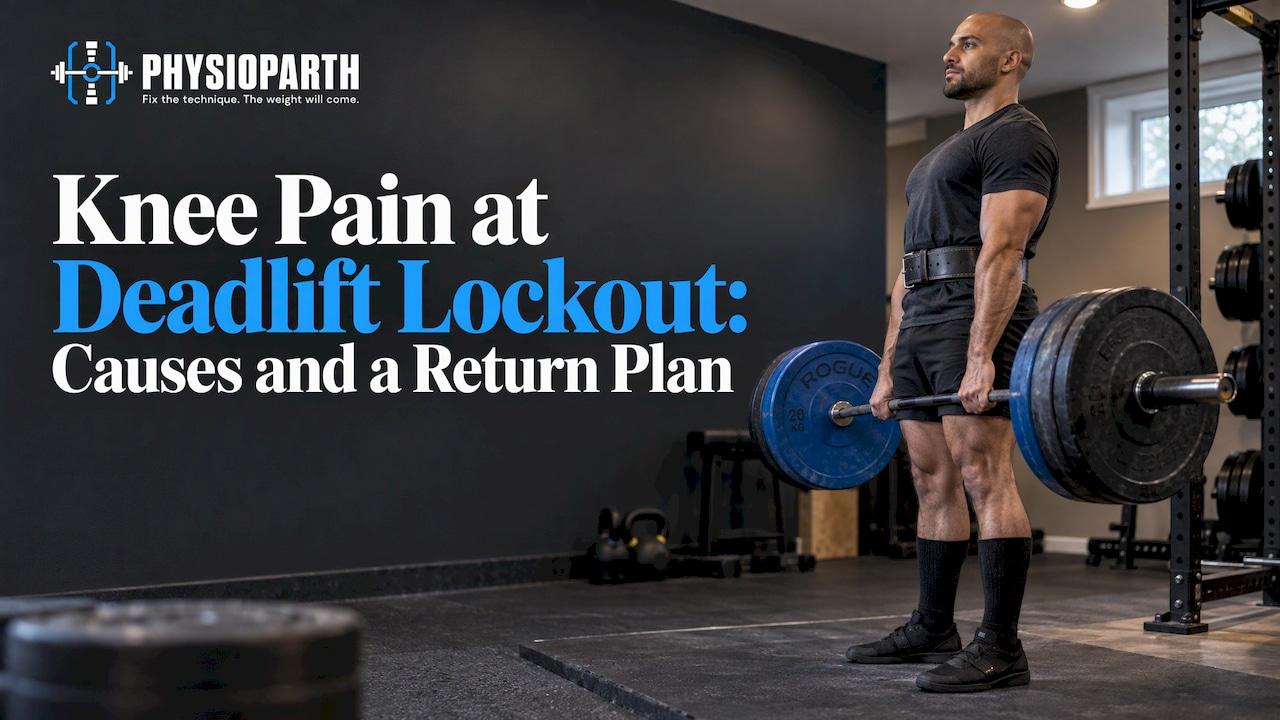
Knee pain at deadlift lockout usually shows up in the last few inches, when the knees finish extending and the hips come through. It may come from how you finish the lift (snapping the knees back, shifting weight to the toes, leaning back), from how much you have been doing (volume, intensity, frequency, recovery), or from a tissue that was already irritated. I'm Parth Suthar, a registered physiotherapist in Ontario and a former competitive powerlifter. Below I separate those causes, name the structures most likely involved, list the red flags, and give a return-to-lifting progression built on criteria, not calendar dates. If you want help with your own pulls, I offer a free 15-minute consult as a fit check.
TL;DR
- Pain at lockout may indicate a technique issue (early or snapped knee extension, bar drifting forward, hyperextension) or a load issue (a recent jump in volume, intensity or frequency).
- Where the pain sits helps narrow it down: the front of the knee, the joint line, the outer side, or behind the knee each point to different structures.
- Locking, catching, giving way, a swollen knee or pain that does not settle needs in-person assessment.
- Return by criteria: tempo, paused, pin or block pulls, trap bar, then isometrics and load, moving up only when the previous step is calm.
- I can't diagnose you from an article. A video assessment aims to look at your pull and build a plan around it.
Table of Contents
- Does the knee need to be straight at lockout?
- Technique causes at lockout
- Load-management causes
- Which structures may be involved, and how to tell them apart
- Red flags: when to get in-person or medical assessment
- Rate it, then decide: a simple pain rule
- A criteria-based return-to-lifting progression
- Free guides for your pull
- Working with me
- Perspective
- FAQ
- Next step
- Sources
Does the knee need to be straight at lockout?
Yes, the knees finish extended, but the way you get there matters. The American College of Sports Medicine's deadlift guidance advises extending the knees in a slow, controlled manner, avoiding premature knee extension, and avoiding jerking or hyperextending the back at the top. Even in stiff-leg variations it says not to lock or hyperextend the knees.
In practice, lockout means standing tall with glutes squeezed and hips brought to the bar. It does not mean throwing the knees back and leaning behind the bar. If you feel a pinch, ache or pressure at the front or back of the knee only in that final range, the finish itself is the first thing I'd look at.

Technique causes at lockout
These are the faults I'd look for on video, one at a time.
- Set-up and stance: hips too low turns the start into a squat, so the knees extend early and the bar swings out. Hips too high shifts work off the quads and onto the back and hamstrings. A stance that is too narrow or too wide can change the knee angle you finish through.
- Bar path: a bar that drifts forward of mid-foot makes you chase it, and the finish often becomes a lean back with knees snapped straight.
- Bracing: if you lose tension in the trunk, the knees often take over the finish, because the glutes and abs aren't holding the position.
- Grip: a failing grip can cause a rushed, jerky finish.
- Depth and range: an inconsistent start height changes how much knee extension the pull asks for.
- Finish: pushing the knees into hyperextension and tilting the pelvis forward, instead of finishing with the glutes.
My cue is simple: stand up, don't lean back. Film the pull from the side at hip height and watch the last third.
Load-management causes
A clean pull can still hurt if the weekly dose outpaced what the knee tolerates.
- Volume: extra sets, back-off work or added squat volume in the same week.
- Intensity: repeated heavy singles, or a jump in percentages after a meet or a deload.
- Frequency: deadlifting and squatting heavy on consecutive days.
- Recovery: poor sleep, a hard block of training, or a new job or schedule.
Ask yourself what changed in the last two to four weeks. Often the answer is a change in load, not a sudden technique problem. If so, trim the dose before you rebuild the technique.
Which structures may be involved, and how to tell them apart
This is a guide to likely patterns, not a diagnosis. Health Canada's musculoskeletal guidance lists pain, swelling, heat, stiffness, limited movement, instability and joint locking as features to assess, and recommends asking how symptoms relate to activity. That relationship to the lift is your best clue.
| Pattern | Structure that may be involved | Clues that may indicate it |
|---|---|---|
| Pain at the front of the knee, around or just below the kneecap | Patellar tendon or the patellofemoral joint | Aching with squats, stairs, or after sitting; tender just below the kneecap |
| Pain on the outer side of the knee | Iliotibial band area or the lateral knee structures | Sharp or burning on the outside, often with repetitive volume |
| Pain along the joint line, with catching or swelling | Meniscus | Followed a twist with the foot planted; catching, swelling or difficulty fully straightening |
| Pain behind the knee at the top | Hamstring tendon insertion or the back of the joint capsule | Worse as you snap or hyperextend the knee; tender behind the knee |
| Pain with a feeling of the knee giving way | Ligament structures | Instability, often after a specific event |
Health Canada notes that meniscal injury commonly follows twisting with a planted foot, though degenerative tears may occur without clear trauma, and symptoms can include joint-line pain, swelling, catching, locking and inability to fully extend.
Pain at lockout is not the same as a locked knee. A knee that is truly locked physically can't straighten. Pain at the top of a pull is a different complaint, and the first is a reason for in-person assessment.
If the front of the knee is the issue, my piece on patellar tendonitis and squats covers the tendon in more detail, and knee pain when squatting is the companion read if squats bother the same knee.
Red flags: when to get in-person or medical assessment
Stop deadlifting and get assessed in person if you notice any of these:
- The knee is locked and won't fully straighten, or it keeps catching.
- The knee gives way or feels unstable.
- Significant swelling, heat or redness.
- Pain after a high-speed injury or a clear twisting event. Health Canada recommends prompt medical consultation when the diagnosis is uncertain, especially after a high-speed injury.
- Persistent pain, giving way or swelling after three weeks of conservative care; that guidance says to refer for orthopaedic assessment.
- Severe muscle pain and weakness with dark urine after hard training. The Department of National Defence says exertional rhabdomyolysis needs immediate medical attention in that situation.
- Night pain, fever, numbness or a hot, swollen calf.
See a doctor or go to urgent care for these. In Ontario you don't need a referral to see a physiotherapist, though some insurers ask for one for reimbursement. Outside the red flags, a physiotherapy assessment is a reasonable next step as well, because a doctor's visit alone doesn't usually give you a plan for the barbell.
Rate it, then decide: a simple pain rule
Use a 0 to 10 scale. The Canadian Physiotherapy Association describes the 11-point numeric rating scale and says a two-point change is considered clinically meaningful. I use that to make the rule practical: log your pain during the set, after it and the next morning. If a variation raises the knee by two points or more, or leaves it worse the next day, it is too much for now. Step back one level.

A criteria-based return-to-lifting progression
Health Canada advises that after a meniscal injury you should avoid positions that put substantial pressure on the knee until pain and swelling settle, then add gentle pain-free movement and progressive strengthening. It also says early movement improves healing and that a return to sport should wait for full range of motion and strength. Sport Physiotherapy Canada says progressive exercise and planned return-to-sport training aim to reduce re-injury risk. The steps below follow that logic. Move on only when you meet the criteria, not when a date arrives.
Step 1: Calm the knee.
- Isometrics: mid-range quad holds or wall sits, 30 to 45 seconds, at a comfortable effort.
- Criteria to move on: daily movement is comfortable, no swelling, and pain during isometrics stays low and settles within an hour.
Step 2: Reload the pull with less knee demand.
- Trap bar deadlift from the handles, with a controlled finish.
- Block pulls or pin pulls from just below the knee, which shorten the range.
- Criteria: pain stays within your agreed limit during the set and is no higher the next morning, for two sessions in a row.
Step 3: Own the lockout.
- Tempo deadlifts, for example a three-second lowering phase, and paused deadlifts just below the knee.
- Add a glute squeeze at the top, hips to the bar, no lean back.
- Criteria: the finish looks the same from rep one to the last rep on video, with no snapping.
Step 4: Return the range.
- Lower the blocks or pins toward the floor in small steps; return to conventional pulls at submaximal loads.
- Criteria: full range with no rise in pain, and strength that feels even side to side.
Step 5: Rebuild load and frequency.
- Add load first, then volume, then frequency, one change at a time.
- Criteria: repeat the same week at the new dose without a flare before changing anything else.
If squatting bothers the same knee, a Safety Squat Bar or a box squat with a tempo may let you keep training the legs while it settles. If the bench or press is fine, keep them going. For bench-related work, the free bench guide is a place to start. If a flare happens, drop back one step, not to rest.
Free guides for your pull
The deadlift guide covers set-up and the lockout. If the hips and lower back are involved as well, The Lifter's Hip & Lower Back Toolkit and the resources page are free to look through. Related pain patterns I've written about include groin pain with deadlifts and deadlift back pain.
Working with me
My Initial Assessment is $130 and is delivered by video. It includes a full subjective and objective assessment and a movement screen, plus a lift analysis if you send videos beforehand. It aims to explain what tissue may be irritated and to build a criteria-based return-to-lifting plan, using modified variations where appropriate rather than complete rest. A Follow-Up Session is $100. Many extended-health plans cover physiotherapy, and I provide receipts for reimbursement.

The free 15-minute call is a fit check, not an assessment or treatment. You can start from the Initial Assessment page.
Perspective
Most lifters I talk to want one thing: to keep training. I was a competitive powerlifter, and I know how tempting it is to either ignore a knee that complains at lockout or to stop pulling altogether.
My view is that neither extreme is a plan. The knee is telling you something about technique, load or a specific tissue, and the job is to sort out which. That is why I look at the pull on video, ask what changed in training, and build the return around criteria you can check yourself.
I aim to explain what may be irritated in lifter terms, and to use modified variations where appropriate. It is a plan, not a promise.
Parth
FAQ
Should I lock my knees at the top of a deadlift?
Your knees finish extended, but controlled. ACSM advises extending them slowly rather than snapping them back, and not locking or hyperextending them in stiff-leg variations. Finish with the glutes, not by leaning back.
Why does my knee hurt only at the top of the pull?
It may indicate an early or snapped knee extension, a bar drifting forward, or a recent jump in load. It may also involve a tissue such as the patellar tendon or meniscus. A video assessment can look at your finish and your training log together.
Can I keep deadlifting with knee pain?
Often a modified version is possible, such as trap bar, block or pin pulls and tempo work, as long as pain stays within your limit and settles by the next morning. If the knee locks, gives way or swells, stop and get assessed in person.
Do I need a referral to see a physio in Ontario?
No. You can book directly, though some insurers require a referral to reimburse you. Check your plan first.
Next step
If your knee hurts at lockout and you want a plan built around your pull, book with me for a free 15-minute consult.
Sources
- Chapter 7 – Musculoskeletal System, Health Canada
- Understanding the Deadlift and Its Variations, ACSM Health & Fitness Journal
- Ask the Expert: Exertional Rhabdomyolysis, Department of National Defence
- Numeric Rating Scale (NRS-11), Canadian Physiotherapy Association
- Public Resources, Sport Physiotherapy Canada
Recommended
- Groin Pain With Deadlifts: Causes, Modifications, Return
- Knee Pain When Squatting: Causes, Tissue Clues and a Return Plan
- Patellar Tendonitis and Squats: A Lifter's Return Plan
- Sciatica and Deadlifts: How to Train Around Leg Pain
This article is general education for strength athletes and is not a substitute for an individual assessment. Pain that is severe, worsening, or accompanied by numbness, weakness or loss of function needs prompt in-person or medical assessment. Author: Parth Suthar, Registered Physiotherapist (Ontario).