
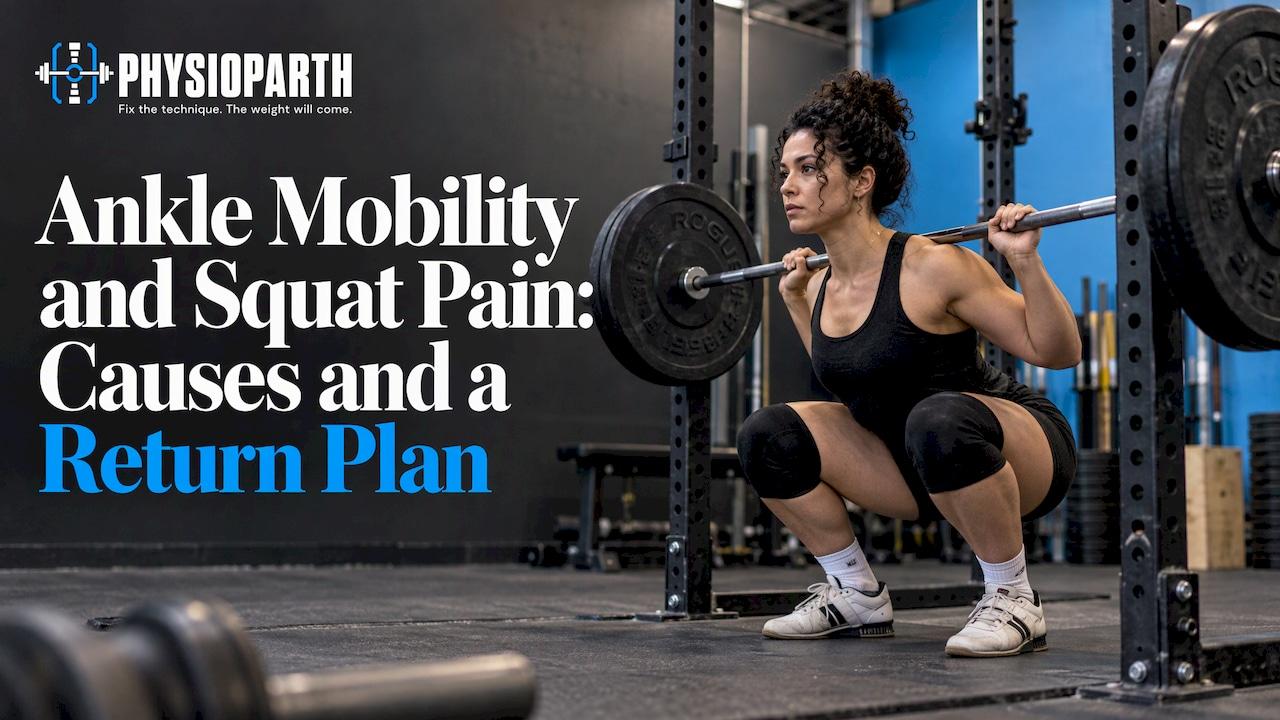
If your ankle pinches, aches or feels blocked at the bottom of the squat, limited ankle dorsiflexion may be part of the picture, but it is rarely the whole story. The location of the pain, the position where it appears and what changes when you alter your set-up can help tell the likely structures apart. I'm Parth Suthar, a registered physiotherapist in Ontario and a former competitive powerlifter. Below I'll walk through what may be involved, how to check your range, which squat variations to use while it settles, and the criteria I'd want to see before you go back to your usual squat.
TL;DR
- Front-of-ankle pinching at depth may indicate anterior ankle impingement. Pain in the back of the ankle or heel may point more toward the calf and Achilles. Outer or inner ankle pain may involve the tendons that run behind those bony points.
- Limited dorsiflexion can push the work elsewhere: a 2025 study linked it to more trunk lean and more pelvic and lumbar motion in the squat.
- Separate technique causes (stance, shin angle, heel pressure, depth) from load causes (volume, intensity, frequency, recovery). They need different fixes.
- Return by criteria, not dates: tempo, paused, pin and Safety Squat Bar variations first, then back to your competition-style squat as each stage settles.
- Swelling with inability to bear weight, instability, numbness or tingling need in-person assessment.
Table of Contents
- What ankle pain in the squat may involve
- Why limited dorsiflexion changes the whole squat
- Technique causes versus load-management causes
- Check your dorsiflexion with the knee-to-wall test
- Mobility and strength work that fits the picture
- A criteria-based return-to-lifting progression
- Red flags: when you need in-person or medical assessment
- Perspective
- Work with me on your squat
- FAQ
- Sources
What ankle pain in the squat may involve
The ankle has to bend (dorsiflex) as your knee travels forward over your toes. Under a heavy bar, that range gets used up fast. Where it hurts gives the first clue, and I'd treat these as patterns to explore, never as a diagnosis.
| Where it hurts | Structures that may be involved | What may point that way |
|---|---|---|
| Front of the ankle, a pinch or block at depth | Joint capsule, soft tissue or bone at the front of the tibiotalar joint (anterior impingement) | Pain at end-range dorsiflexion, often with a feeling of blockage; eases when you come up or raise your heels |
| Back of the ankle or just above the heel | Achilles tendon, calf (gastrocnemius, soleus) | Stiffness or ache after loading, worse on the first steps in the morning or after sitting; tender along the tendon |
| Outer ankle | Lateral ligaments (especially with a sprain history), peroneal tendons | Pain with side-to-side wobble or when the foot rolls outward under load |
| Inner ankle or arch | Tibialis posterior tendon, plantar fascia | Pain that rises when the arch collapses or the knees cave in at the bottom |
The front-of-ankle pattern is the one most tied to squat depth. A 2016 paper in the Journal of Orthopaedic Surgery and Research describes anterior ankle impingement as compression of structures at the front of the tibiotalar joint during dorsiflexion, with deep squatting among the activities that commonly provoke it. A physiotherapy source lists risk factors such as repeated ankle sprains, sudden jumps in training volume, reduced calf strength and altered foot mechanics.
How to tell them apart
Three quick questions help sort the picture before you ever see a clinician:
- Where exactly, and at what depth? Pain only in the last few degrees of the bottom position may indicate end-range joint compression. Pain that builds across a set may indicate a tendon being loaded.
- What does a heel raise change? If a small heel lift or a weightlifting shoe takes the pinch away, restricted dorsiflexion at the front of the joint may be a factor. If nothing changes, look at other structures.
- What does a calf raise or a single-leg hop feel like? Pain along the Achilles or behind the inner or outer ankle bone with loaded calf work may point toward tendon involvement rather than joint pinching.
These clues narrow the field. They do not confirm a tissue, which is why a hands-on and movement-based assessment matters when the pain sticks around.
Why limited dorsiflexion changes the whole squat
When the ankle cannot supply the range, the body tends to find it somewhere else. In a 2025 study of 44 active people, those with limited dorsiflexion (under 30° on the weight-bearing lunge test) showed more pelvic motion, more hip and lumbar flexion and more forward trunk lean than those above 35°. That is a useful reminder: an ankle restriction may show up as a low back or hip complaint. If your squat bothers your back, my article on butt wink in the squat covers when that matters, and the hip pain squatting guide covers the other neighbour.

Research in which dorsiflexion was artificially restricted with a forefoot wedge also reported reduced knee flexion, more knee valgus and more calf activation. If your knees hurt at depth, the knee pain squat guide is the next read, and patellar tendonitis and squats applies if the pain sits just below the kneecap.
Not everyone with stiff ankles has pain, and not everyone with pain has stiff ankles. Mobility is one input among strength, control, foot mechanics and training load.
Technique causes versus load-management causes
Separating these two groups is the most useful thing you can do, because the fix for one does not touch the other.
Technique causes
- Stance width and angle. A narrow, upright squat demands the most dorsiflexion. A wider stance reduces ankle dorsiflexion demand and produces a more hip-biased pattern, though the same review notes that stances beyond roughly 150% of shoulder width may raise knee valgus moments. Wider helps up to a point.
- Bar position. A low-bar position leans the torso forward and shortens the shin travel needed. High-bar squats typically ask for more forward knee travel.
- Heel pressure. If your heels lift or your arch collapses at the bottom, the ankle is getting loaded in a position it does not control well.
- Depth. Forcing depth past your available range is a common reason for the pinch. Your depth target should match the range you can currently own.
- Bracing and foot position. Twisting or shifting to reach depth often shows up first as a hip shift. My squat hip shift article explains the clues.
Load-management causes
- Volume spikes. Sudden increases in training volume or intensity are listed among risk factors for front-of-ankle problems in the source above.
- Intensity and frequency. Frequent heavy squatting with little time for the calf, Achilles and ankle structures to adapt may add up.
- Recovery. Poor sleep, a heavy run of accessory work for the calves, or a new running block may all add load to the same tissues.
- A change in footwear or surface. Moving from lifting shoes to flat soles, or the reverse, changes the dorsiflexion your squat needs.
A simple log helps: note the date pain started against changes in volume, shoes, stance or bar position. The overlap often points to the cause.
Check your dorsiflexion with the knee-to-wall test
The weight-bearing lunge test is a practical way to look at your range under load. A 2017 NSCA Strength and Conditioning Journal article recommends the weight-bearing lunge over non-weight-bearing methods for loaded closed-chain tasks, because the two methods correlate poorly.
- Place your foot a measured distance from a wall, toes pointing straight ahead, heel flat.
- Drive the knee forward to touch the wall without the heel lifting.
- Move the foot back until you can only just touch. Measure toe-to-wall distance.
- Repeat on the other side and compare.
A 2025 Frontiers review reports normative values above roughly 9 to 10 cm, and treats a difference of more than 1.5 cm between sides as clinically relevant. A pinch at the front of the ankle during the test may indicate that the same spot hurts in your squat. A side-to-side gap may be a more useful number than the absolute figure.
Mobility and strength work that fits the picture
Stretching alone is rarely the whole plan, but calf range work has a place when tightness is what limits the ankle. The Frontiers review notes that static stretching can increase dorsiflexion range, especially when triceps surae tightness is the restriction, and that intensity, total time under stretch and number of weeks all influence the result. Its example protocol was long, three sets of 75 seconds, which shows how much accumulated time may be needed.
Pair range work with strength so you can use the range under a bar:
- Knee-to-wall rocks to a comfortable end range, not through a pinch.
- Straight-knee and bent-knee calf raises, slow, with a pause at the top. Slow heavy calf work is also a common starting point for Achilles-type irritation.
- Isometric holds in a bottom position of a goblet squat with a heel lift, building tolerance without moving through the painful arc.
- Tibialis anterior raises and foot-arch control work if the arch collapses at the bottom.
If you want a structured set of hip and lower back drills to pair with this, my Lifter's Hip & Lower Back Toolkit is a free resource.
A criteria-based return-to-lifting progression
Progress when you meet the criteria for a stage, not when a week has passed. Pain during the work should stay at a level you consider tolerable and settle back to your baseline within a day. If it does not, stay at the stage or step back one.
Stage 1: Reduce the dorsiflexion demand
- Variations: box squat with a more vertical shin, pin squat to a tolerable depth, Safety Squat Bar squat, wider low-bar stance, trap bar deadlift if your ankle also objects to the start position.
- Physio Network suggests that a box squat or pin squat to a tolerable depth is a reasonable modification for ankle pain, with wider, low-bar squatting favoured for knee or ankle problems because of its hip dominance.
- Heel support: a heel lift may reduce demand. One study of 25 resistance-trained women found a heel wedge produced about 27.6% less ankle dorsiflexion during back squats. One shoe guide lists 16 mm heels for lifters with good mobility and 22 mm or higher for restricted ankles.
- Move on when: the pinch is gone or minimal in these variations for several sessions in a row and the next-day ankle is no worse.
Stage 2: Add control and time under tension
- Variations: 3-second tempo squats to a box or pin, paused squats at a depth just above your pain point, isometric holds at that depth.
- Move on when: you can pause at your target depth without the heel lifting, the arch collapsing or the pain rising above your baseline, and your knee-to-wall difference between sides is not getting worse.
Stage 3: Rebuild load and depth
- Variations: lower the pin or box by small steps, progress the Safety Squat Bar toward your usual bar, then use your competition stance with a heel lift if it is helping.
- Move on when: you can hit your working sets in your competition-style squat across a full week of training without a flare that lasts into the next day.
Stage 4: Return to full training
- Reintroduce volume and frequency one variable at a time, not both together. Wean the heel lift only if you want to, and only if your range and pain allow.
- Keep one or two of the stage 2 variations in your block as maintenance work.
On the pulling side, block pulls from a higher start and a trap bar can reduce the knee-forward travel demanded at the bottom. For pressing days, the ankle is rarely the limiter, so leave bench and overhead work as they are unless a flare says otherwise.
Red flags: when you need in-person or medical assessment
This is the section where I'd want you to stop and get hands-on help rather than modify and wait. A Canadian physiotherapy practice advises seeking medical care when a joint is painful or swollen and you cannot put weight through it, feels unstable, moves abnormally, or you have numbness or tingling. In practice, I'd add these for lifters:
- You cannot bear weight, or you felt a pop or sudden give during a lift or a landing.
- Marked swelling, bruising, heat or redness around the ankle, or a calf that is swollen, hot and tender, particularly after travel or a layoff.
- The ankle gives way or feels wobbly during normal walking.
- Numbness, tingling or pins and needles in the foot.
- Night pain or constant pain that does not change with position or rest.
- No response to sensible load modification over a couple of weeks. The ACOEM ankle and foot guideline says that if recovery is slower than expected, the diagnosis or treatment approach should be reconsidered.
In Ontario you can see a physiotherapist without a doctor's referral. For a suspected fracture, a joint that looks deformed, or symptoms such as a hot swollen calf, go to an urgent care centre or emergency department, or call 911 if you are unsure.
Perspective
When a lifter tells me their ankle hurts in the squat, I don't start with a stretch. I start with questions: where, at what depth, with which bar, after what change in training. The ankle is often the place the pain shows up, not the only place the problem lives.
I'd rather you keep training a version of the squat that your ankle tolerates than take complete rest. That is where criteria help. Each stage has a checkpoint, and a lift analysis from side-on video can show whether your shin angle, stance, heel pressure or depth is adding to the load on that joint.
My Initial Assessment includes a full history, a movement screen and a lift analysis if you send videos beforehand. It aims to explain what tissue may be irritated and to build a return-to-lifting plan with modified variations where appropriate. It is an aim, not a promise, and the plan changes as you respond.
Parth
Work with me on your squat
If your ankle pain has outlasted a couple of weeks of sensible changes, or your squat keeps shifting as the weight goes up, an individual assessment may save you guesswork. The Initial Assessment is $130 and a Follow-Up Session is $100. Both are delivered by video, and I provide receipts for insurance reimbursement. Many extended-health plans cover physiotherapy, though some insurers require a referral to reimburse. You can see the current options on my booking page.

The free 15-minute call is a fit check. It is not an assessment or treatment. It is a chance to tell me what is going on and see whether virtual care suits you. If you'd like to start there, book with me for a free 15-minute consult.
FAQ
Can I keep squatting with ankle pain?
Often a modified version is possible. Reducing depth with a box or pin, widening the stance, using a Safety Squat Bar or adding heel support may lower the demand on the ankle. If pain stays above your baseline the next day, or any red flag above applies, stop and get assessed.
Do heel-elevated shoes fix limited ankle mobility?
They do not change the range in your ankle, but they may reduce how much range the squat needs. One shoe guide estimates a 20 mm heel reduces dorsiflexion demand by roughly 10 to 12 degrees. Treat them as a tool while you build range and strength, not a replacement for either.
How do I know if my ankle is the reason my squat depth is limited?
Compare your knee-to-wall distance between sides and watch for heel lift or forward trunk lean at depth. Squat depth has been shown to correlate strongly with ankle dorsiflexion range in bodyweight squatting. Hip structure, hip mobility and technique also matter, so a video review is worth doing.
How long will it take to improve?
It depends on the tissue involved, how long it has been irritated and how much load you are managing. I would not give a fixed number of weeks. Progress by criteria, and get an individual assessment if things are persistent, worsening or repeatedly returning.
Sources
- Ankle impingement, Journal of Orthopaedic Surgery and Research (PMC)
- Anterior ankle impingement, Peak Physio
- Effect of Limited Ankle Dorsiflexion on Lower Limbs, PubMed
- Ankle and hip mobility for squats, TurnFit
- A Biomechanical Review of the Squat Exercise, PMC
- Practical Approach to Problem-Solving Movement Tasks, NSCA Strength and Conditioning Journal
- Restoring ankle dorsiflexion range of motion, Frontiers in Sports and Active Living
- The Best Damn Squat Article For Physios, Physio Network
- The Effect of Heel Wedge on Back Squat Kinematics, IJESAB
- Weightlifting Shoe Heel Height Guide, Castiron Lift
- How to Test Ankle Mobility for Your Squat, Notorious Lift
- Physiotherapy in Coaldale for Injury Care, IMPACT Health
- Ankle and Foot Complaints, ACOEM guideline
Recommended
- Knee Pain When Squatting: Causes, Tissue Clues and a Return Plan
- Patellar Tendonitis and Squats: A Lifter's Return Plan
- Hip Pain Squatting: Causes, Fixes and Return Criteria
- Squat Hip Shift: Causes, Clues and a Return Plan
This article is general education for strength athletes and is not a substitute for an individual assessment. Pain that is severe, worsening, or accompanied by numbness, weakness or loss of function needs prompt in-person or medical assessment. Author: Parth Suthar, Registered Physiotherapist (Ontario).