
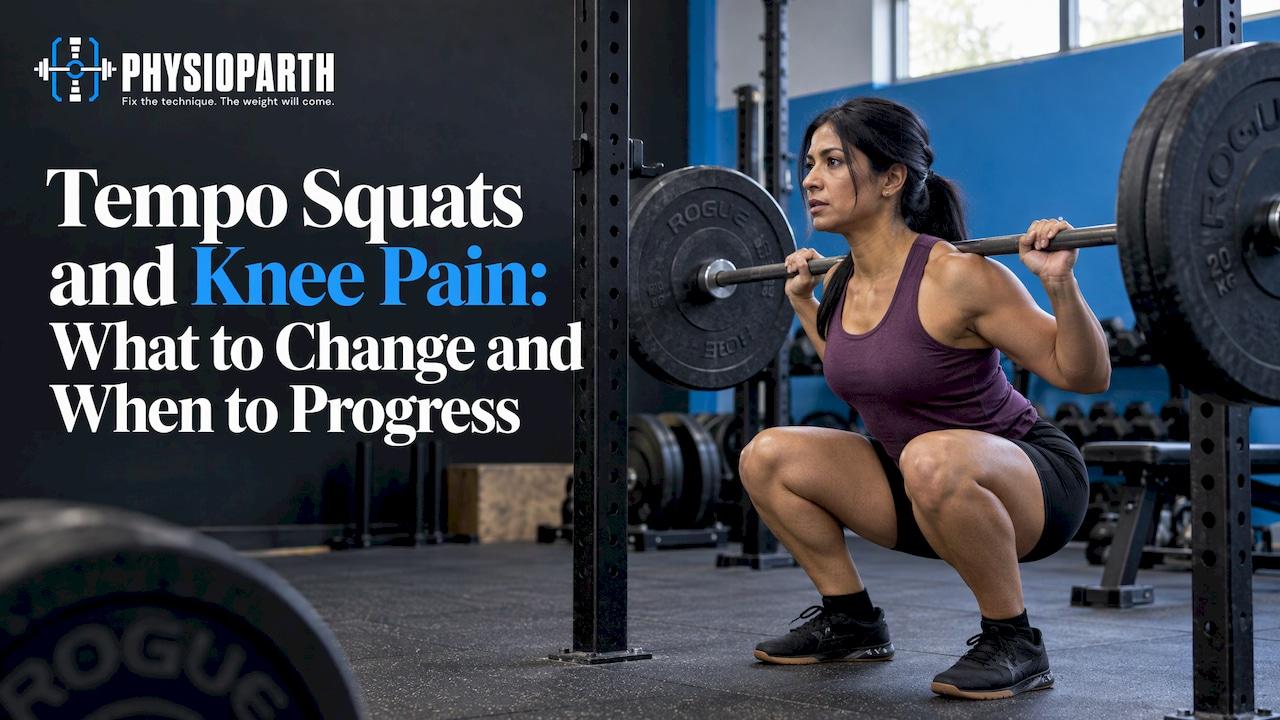
If your knee hurts on tempo squats, the slow tempo is rarely the whole story. Pauses and 3-second descents keep your knee under load for longer, so they tend to show up a technique fault, a depth that is too aggressive or a training load that has outpaced your recovery. The useful move is to work out which of those is driving it, adjust that one variable, and progress by criteria rather than by the calendar.
I'm Parth Suthar, a registered physiotherapist in Ontario and a former competitive powerlifter. Below is how I would think it through with a lifter: the structures most likely involved, how to tell them apart, what to change first, and the exact variations to move through. This is education, not a diagnosis. Only an assessment of you can say what is irritated.
TL;DR
- Front-of-knee pain on tempo squats may indicate patellofemoral irritation or a loaded tendon. Where exactly it hurts, and at what depth, helps separate them.
- Separate technique causes (set-up, stance, depth, bracing, bar path) from load-management causes (volume, intensity, frequency, recovery) and change one at a time.
- Modify the squat rather than abandoning it: box or pin height, tempo, Safety Squat Bar, isometrics.
- Progress when criteria are met (symptoms settle, the movement looks the same on video, the next step feels like the last one), not when a date arrives.
- Locked knee, giant swelling, inability to bear weight or a hot, red joint with fever needs in-person or medical assessment.
Table of Contents
- Why tempo squats can bring knee pain out
- Which structure may be involved, and how to tell them apart
- Technique causes to check first
- Load-management causes to check second
- A criteria-based return-to-squatting progression
- Red flags: when to stop and get assessed in person
- How I can help
- My perspective
- FAQ
- Ready to look at your squat?
- Sources
Why tempo squats can bring knee pain out
A tempo squat slows the descent, adds a pause, or both. That is a useful tool: a 2024 biomechanical review of the squat notes that slower loading rates may be better tolerated when the aim is to stimulate tendon remodelling and muscle strengthening. It also means your knee spends more time at the angles where it has the most to say.
A 2022 review of squats and patellofemoral pain found that all squat variations can overload the patellofemoral joint (where the kneecap glides on the thigh bone), especially around 60° to 90° of knee bend. It named the knees travelling forward past the toes and an imbalance between thigh muscles as main aggravating factors. A slow 3-second descent through that range spends more time exactly there.

Patellofemoral pain is common in people who train hard. A 2014 review in ACSM's Clinical Sports Medicine Reports describes it as front-of-knee pain that rises with squatting, stairs and prolonged sitting, and reports it accounts for up to 25% of knee injuries seen in sports medicine clinics. So you are not unusual, and a painful tempo squat is information, not a verdict on your knees.
Which structure may be involved, and how to tell them apart
I can't diagnose you from an article. What I can do is give you the questions I'd ask, because the answers point toward different structures and different plans.
| Structure | Where it tends to be felt | What it tends to do | Clue on tempo squats |
|---|---|---|---|
| Patellofemoral joint (kneecap and groove) | Diffuse ache around or behind the kneecap | Worse with stairs, sitting for long periods, deep or heavy squats | Builds as you spend time in the bottom half of the rep |
| Patellar tendon | A specific spot just below the kneecap | Warms up as you go, then stiffens afterward; tender to press | Often worse on the pause and drive out of the hole |
| Quadriceps tendon | Just above the kneecap | Similar load-related pattern, often with heavy, deep squatting | Pain at the top of the kneecap in the bottom position |
| Medial or lateral joint line (menisci) | Along the inner or outer joint line | May involve catching, twisting sensitivity or pain on deep flexion | Sharper pain when you rotate or sit very deep |
| Inner knee soft tissue (e.g. pes anserine area) | Inner knee, a few centimetres below the joint line | Tender to touch, can follow a jump in volume | Worse when the knees drift inward during the drive |
Three questions help sort these:
- Can you point to it with one finger? A single tender spot below the kneecap may indicate tendon involvement. A vague, whole-kneecap ache may indicate the patellofemoral joint.
- What depth does it start at? Pain that ramps up past roughly parallel fits with compression-related irritation. Pain at the top of the range or on the drive may point toward a tendon.
- Does it catch, lock or give way? Mechanical symptoms are a reason for an in-person look (see the red flags below).
If your pain sits just under the kneecap, my guide on patellar tendonitis and squats goes further. For the broader picture, see knee pain when squatting. If your knees collapse inward as you stand, knee cave in the squat covers that pattern.
Technique causes to check first
Film a set from the front and from the side at about hip height. Then look at these:
- Stance and foot angle. A stance that forces your knees to travel in a direction your hips don't like can leave the knee absorbing the rotation. Many lifters feel better with a slightly wider stance and toes turned out a little.
- Depth. Pain that only shows up in the last few centimetres of depth may be a depth issue. The Association of Physiotherapy Educators in Canada says a squat that hurts should be modified, not abandoned, for example by working to a depth you tolerate.
- Knee tracking. Knees caving inward on the way up can overload the inner knee. A systematic review in military personnel found that a larger inward knee angle during a single-leg squat was a risk factor for patellofemoral pain in males, and that knee-extensor weakness also predicted it.
- Bracing and trunk position. If you lose tension at the bottom, your torso tips forward and the load shifts from hips to quads and knees. A slow tempo exposes this because there is nowhere to hide.
- Bar position and path. A bar that drifts forward of mid-foot makes the rep harder to control and can push the knees forward.
- Ankle range. Limited ankle bend can push the knees forward or the heels up. Ankle mobility and squat pain is worth a look if your heels lift.
The tempo itself can also be a technique issue. If you rush the first half and lose control in the second half of a 3-second descent, the tempo is too slow for the weight. Cut the load, not the control.
I've put free, lift-specific guides on the squat and a lower-body toolkit on the site if you want checklists for your set-up.
Load-management causes to check second
Sometimes the technique is fine and the knee is simply being asked for more than it has adapted to. Ask yourself:
- Volume. Did sets or total reps jump recently, especially tempo work where each rep takes 6 to 8 seconds?
- Intensity. Did you add a tempo block at a weight close to what you would normally squat at normal speed? Slow reps feel heavier than the plate says.
- Frequency. How many days a week does the knee take a hard squat session, with leg press, lunges and cycling on top?
- Recovery. Sleep, stress and a bigger-than-usual training week all change how well a tissue copes.
The tendon literature is useful here. A 2023 meta-analysis in the British Journal of Sports Medicine of 110 studies on resistance exercise for tendinopathy found larger effects with higher-intensity loading using external resistance and with less-than-daily training, and little link between volume and effect. In plain terms, for a loaded tendon, heavier, well-spaced work tends to be a better fit than lots of light, daily work. Canada's Choosing Wisely sport and exercise medicine list lists relative rest, activity modification and physical or athletic therapy as first-line options for tendinopathies.
The practical read: if the cause looks like load, reduce the dose of the aggravating work and keep a smaller, well-spaced dose of loading in.
A criteria-based return-to-squatting progression
This is a framework, not a prescription for your knee. Each stage moves on when its criteria are met, never on a date. Criteria in every stage: the pain stays low during the set, it settles back to your normal baseline by the next morning, and the rep looks the same on video at the end of the set as at the start.
Stage 1: calm it down with isometrics and a short range
- Isometric squat holds at a knee angle that is comfortable. A review of patellar tendinopathy rehabilitation reports that sustained mid-range isometric exercise can reduce patellar tendon pain, and it describes a trial where an isometric squat helped in-season athletes.
- Box squats or pin squats to a height you tolerate, so you control depth.
- Moves on when: you can hold the position for the planned time without your symptoms rising, and the knee is no worse the next day.
Stage 2: bring back movement with support
- Tempo squats with a Safety Squat Bar or a high-bar squat to a box, light enough that the 3-second descent stays smooth.
- Chair- or hand-supported squats if balance or depth is limiting. The APTEI paper gives examples of one set of 5 to 10 reps for chair-supported squats, performed twice daily as a minimum.
- Moves on when: every rep of the tempo set is controlled, there is no new catching, and next-day knee symptoms are at baseline.
Stage 3: add load and depth
- Paused squats at the depth you have been working to, then slightly deeper.
- Pin squats from the bottom to check how the lowest position tolerates load.
- Trap bar deadlifts to keep leg and hip loading going when the squat is still sensitive. For the deadlift side, see deadlift guides.
- Moves on when: the pause does not provoke your usual pain, and depth is similar to your normal squat.
Stage 4: back to your competition-style squat
- Tempo squats with your own bar at a weight that is a clear step below your normal working weight.
- Then normal-speed squats, starting at a lower volume.
- Moves on when: you can repeat the session twice without symptoms rising, and the knee behaves the same the following day.
If pain returns at any stage, go back one stage and look again at technique and load before pushing forward. If the hip is the limiting factor, my write-up on hip pain when squatting covers that.
Do not treat these as stretching-only or rest-only solutions. The goal is to find a version of the squat your knee can handle and build from there.
Red flags: when to stop and get assessed in person
Tempo squats are not worth pushing through if any of these show up. Get in-person or medical assessment (a family doctor, urgent care or an emergency department, depending on severity):
- Your knee locks and will not fully straighten or bend.
- Your knee gives way or feels unstable.
- Rapid, significant swelling after a twist, pop or fall.
- You cannot put weight on the leg.
- The joint is hot, red and swollen, especially with fever or feeling unwell.
- Night pain or constant pain that does not change with position or activity.
- Numbness, pins and needles or weakness in the leg.
- Pain after a significant impact or injury.
HealthLink BC, a public health body in British Columbia, advises stopping an exercise and asking for alternatives if it causes pain (HealthLink BC). That fits what I would tell a lifter: pain that is clearly escalating is a signal to change the plan, not to grit through another set.
How I can help
If you want someone to look at your squat and your knee together, the Initial Assessment is $130. It includes a full subjective and objective assessment and a movement screen, plus a lift analysis if you send videos beforehand. It aims to explain what tissue may be irritated and to build a criteria-based return-to-lifting plan, using modified variations where appropriate rather than complete rest. Follow-up sessions are $100. No doctor's referral is needed to see a physiotherapist in Ontario, though some insurers require one for reimbursement, and many extended-health plans cover physiotherapy.

You can see the options on the PhysioParth site.
My perspective
Most lifters I talk with about knee pain have been told one of two things: stop squatting, or fix your mobility. Neither answers the question that matters, which is what the knee can do today and what would move it forward.
I was a competitive powerlifter before I was a physiotherapist, so I think about the squat the way a lifter does. Taking away the lift entirely costs you more than the pain does. My approach is to look at what may be irritated, what in your set-up or training load could be feeding it, and which modified variation lets you keep loading the movement while the knee adapts.
Tempo work is a good example. In the right dose, it is a useful tool. In the wrong dose, it shows you exactly where the problem is. A video of your squat and a conversation about your last few weeks of training usually tell me more than a long list of exercises ever could.
Parth
FAQ
Is it okay to do squats with knee pain?
It depends on the pain and what it is doing. A 2020 clinical practice appraisal gives top-grade recommendations for hip- and knee-targeted exercise, including weight-bearing squats, for patellofemoral pain. If pain is escalating, if you have any of the red flags above, or if it lingers after training, change the variation or get assessed.
What are tempo squats good for?
They build control through the full range and let you spend more time under tension at lighter weights. For knee-related issues, slower loading may be better tolerated, according to the 2024 squat review. They also make technique faults visible, which is useful when you are trying to work out why a knee is sore.
Why do squats give me knee pain?
Common contributors include squat depth, knee tracking, a sudden jump in volume or intensity, and weakness around the hip and thigh. Where the pain sits (kneecap, below it, inner or outer joint line) may indicate which tissue is involved. A video and a clinical assessment can narrow it down.
Should I stop squatting entirely?
Not necessarily. Modifying depth, load, tempo or bar type is often the better first step than complete rest. If the knee locks, gives way or swells rapidly, stop and get seen in person.
Ready to look at your squat?
If your knee is sore on tempo squats and you want a plan built around your lifts, book a free 15-minute consult at physioparth.com. The call is a fit check, not an assessment or treatment. Book with me and we can see whether virtual physiotherapy suits you.
Sources
- A Biomechanical Review of the Squat Exercise: Implications (PMC, 2024)
- Patellofemoral Pain Syndrome Risk Associated with Squats (PMC, 2022)
- Update on Rehabilitation of Patellofemoral Pain (ACSM's Clinical Sports Medicine Reports, 2014)
- Deep Squatting: Good or Bad? (Association of Physiotherapy Educators in Canada, 2015)
- Risk Factors for Patellofemoral Pain in the Military (PMC)
- Resistance exercise for tendinopathy meta-analysis (British Journal of Sports Medicine, 2023)
- Sport and Exercise Medicine Recommendations (Choosing Wisely Canada)
- Rehabilitation of patellar tendinopathy (PMC)
- Knee exercises for osteoarthritis (HealthLink BC)
- Appraisal and summary of patellofemoral pain clinical practice guidelines (PMC, 2020)
Recommended
- Knee Pain When Squatting: Causes, Tissue Clues and a Return Plan
- Patellar Tendonitis and Squats: A Lifter's Return Plan
- Knee Cave in the Squat: Causes, Tissue Clues and a Return Plan
This article is general education for strength athletes and is not a substitute for an individual assessment. Pain that is severe, worsening, or accompanied by numbness, weakness or loss of function needs prompt in-person or medical assessment. Author: Parth Suthar, Registered Physiotherapist (Ontario).