
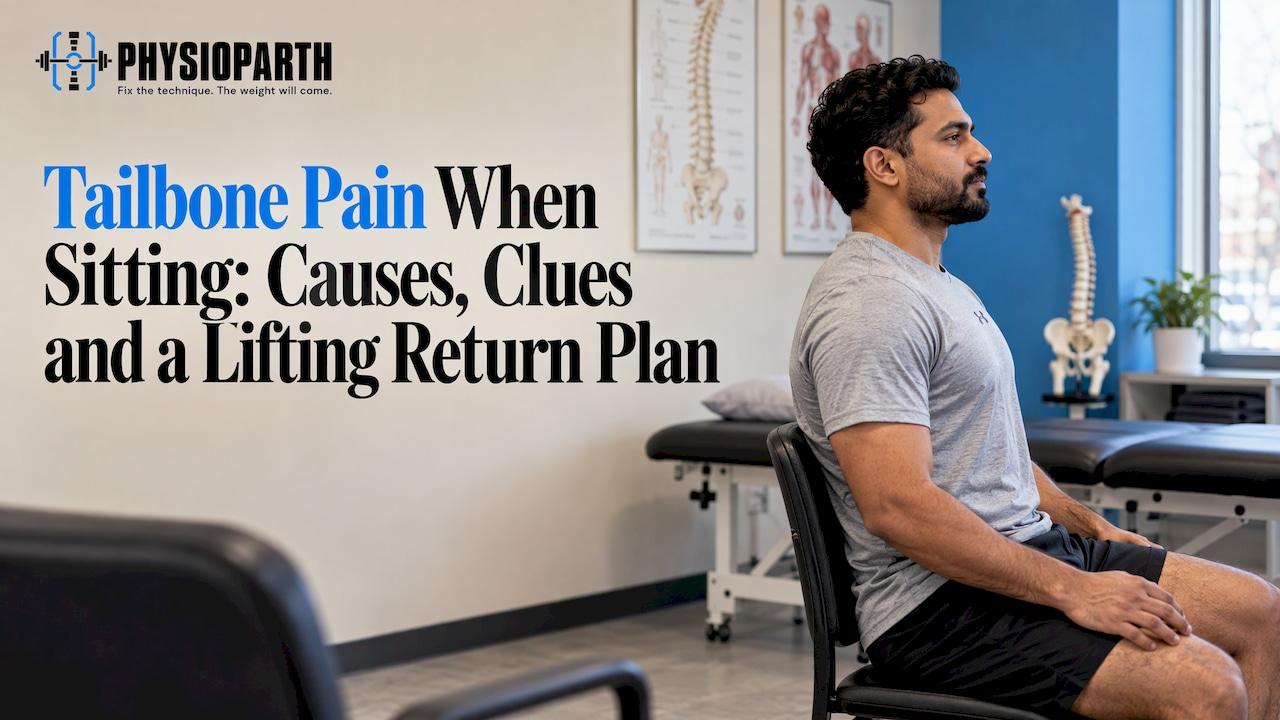
Tailbone pain that flares when you sit, lean back or stand up from a chair is common, and it does not automatically mean you have to stop training. Coccydynia, the medical term for localized tailbone pain, is typically aggravated by sitting, direct pressure and the sit-to-stand transition. For lifters, the useful questions are what is being loaded, which of your positions or training habits may be adding to it, and what you can still do while it settles. I'm Parth Suthar, a registered physiotherapist in Ontario and a former competitive powerlifter, and this article walks through exactly that.
- ✓Full subjective and objective assessment
- ✓Movement screen
- ✓Lift analysis with videos sent beforehand
- ✓Criteria-based return-to-lifting plan
TL;DR
- Tailbone pain is often provoked by sitting on hard surfaces, leaning back, and rising from a chair. A fall, childbirth, repeated loading or no clear cause are all described as common contexts.
- Pain near the tailbone can also come from the pelvic floor, the low back, the SI joint or the sit bones. A few simple position tests can help you tell the patterns apart, but only an assessment can sort them out.
- Early self-care is simple: lean slightly forward when you sit, break up long sitting, and use a cushion with an opening at the centre or back.
- Return to lifting by criteria, not dates: isometrics and tempo work first, then pin, paused and Safety Squat Bar or trap bar variations, then your competition lifts.
- Severe pain, leg symptoms, numbness, or bladder and bowel changes need urgent medical care. See the red flags section below.
Table of Contents
- What the tailbone is and why sitting loads it
- Structures that may be involved, and how to tell them apart
- Why lifting can aggravate it
- What to do about it this week
- A criteria-based return to lifting
- Red flags: when you need in-person or medical assessment
- How I can help
- My perspective
- FAQ
- Sources
What the tailbone is and why sitting loads it
The coccyx is the small bony tip at the bottom of your spine. It connects to the sacrum through a small joint, and ligaments and pelvic floor muscles attach to it. When you slump or lean back in a chair, more of your body weight can pass toward that tip instead of through your sit bones, which are the two bony points you feel when you sit upright on a hard surface.
That is why the classic pattern is pain on sitting, pain when leaning back, and a sharp catch when you stand up. The Canadian Chiropractic Guidelines describe common contexts as a fall or other trauma, childbirth, repeated or prolonged loading, and sometimes no identified cause. They also note that nearby pelvic, lumbar or pelvic-floor structures can contribute. For you, that last point matters most, because a barbell athlete loads every one of those structures.
Structures that may be involved, and how to tell them apart
I can't diagnose you through an article, and pain in this area overlaps a lot. What I can do is lay out the structures most likely involved and the clues that may point toward each one. Treat these as questions to bring to an assessment, not conclusions.
| Structure | Where you may feel it | Clues that may indicate it |
|---|---|---|
| Coccyx and the joint where it meets the sacrum | Midline, at the very bottom of the spine, often tender to direct pressure | Worse when sitting on a hard seat or leaning back; sharp on standing up; eases when you perch forward or on a cushion with a cut-out |
| Pelvic floor muscles that attach to the coccyx | Deep in the buttocks or around the tailbone, sometimes with a heavy or tight feeling | Aggravated by prolonged sitting or heavy bracing; may feel tight after hard Valsalva sets; may change with relaxation and breathing |
| Sit bones and hamstring origin | One or both sides, a few centimetres off the midline | Worse on hard seats and on the pull off the floor or the bottom of a deep squat; eases when weight shifts off one side |
| SI joint and lower back | Beside the base of the spine, sometimes with groin or buttock referral | Often one-sided; may change with single-leg loading, rolling over in bed or the deadlift setup. My SI joint and deadlift article goes through this pattern |
| Deep hip rotators, including piriformis | Deep in the buttock, may travel down the back of the leg | Provoked by sitting with legs crossed, deep hip flexion or wide stance. See the piriformis and deadlift clues |
A simple self-check you can do on a hard chair: sit upright on your sit bones for two minutes, then slump and lean back for two minutes. If the slumped, leaning-back position clearly provokes a central pain and the upright position eases it, that may indicate the tailbone is taking more load than it likes. If the pain is off to one side, travels down the leg or changes mainly with hip position, a different structure may be involved. Write down what you notice, because it makes an assessment faster.
According to the Contemporary Management of Coccydynia review, clinicians start with a history and focused examination, with palpation for localized tenderness and symptom provocation. The same review says standard X-rays are mainly used to rule out serious pathology, and dynamic sitting and standing films may be considered when mechanical pain persists. The Canadian Chiropractic Guidelines add that routine imaging is not required for a typical presentation without red flags. A bone spur on a scan does not by itself explain your pain, so the examination matters more than the picture.
Why lifting can aggravate it
I separate causes into two groups, because the fix for each is different.
Technique causes
These are about how you move under the bar.
- Depth and pelvic position: at the bottom of a squat, a pelvis that tucks under (often called butt wink) may shift load toward the tailbone and pelvic floor, especially if you then sit back on a box or bench.
- Bracing: breath-holding with the pelvic floor clamped down hard, or the opposite, losing pressure and letting the pelvis drop, may both irritate the area.
- Stance and hip position: a stance that forces you to the end of your hip range may push the tailbone into the bottom of the movement.
- Deadlift setup: starting with hips too low and the pelvis tucked, then pulling the slack out by rounding, may load the sacrum and tailbone region.
- Sitting technique on non-lifting days: slumped desk posture with the tailbone pressed into a hard seat is a loading habit, not a character flaw. I would not blame posture alone, but sustained pressure on the tip of the spine is exactly what the sources above describe as aggravating.
- Bench press: a very flat back with the pelvis pressed hard into the bench pad may annoy the area on a firm bench.
Load-management causes
These are about how much you do and how well you recover.
- Volume spikes: a sudden jump in squat or deadlift sets, especially bottom-position work.
- Intensity: repeated near-max singles, which usually come with maximal bracing.
- Frequency: hitting the same hip-dominant pattern three or four times a week without enough rest between.
- Recovery: poor sleep, long drives or desk days after heavy sessions, so the area never gets a break from sustained sitting.
The difference matters. If technique is the driver, changing the variation or the setup may change your pain on the next session. If load is the driver, the same technique may be fine at a lower weekly dose. If you aren't sure which it is, a lift analysis from video can help separate them.
What to do about it this week
The Santé Québec guidance on tailbone injury, updated in November 2026, gives straightforward first steps:
- Lean slightly forward when you sit, and limit long stretches of sitting.
- Use a cushion with an opening at the centre or back, so the tailbone is not pressed into the seat.
- For an acute injury, apply cold for 15 to 20 minutes every 2 to 3 hours during the first 24 to 48 hours, then heat for 20 to 30 minutes four times a day.
- Acetaminophen or ibuprofen may be used; ask a pharmacist if you are unsure which suits you, particularly if you take other medications.
The Contemporary Management of Coccydynia review supports conservative first-line care: education, ergonomic advice, offloading, simple pain relief and structured physiotherapy. A 2025 systematic review of physiotherapy approaches included nine randomized trials with 532 participants. Its authors note that small samples and varied methods limit firm conclusions about which technique works best, so I focus on a thorough assessment and a plan built around your loading, rather than a single magic modality.
Standing up is a pain spot, so change how you do it: slide forward on the seat, put your feet under you, lean forward and drive through your legs rather than pushing back through the tailbone. For long drives or office days, stand and walk every so often.
A criteria-based return to lifting

There are no calendar dates here. You move to the next stage when you meet the criteria for the stage you are in. A reasonable standard for each stage is that pain during and after the session stays low and settled, and it is no worse the next morning than before you trained. If you flare, go back one stage, not to the start.
Stage 1: calm it down and keep the pattern
- What: isometric holds such as a mid-range wall sit or a split squat hold, bridges, and upper body work with a supported, non-slumped seat. Bench with a floor press if a flat pad is irritating.
- Move on when: you can sit upright for a normal work block with a cushion and the standing-up catch has clearly softened.
Stage 2: rebuild loaded patterns above the painful range
- What: pin squats or box squats to a height above where the tailbone is provoked, using a Safety Squat Bar if a straight barbell bothers your upper body and bracing. Trap bar deadlifts from blocks, or block pulls at a height where your pelvis stays neutral. Tempo work with a slow lowering phase to keep control.
- Move on when: you can complete your planned sets with the same neutral pelvis in the last rep as the first, and symptoms remain settled over the next day.
Stage 3: add depth and pauses
- What: paused squats, a little lower each week as the criteria allow; pause deadlifts off lower blocks; tempo reps to practise the bottom position without bouncing out of it.
- Move on when: you can reach your usual depth without a pelvic tuck you can see on video and without symptom increase.
Stage 4: return the competition lifts
- What: your normal squat, bench and deadlift at reduced load, then built back up gradually, with weekly volume increased before intensity.
- Done when: you tolerate your usual week of training and a long sitting day without a flare.
If you want to record your lifts for self-review, my free technique audit is a place to start. For the hip and leg overlap, my guides on hip pain when squatting and sciatica and deadlifts use the same criteria logic.
Red flags: when you need in-person or medical assessment
This is not a section to skim. According to Santé Québec, go to a hospital right away if you have any of these:
- Severe pain
- Pain radiating down one leg
- Leg numbness, weakness or loss of sensation
- Inability to urinate or have a bowel movement, or incontinence
- Blood in your urine or stool
- Unusual vaginal bleeding
Contact a physician or other regulated care provider in person if your pain persists or does not improve despite self-care, if it started after a significant fall or a hit you think may have broken something, or if you have fever, unexplained weight loss or night pain that does not change with position. Those situations need hands-on assessment and possibly imaging, which a video session cannot provide.
How I can help
Virtual care suits this problem because the key questions are about how you sit, set up and move, and I can watch those on video. My Initial Assessment is $130 and includes a full subjective and objective assessment and a movement screen, plus a lift analysis if you send videos beforehand. It aims to explain what tissue may be irritated and to build a criteria-based plan using modified variations where appropriate rather than complete rest. Follow-up sessions are $100. You do not need a doctor's referral to see a physiotherapist in Ontario, though some insurers require one for reimbursement, and many extended-health plans cover physiotherapy.

The free 15-minute call is a fit check, not an assessment or treatment: it is a way to see whether my approach suits your situation. You can read more on the free consult page.
My perspective
Most of the tailbone pain advice online stops at "get a cushion and see a doctor". The cushion is reasonable, and the red flags matter, but a lifter needs more than that. You need to know which of your positions are loading the area and what you can still train this week.
I was a competitive powerlifter before I became a physiotherapist, so I know how hard it is to be told to stop. My approach aims to work out what may be irritated, separate technique causes from load-management causes, and set return criteria you can check yourself. Where it is appropriate, I use modified variations rather than complete rest.
I do not diagnose from an article, and I do not promise an outcome. What I can promise is a clear reason for each change and a clear signal for when to progress.
Parth
FAQ
Why does my tailbone hurt when I stand up from a chair?
Standing up shifts load through the pelvis quickly, and the tailbone region can be provoked by that transition. Slide forward, place your feet under you and lean forward as you stand. If it keeps happening, an assessment may help work out whether the tailbone, pelvic floor or another structure is involved.
Can I keep squatting and deadlifting with tailbone pain?
Often training can be modified rather than stopped. Isometrics, pin work, a Safety Squat Bar, trap bar pulls from blocks and tempo variations may keep loading you can tolerate while the area settles. Progress by the criteria above, and stop and seek care if you have any red flag symptom.
Do I need an X-ray for tailbone pain?
Not usually. The Canadian Chiropractic Guidelines say routine imaging is not required for a typical presentation without red flags, and imaging is chosen when the result could change care. A clinician decides that after a history and examination.
Does a donut cushion help?
A cushion with an opening at the centre or back is part of Santé Québec's advice, because it reduces pressure on the tailbone while you sit. Pair it with leaning slightly forward and breaking up long sitting periods.
Can I book a physio session without a referral in Ontario?
Yes. No referral is needed to see a physiotherapist in Ontario, though some insurers require one for reimbursement, so check your plan. If you want to see whether I am the right fit, book with me for a free 15-minute consult at physioparth.com.
Sources
- Coccydynia, Canadian Chiropractic Guidelines
- Tailbone Injury, Santé Québec
- Contemporary Management of Coccydynia, e-Neurospine
- Physiotherapy approaches for coccydynia, BMC Musculoskeletal Disorders
Recommended
- Groin Pain Squatting: Causes, Clues and a Return Plan
- Piriformis Pain From Deadlifts: Clues and a Return Plan
- Hip Pain Squatting: Causes, Fixes and Return Criteria
- Sciatica and Deadlifts: How to Train Around Leg Pain
This article is general education for strength athletes and is not a substitute for an individual assessment. Pain that is severe, worsening, or accompanied by numbness, weakness or loss of function needs prompt in-person or medical assessment. Author: Parth Suthar, Registered Physiotherapist (Ontario).