
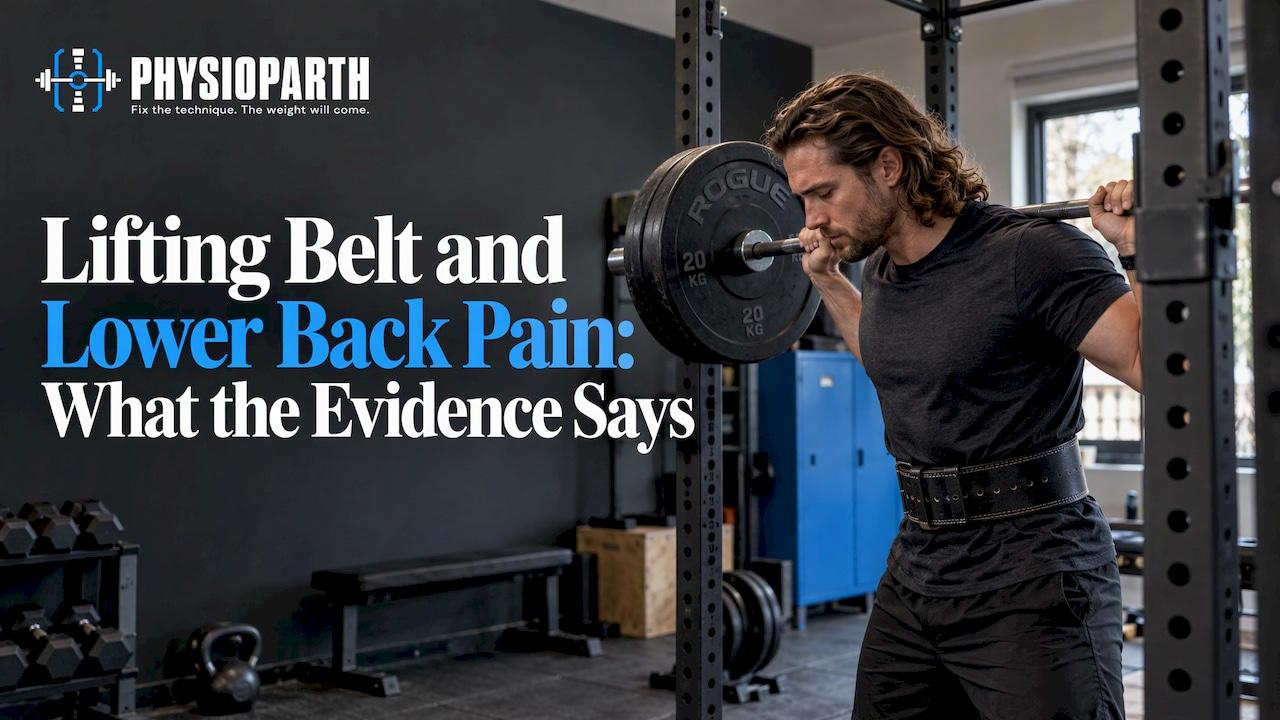
A lifting belt may change how you brace, but the research does not show it treats a sore lower back or makes one lifting-proof. The belt is best treated as a bracing tool for heavy sets. The bigger questions are what is irritated, whether the cause sits in your technique or your load management, and which variations let you keep training while it settles. I'm Parth Suthar, a registered physiotherapist in Ontario and a former competitive powerlifter, and this is how I'd work through it with a lifter.
TL;DR
- Evidence for belts as back protection is mixed. A Canadian Task Force review made no recommendation for or against them, and CCOHS states no evidence supports that they reduce back-injury risk.
- In a small study of experienced lifters, a tight, stiff belt reduced spinal compression by about 10%, and only when the lifter inhaled before the lift.
- Belt position, tightness and your bracing habit matter more than the brand. If the belt itself seems to provoke pain, adjust fit first and note what changes.
- Separate technique causes (set-up, bar path, bracing, grip, stance, depth) from load-management causes (volume, intensity, frequency, recovery) before you decide what to change.
- Progress back to heavier lifting by criteria, not calendar dates, using tempo, paused, pin, Safety Squat Bar, trap bar and block-pull variations.
Table of Contents
- What the research says about belts and a sore back
- What a belt may do under a heavy bar
- How to wear a belt so it is not part of the problem
- Which tissues may be involved, and how lifters tell them apart
- Technique causes versus load-management causes
- A criteria-based return to lifting
- Red flags: when you need in-person or medical assessment
- How I work with lifters who have belt and back questions
- My view on belts
- FAQ
- Sources
What the research says about belts and a sore back
Most belt research comes from workplaces, not powerlifting platforms, so it is worth reading with that in mind.
The Canadian Task Force on Preventive Health Care reviewed back belts for preventing occupational low-back pain. It found conflicting evidence and gave a grade C recommendation, which is neither for nor against. Three of the five randomized trials it reviewed showed no positive result. It noted that people with a previous history of low-back pain may experience some benefit, and that belts should be prescribed only for short-term use, with cardiovascular screening and lifting-mechanics training first.
The Canadian Centre for Occupational Health and Safety (CCOHS) states that no evidence supports belts improving back safety and that Ontario's labour ministry does not recommend them as protective equipment for manual materials handling. It adds that this may not apply to belts used as medical treatment during rehabilitation. A BMJ systematic review of 17,720 trial participants found no evidence that lifting-technique training, with or without equipment such as back belts, prevents back pain in lifting and handling work.

That is the workplace picture. Barbell athletes use belts differently: to brace against at near-maximal loads.
What a belt may do under a heavy bar
In a 2006 study of nine experienced weightlifters, a tight, stiff belt reduced spinal compression by about 10%. That only happened when the lifter inhaled before the lift, and the reduction came from a moment generated by the belt itself rather than from higher intra-abdominal pressure. Nine lifters is a small sample, but it fits what many of us feel: the belt works together with your breath, not instead of it.
The belt also gives your abs something to push against. That cue can help some lifters brace harder, which is a useful thing when a technique fault is leaving your trunk loose. It does not change the demands of the session. If volume, intensity or recovery are the reason your back is irritated, the belt does not remove that cause.
Some safety points for lifters who brace hard against a belt:
- Belted, breath-held lifting raises blood pressure. WorkSafe Victoria reports that diastolic blood pressure and respiration can increase during belted lifting, which raises risk in susceptible people. If you have a heart or blood pressure condition, talk to your physician before you train heavy with a belt.
- The same page notes that when a doctor or physiotherapist prescribes a brace after an injury, it acts as a reminder of strength and movement limits rather than as an injury-prevention device.
How to wear a belt so it is not part of the problem
Poor fit can make a belt feel like the cause of your pain. Check these basics, which follow Iron Bull Strength's sizing guide:
- Measure your waist around the belly button with a snug, level tape and use the size chart. If you are between sizes, go larger.
- Wear the belt on the narrowest part of your waist, just above the hip bone.
- Tighten it so a hand still fits between the belt and your belly. It should not restrict breathing or movement.
- Brace by breathing into your belly and pushing your abs out against the belt.
What to watch for if you wonder whether the belt is the issue:
- Pinching or bruising at the hip crest or ribs may indicate the belt sits too low or too high, or is cinched too hard.
- Pain that only shows up in the belted set, not in the same lift without it, may indicate a fit or bracing issue worth adjusting.
- Pain that shows up in both belted and unbelted work points back to the tissue and the training, not the belt.
If you use a belt, treat it as something you put on for your heaviest working sets, not for warm-ups. Your unbelted bracing should still hold up at lighter loads.
Which tissues may be involved, and how lifters tell them apart
I can't diagnose you through an article, and several structures can produce lower back pain under a bar. These are the ones I'd think about first, with the clues that may help separate them. Treat them as clues to discuss with a clinician, not a verdict.
| Structure | Typical clue | What may provoke it |
|---|---|---|
| Back extensor muscles (erector spinae) | Ache or tightness on one or both sides of the spine, often settles with movement and gets sore after heavy volume | High-volume pulls, long sessions, fatigue |
| Facet joints | Sharp or pinching pain, often to one side, may be worse extending or twisting | Hard lockouts with hyperextension, deep arched positions |
| Intervertebral disc | Pain that may feel worse with repeated or sustained flexion, sitting or the bottom of a deadlift; leg symptoms are possible | Heavy flexion under load, loss of position at the floor |
| Sacroiliac joint area | Pain low and to one side near the dimple over the pelvis, often with single-leg tasks or stairs | Asymmetric stance, wide sumo or split positions |
A pattern I'd look at: what position hurts, which lift triggers it, and whether it eases with movement or lingers. For deadlift-specific clues, my article on lower back pain after deadlifts goes through them in more detail, and morning back stiffness covers what a 30 to 60 minute stiffness window may indicate. If pain travels down the leg, sciatica and deadlifts is the better starting point.
Technique causes versus load-management causes
A belt cannot sort these two out for you, and they need different fixes.
Technique causes
- Set-up: hips too high or too low, bar too far from the midfoot, slack not pulled out before the bar leaves the floor.
- Bar path: the bar drifting forward in a squat or away from the shins in a deadlift, which lengthens the lever on your lower back.
- Bracing: bracing late, losing the brace mid-rep, or relying on the belt to do the work.
- Grip: a grip that limits your ability to stay tight through the lats.
- Stance: a width or toe angle that your hips do not tolerate, so the lower back picks up the slack.
- Depth: going deeper than your hip and pelvis control allow, where the pelvis tucks under at the bottom.
If your back rounds at the floor, when a rounded back deadlift matters explains how I think about it. My free guides for the squat, deadlift and the toolkit cover set-up and bracing cues.
Load-management causes
- Volume: a jump in weekly sets or reps, especially of heavy hinges.
- Intensity: too many near-max singles in a short stretch.
- Frequency: squatting and deadlifting heavy on back-to-back days.
- Recovery: poor sleep, a stressful block of work, or a sudden return after time off.
A useful question: did the pain start after a change in training, or after a rep where position slipped? The first may indicate load management. The second may indicate technique. Often it is both.
A criteria-based return to lifting
This is a framework, not a prescription for your back. Move to the next stage only when you meet the criteria for the one you are in. There are no dates, because tissues and people don't follow a calendar.
Stage 1: Calm it down and keep moving
- Variations: isometrics (for example a mid-range isometric pull into pins, or a pause-heavy hold in a squat at a comfortable depth), light tempo goblet or front squats, and walking.
- Criteria to move on: everyday movement such as bending, sitting and getting out of bed is no longer provoking your usual pain, and your pain is settling between sessions rather than building.
Stage 2: Rebuild position and bracing at manageable loads
- Variations: tempo squats (slow lowering, such as three to five seconds), paused squats, Safety Squat Bar squats, trap bar deadlifts, and pin or block pulls from a height that you can reach without losing position.
- Criteria to move on: you can repeat your working sets with your usual position and bracing, symptoms stay at a level you and your clinician consider acceptable, and they settle by the next day.
Stage 3: Rebuild range and load
- Variations: lower the block or pin height in steps, move from trap bar toward the conventional or sumo pull, move from Safety Squat Bar toward the straight bar, and add paused reps to build control at the bottom.
- Criteria to move on: the new height or bar produces no more pain than the previous stage did, and your bar speed and position look like they did before.
Stage 4: Return to full programming
- Variations: your competition-style squat, bench and deadlift, with belted work reserved for heavy sets if you use a belt. Floor press and other bench variations can be used if the bench is also part of your picture.
- Criteria: you handle your normal weekly volume and intensity, and pain does not rise across the week.
If a stage stirs symptoms up for more than a day, step back one stage and review the variable you changed: load, height, bar, or volume. Isometrics, tempo and paused work are not a stretching-only plan. They keep tissues loaded while you work toward the next stage.
Red flags: when you need in-person or medical assessment
Back pain from lifting is common, but a few presentations are not something to manage through a video call or by training around. Get assessed in person, or go to an emergency department, if you have:
- Numbness around the groin or inner thighs, or new difficulty controlling your bladder or bowels.
- Progressive leg weakness, a foot that drags, or numbness spreading down the leg.
- Pain after a significant fall, collision or a sudden pop with immediate inability to continue.
- Fever, unexplained weight loss, a history of cancer, or pain that is constant and unrelenting at night.
- Chest pain, unusual shortness of breath, dizziness or faintness while lifting with a belt.
Seeing a physician is the first step in those cases, not the last. For other back pain, a physiotherapist can assess you directly: no doctor's referral is needed in Ontario, though some insurers require one for reimbursement.
How I work with lifters who have belt and back questions
My Initial Assessment is $130 and includes a full subjective and objective assessment and a movement screen, plus a lift analysis if you send videos beforehand. It aims to explain what tissue may be irritated and to build a criteria-based return-to-lifting plan, using modified variations where appropriate rather than complete rest. A Follow-Up Session is $100. Many extended-health plans cover physiotherapy, and I provide receipts for reimbursement. You can see the options and book here.

If you'd like a second set of eyes on your belt use first, send your squat and deadlift videos through my lift audit page. The free 15-minute call is a fit check to see whether working together suits you. It is not an assessment or treatment.
My view on belts
I don't see the belt as good or bad. It is a tool that may help you brace at heavy loads, and the evidence says it is not a stand-alone answer to a sore back.
What I look for first is why the back is irritated. Is the bar drifting forward? Is the brace gone by the second rep? Did the volume jump? Those answers decide what to change, and a belt does not answer any of them.
As a former competitive powerlifter, I know the pull to push through. My assessment aims to give you a clear picture of what may be irritated, then a plan with modified variations and criteria so you can keep training where appropriate, rather than stop completely.
Parth
FAQ
Does a lifting belt help lower back pain?
The research does not show that belts treat back pain. The Canadian Task Force found conflicting evidence, and people with a history of low-back pain may experience some benefit. A belt may help you brace at heavy loads, but it does not address technique or load-management causes.
Can my belt be causing back pain?
It may contribute if it is too tight, sits too low or high, or restricts your breathing. If the pain shows up only in belted sets, adjust size and position first, using the fit steps above. If pain appears with or without the belt, the cause may lie elsewhere.
Should I wear a belt for every set?
A belt is generally kept for heavy working sets. Warm-ups and lighter work are a chance to practise bracing without it. The Canadian Task Force said belts should be used only short-term when prescribed.
Can I keep squatting and deadlifting with a sore lower back?
Often you can modify rather than stop completely, using variations such as tempo, paused, pin, Safety Squat Bar and trap bar work, and progressing by criteria. If you have any red flag listed above, get assessed in person first.
Do I need a referral to see a physiotherapist in Ontario?
No. You can book directly. Some insurers require a referral for reimbursement, so check your plan.
Sources
- Use of back belts to prevent occupational low-back pain (Canadian Task Force review)
- CCOHS: Back Belts
- BMJ systematic review on lifting techniques and equipment
- Effect of a stiff lifting belt on spine compression (PubMed)
- WorkSafe Victoria: Back belts are not effective in reducing back injuries
- How to size and wear a weightlifting belt
Recommended
- Deadlift Back Pain: Ontario Lifters’ Tissue Clues and Return Criteria
- Piriformis Pain From Deadlifts: Clues and a Return Plan
- Rounded Back Deadlift: When It Matters and How to Progress
- Sciatica and Deadlifts: How to Train Around Leg Pain
This article is general education for strength athletes and is not a substitute for an individual assessment. Pain that is severe, worsening, or accompanied by numbness, weakness or loss of function needs prompt in-person or medical assessment. Author: Parth Suthar, Registered Physiotherapist (Ontario).