
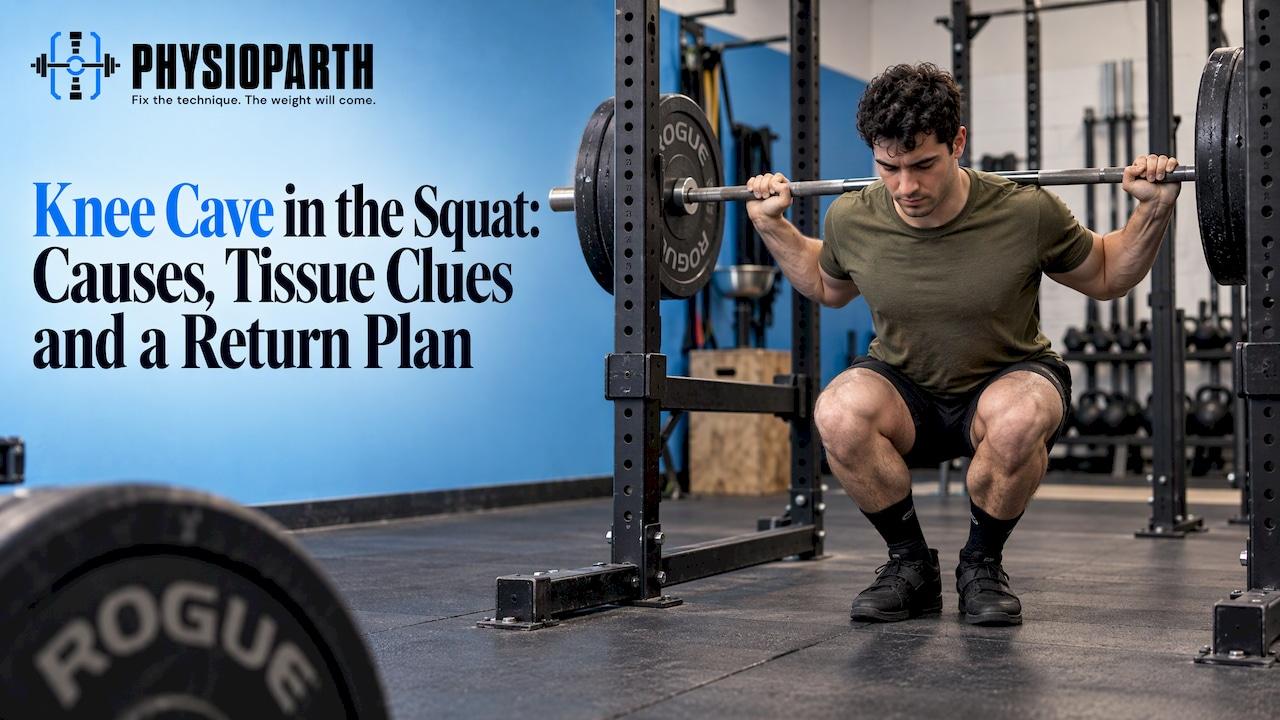
Knee cave is the knee travelling inward past the line of the foot as you squat. It is not automatically an injury and not automatically harmless. What matters is whether it is repeatable and controlled, whether it changes your bar path, depth or foot pressure, and whether you have pain with it. I'm Parth Suthar, a registered physiotherapist in Ontario and a former competitive powerlifter, and this is how I think about it with barbell athletes.
TL;DR
- A small, controlled inward drift may be normal for your build. Inward movement that grows with load or fatigue, shifts your hips back, or comes with pain deserves a closer look.
- Film 3 to 5 comparable reps from a front-quarter angle. One frame tells you very little.
- Possible contributors include hip strength, ankle and foot mobility, trunk control, stance and toe angle, and load management. Research on this is strongest for single-leg tasks, not barbell squats.
- Change one variable at a time, and progress by criteria (control, symptoms, repeatability), never by calendar dates.
- Swelling, locking, giving way or a sudden new change in knee movement needs in-person assessment.
Table of Contents
- What counts as knee cave, and what doesn't
- How to film it properly
- Structures that may be involved, and how to tell them apart
- Technique causes
- Body and capacity contributors
- Load-management causes
- What may help improve knee control
- A criteria-based return-to-squatting progression
- Red flags: when to get in-person or medical assessment
- Where I come in
- Get your squat looked at
- FAQ
- Sources
What counts as knee cave, and what doesn't
In the research literature, dynamic knee valgus is an observable inward movement of the knee relative to the foot. The pattern shows as medial knee displacement beyond the foot-thigh line, and it can involve a mix of hip adduction and internal rotation, knee abduction, shin rotation and ankle eversion. In one 2014 study, researchers classified a single-leg squat as valgus when the frontal-plane projection angle moved more than 10 degrees toward the body midline. That is a research threshold for single-leg tasks, not a pass/fail line for your back squat.
Not all horizontal knee motion is knee cave. Coach Greg Everett suggests keeping the thigh and foot approximately in line, with toe angle depending on your body structure. A knee that tracks over the middle of the foot, with the whole foot staying planted, is a different picture from a knee that dives inward while the arch collapses and your hips shoot back.
A useful filter is to ask four questions about your reps:
- Is it the same on every rep, or does it appear only on grinders and late sets?
- Do you lose pressure through the whole foot (big toe, little toe, heel)?
- Do your hips shift back and your chest fold forward as the knees move in?
- Does it change your depth or bar path?
If the answers are no, no, no and no, you may simply be looking at your normal squat pattern. If the answer to any is yes, keep reading.
How to film it properly
A single screenshot can make almost anyone look like they have knee cave. Instead:
- Film from the front-quarter angle (about 45 degrees in front of you) so you can see the knee, foot and pelvis together.
- Capture several reps at the same weight, plus one set near your working top weight and one late in a fatigued set.
- Watch for foot contact, the knee-to-foot relationship, pelvis and bar path, and whether the pattern worsens with load or fatigue.
- Keep the same camera position each session so you are comparing like with like.
I cannot tell you what your video means in an article, and I won't diagnose you from text. What I can do is give you a structure for reading your own footage and for deciding whether you need someone to look at it with you.
Structures that may be involved, and how to tell them apart
Knee cave is a movement pattern, not a tissue. When it hurts, different structures may be irritated, and the location and behaviour of the pain gives clues. These are clues, not a diagnosis.
| Structure | Where the pain tends to sit | Behaviour clues that may indicate it |
|---|---|---|
| Patellofemoral joint (kneecap and groove) | Around or behind the kneecap | Aching with deep squats, stairs, long sitting; often worse at the bottom |
| Patellar tendon | Just below the kneecap, a small spot | Sharp or sore with loaded knee flexion, jumping, or the first reps of a session; may warm up then return afterward |
| Quadriceps tendon | Just above the kneecap | Similar load-related pattern, higher on the knee |
| Medial joint line or meniscus | Inner knee, deep in the joint | Catching, locking or pain with twisting under load |
| Medial collateral ligament region | Inner side of the knee | Tenderness along the inner side, discomfort when the knee is pushed inward |
| Pes anserine area | Inner side, a few centimetres below the joint line | Tender to press; irritated by high-volume squatting and stairs |
| Iliotibial band / lateral knee | Outer knee | Aching on the outside, often with volume spikes |
The most useful way to tell them apart is a combination of three things: the exact spot you can press with one finger, what positions or loads reproduce it, and how it behaves over the day. Patellofemoral pain tends to be diffuse and position-driven, tendon pain tends to be a pinpoint spot tied to load, and joint-line pain tends to come with mechanical symptoms like catching. If you want a deeper walkthrough of tissue clues, my article on knee pain when squatting goes through them, and the one on patellar tendonitis and squats covers the tendon in detail.
Pain around the hip or groin with the same pattern is a separate conversation, covered in hip pain squatting.
Technique causes
Separate these from load causes, because the fix is different. Technique causes are about how you set up and move on a given rep.
Stance and toe angle. Squat mechanics depend on modifiable factors such as trunk position, tibia position, foot rotation, stance width and depth, and changing one changes the muscular demands and joint loading. The same review reports that a wide stance produced a 23% greater knee-valgus moment than narrow or medium stances in the cited comparisons. A separate 2018 study found that stance width and foot angle alter knee, hip and trunk loading and recommended avoiding exaggerated foot angles. If you squat very wide with a flared toe, a modest narrowing or a smaller toe angle is a reasonable first experiment.
Foot pressure and set-up. Knees often drift when pressure leaves the outer foot or the big toe. Check whether your arches collapse as you descend and whether your heels stay down.
Bracing. If you lose trunk tension in the hole, the pelvis and knees can move to find stability. My pieces on squat bracing and the Valsalva manoeuvre cover how to build that tension.
Bar path and depth. Drift near the sticking point may push the hips back and tip the trunk forward. Everett notes this can increase hip and spinal moments and contribute to a missed lift. His concern is position and performance rather than automatic injury risk, and I think that is the right framing. Also check whether your depth is simply beyond your current ankle or hip range, which brings in butt wink too (see butt wink in the squat).
Grip and upper back. If the bar feels unstable on your back, you may brace the whole system differently. A tighter upper back sometimes changes how the whole squat feels.
Body and capacity contributors
The 2020 review lists possible contributors to knee valgus: lower hip-abductor, hip-extensor and external-rotator strength, greater midfoot mobility, reduced ankle dorsiflexion and trunk-control deficits. Two honest caveats apply. First, the evidence is task-specific and strongest for single-leg tasks, and the authors caution against automatically transferring it to double-leg barbell squats. Second, in a 2016 study of 30 asymptomatic adults, lower ankle dorsiflexion and greater midfoot mobility were associated with larger frontal-plane knee movement in single-leg squats. That is an association, not proof that one thing causes knee cave in every lifter.

So I don't hand out one standard correction. A limited ankle, a weak glute, and a lifter who just crammed in two extra squat days can all produce a similar-looking video.
Load-management causes
If your knee cave is new, or the pain is new, look at the training log before the technique.
- Volume: a jump in weekly squat sets, or a block of high-rep work.
- Intensity: more singles above roughly 90% than your body has been used to.
- Frequency: squatting heavy on back-to-back days, or adding a second heavy leg day.
- Recovery: poor sleep, a heavy work week, low food intake or travel.
- Variation changes: new bar, new shoes, new stance, or a return from a layoff straight to old numbers.
When technique becomes non-repeatable, reduce the load and rebuild from a weight you can control consistently. If the pattern only shows up when volume spikes, the answer may be programming rather than a new cue.
What may help improve knee control
Options the research lists include gluteal strengthening, trunk lateral-flexion strengthening, ankle-dorsiflexion and midfoot-mobility work, and biofeedback for single-leg tasks. A narrative review found that elastic bands do not consistently reduce dynamic knee valgus in squat-based movements, so a mini-band around the knees is not a universal correction. For athletes with kneecap-related pain, a 2017 review recommends an individually tailored, multimodal programme, with hip, trunk and lower-extremity exercise having the strongest support. Stretching alone is not the plan.
Practical building blocks I commonly use with lifters:
- Heavy-ish hip work: split squats, step-ups, hip thrusts, lateral band or cable work for the glute medius.
- Ankle work: loaded knee-to-wall drives, heel-elevated squats as a training tool.
- Foot control: tripod-foot cues, slow single-leg balance with load.
- Trunk: side planks, suitcase carries.
Test one change at a time (load, stance width, toe angle, depth, tempo or a cue) and keep it only if it improves repeatability, foot stability, symptoms or performance.
A criteria-based return-to-squatting progression
Progress by criteria, not calendar dates. Move to the next stage only when you meet every criterion in the current one, on two consecutive sessions.
Stage 1: Calm it down and keep training around it. Use isometrics (for example, a wall-sit or a mid-range squat hold on pins or in a rack) and a lighter tempo squat.
- Criteria to move on: pain is at a level you consider low and does not rise after the session or the next morning, no swelling, and you can hold positions with the knee tracking over the foot.
- Meanwhile, bench with a floor press if your shoulders or the setup are irritated, and keep a hinge pattern going with block pulls or a trap bar deadlift from a height that feels comfortable.
Stage 2: Rebuild control with slow, repeatable reps. Tempo squats (3 seconds down) and paused squats at the bottom, using a load you can repeat.
- Criteria: 3 sets of 5 with the same knee path on video, even foot pressure, no hips shooting back, symptoms steady or lower.
Stage 3: Change the demand, not the stimulus. Use a Safety Squat Bar to change trunk and upper-back demands, or box and pin squats to control depth.
- Criteria: you reach target depth with repeatable reps, the last rep looks like the first, and pain does not increase over the following 24 hours.
Stage 4: Return to the competition-style squat. Reintroduce your normal bar and stance at submaximal loads, then add weight in small steps.
- Criteria: video shows the same pattern at moderate and heavy loads, symptoms remain stable, and you can handle your usual weekly volume at moderate load before pushing intensity.
If a step backfires, drop back one stage and check load-management causes first. Trap bar work, block pulls and floor press are there so the rest of your training does not stop while the squat rebuilds.
Red flags: when to get in-person or medical assessment
Stop and get assessed in person by a physiotherapist, sports medicine physician or other qualified clinician if you have:
- Persistent pain, swelling, locking, giving way or instability in the knee.
- A sudden new change in how your knee moves, especially after a pop, a fall or a twist.
- Inability to fully straighten or bend the knee, or to bear weight.
- Night pain or pain at rest that is getting worse.
- Redness, heat, fever, or calf pain and swelling.
- Numbness, tingling or weakness in the leg.
Persistent or concerning symptoms warrant assessment rather than simply forcing the knees outward. In Ontario you can see a physiotherapist without a doctor's referral, although some insurers require one for reimbursement. For sudden severe injury, inability to walk, or signs of infection or a clot, go to urgent care or an emergency department.
Where I come in
My view as a physiotherapist who also competed in powerlifting is that knee cave is a question to answer, not a fault to hunt down. Most lifters I talk with have been told to push their knees out and add mini-bands. Sometimes that helps. Often the more useful question is what your knee is doing under load, which structures are irritated, and what your recent training did to them.
The Initial Assessment I offer aims to answer that with a full subjective and objective assessment, a movement screen, and a lift analysis if you send videos beforehand. It aims to explain what tissue may be irritated in lifter terms and to build a criteria-based plan that uses modified variations where appropriate rather than complete rest.
Technique and load both matter. I would rather you leave with a way to test one change at a time than a list of 15 exercises.
Parth
Get your squat looked at
The Initial Assessment is $130 and a Follow-Up Session is $100, both delivered by video, and I provide receipts for insurance reimbursement. Many extended-health plans cover physiotherapy, so check your own plan. You can see the options on the PhysioParth site.

If you want to start with something free, my Lifter's Hip & Lower Back Toolkit and the lift audit page are there for you. The free 15-minute call is a fit check, not an assessment or treatment. If you are unsure whether virtual care suits your situation, book with me for a free 15-minute consult at physioparth.com.
FAQ
Is knee cave in the squat always bad?
No. A brief, controlled inward movement is not, by itself, an injury diagnosis. What matters more is whether it is repeatable and uncontrolled, with loss of foot pressure, balance, bar path, posture or depth. If it comes with pain, get it assessed.
Should I just push my knees out harder?
Not as a default. Over-cueing can change your hips and trunk position, and the best cue depends on why the knees move in. Try one change at a time (stance width, toe angle, depth, tempo or load) and keep what improves repeatability.
Do mini-bands fix knee cave?
Not consistently. A narrative review found elastic bands do not reliably reduce dynamic knee valgus in squat-based movements. They can be a useful activation or cueing tool, but they are not a universal correction.
Can I keep squatting while my knee is sore?
Often a modified version is possible, such as tempo, paused, pin or Safety Squat Bar squats at lower loads. Use the stage criteria above and watch symptoms over the next 24 hours. Swelling, locking or giving way means you need in-person assessment first.
Sources
- Dynamic Knee Valgus in Single-Leg Movement Tasks (PMC)
- Classification of Lower Extremity Movement Patterns (PMC, 2014)
- Knee Valgus in the Squat, Greg Everett
- A Biomechanical Review of the Squat Exercise (PMC)
- How to squat? Effects of various stance widths, foot placement angles (PMC, 2018)
- The relationship of foot and ankle mobility to the frontal plane projection angle (2016)
- The Use of Elastic Resistance Bands to Reduce Dynamic Knee Valgus (PMC)
- Patellofemoral pain in athletes (PMC, 2017)
- Squat Knee Cave Fix: Diagnose Valgus
- 12 Squat Mistakes: Form Fixes
- Your knees move inwards during squats
Recommended
- Knee Pain When Squatting: Causes, Tissue Clues and a Return Plan
- Patellar Tendonitis and Squats: A Lifter's Return Plan
- Hip Pain Squatting: Causes, Fixes and Return Criteria
This article is general education for strength athletes and is not a substitute for an individual assessment. Pain that is severe, worsening, or accompanied by numbness, weakness or loss of function needs prompt in-person or medical assessment. Author: Parth Suthar, Registered Physiotherapist (Ontario).