
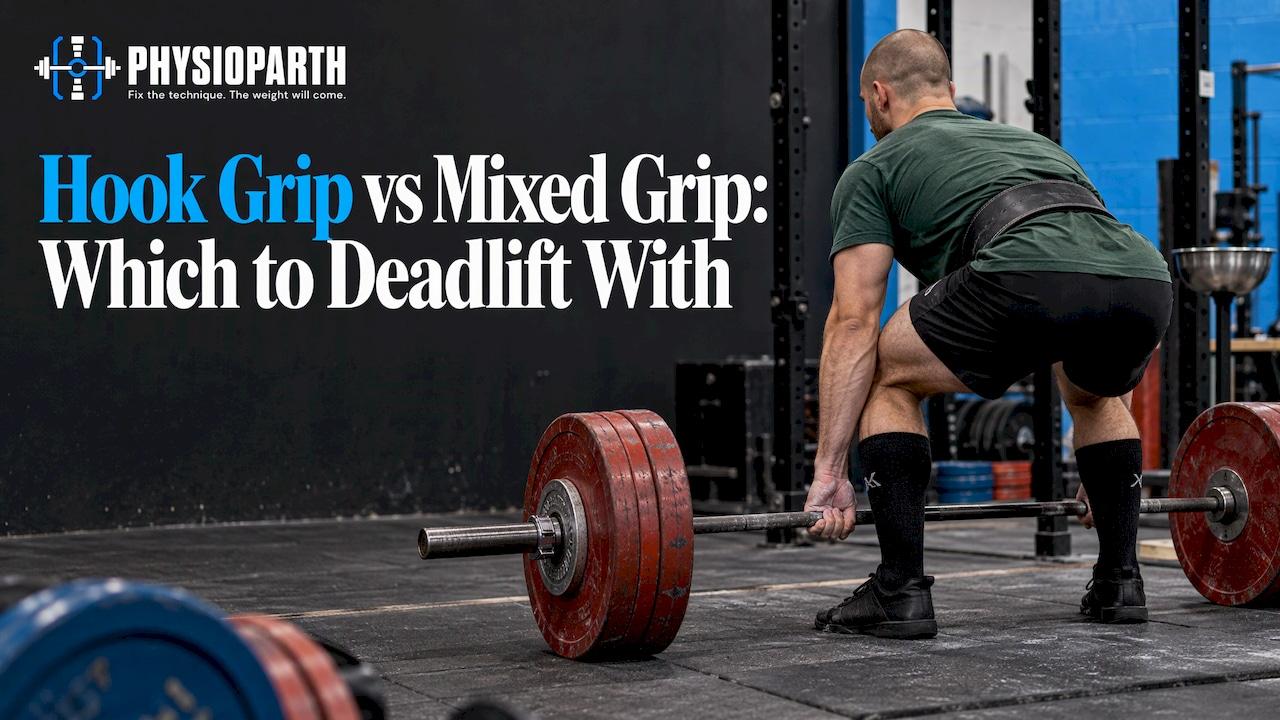
If you can hold your working weights with a hook grip, it is the stronger default for most deadlifters, because both forearms stay pronated (palms facing you) and neither biceps tendon ends up in the exposed position. Mixed grip (one palm facing you, one facing away) is still the most common way to hold a heavy bar, and plenty of lifters pull for years with it. The real decision is about your hands, your elbows and your meet rules, so this article compares both on those terms, adds straps, and gives a return-to-lifting progression if either grip has left you sore.
I'm Parth Suthar, a registered physiotherapist in Ontario and a former competitive powerlifter. I wrote this for lifters who pull heavy and want to keep doing it.
TL;DR
- Mixed grip holds heavy bars well, but the supinated (palm-up) arm carries the exposure for the distal biceps tendon at the elbow.
- Hook grip keeps both forearms pronated and, in published video analyses, none of the mixed-grip ruptures occurred in a pronated arm. The cost is thumb discomfort and a learning period.
- Straps are a separate tool: research shows they raise deadlift numbers and reduce grip fatigue, which is useful in training volume work.
- If a grip change leaves you with thumb, forearm or elbow pain, return by criteria (symptoms, tolerance, load), not by calendar.
- Sudden pop, bruising or loss of strength at the front of the elbow needs in-person assessment the same day.
Table of Contents
- How the two grips actually differ
- What the biceps research says
- Hook grip: what it gives you and what it costs
- Mixed grip: why lifters stay with it
- Hook grip vs straps
- Side by side
- Technique causes and load-management causes
- What structures may be involved, and how to tell them apart
- A criteria-based return-to-lifting progression
- Red flags: get assessed in person
- Working through a grip problem with me
- My view on grip
- FAQ
- Sources
How the two grips actually differ
Mixed (alternate) grip: one hand over, one under. The opposing rotation stops the bar rolling out of your fingers. It needs no learning and works on almost any bar. The downside is that your underhand arm is supinated with the elbow straight while you pull, and you can end up with a slight asymmetry in how your shoulders and upper back set.
Hook grip: both hands overhand, with your thumb tucked under the bar and your fingers wrapping over the thumb. The bar is held by compressing the thumb between the bar and fingers. Both arms stay in the same position, which makes it easier to set a symmetrical upper back before the pull.
Neither is cheating. Both are legal in most strength sport rules, and neither is automatically stronger for every hand. What differs is what gets loaded: mixed grip leans on opposing rotation, hook grip leans on your thumb.

What the biceps research says
This is the strongest argument in the comparison, so I'll keep it specific.
A video analysis of 35 distal biceps tendon ruptures found 25 happened during deadlifts. In the 24 mixed-grip deadlift injuries, every elbow was extended and every rupture was in the supinated arm. The authors suggested that holding the bar with both forearms pronated, as in hook or double overhand grip, may reduce the risk.
A later video-analysis study in Bone & Joint Open looked at 57 ruptures. In 98% the forearm was supinated, 89% occurred at 0 to 10° of elbow flexion, and 88% happened during isometric contraction. Deadlifting was the most common activity, with 38 of the 57 ruptures. That challenges the older idea that these injuries come from a bent elbow lowering a weight.
Two cautions on reading this. These are observational case series, so they show where ruptures happen, not how often they happen per lifter. And a rupture is rare. Most lifters who feel elbow pain on pulls are dealing with something much more minor, covered below.

Hook grip: what it gives you and what it costs
What it may give you
- Both arms pronated, so a more symmetrical set-up and no supinated elbow under load.
- A grip that does not depend on the bar's knurling or on chalk quality as much as a mixed grip often does.
- It is the same grip many Olympic weightlifters use for pulls, so it carries over if you cross-train.
What it costs
- Thumb pain. The thumb is squeezed under high load, and the first weeks are uncomfortable for most people.
- Thicker bars, such as many commercial gym bars, are harder to wrap, and smaller hands feel it more.
- It takes practice at lighter weights before it holds your top sets.
How to adopt it without making it a new injury
- Learn it on warm-up sets and light speed pulls, not on a max attempt.
- Keep a few sets of your usual grip or straps for the heaviest work while the thumb adapts.
- Use thumb tape if skin or the thumb nail bed is irritated.
- Increase the share of sets you hook as the thumb tolerates it, not by a calendar.
Mixed grip: why lifters stay with it
Mixed grip is simple and strong. If the bar stays in your hands and your elbows feel fine, there is no need to change on principle. Its trade-offs are the exposure of the supinated arm, which the research above describes, and a tendency to always put the same hand under the bar. If you stay with it, a few habits are worth building:
- Keep the elbow of the supinated arm locked out and the arm straight before the bar leaves the floor, with no "pre-pull" with the arm.
- Switch which hand is under during warm-ups so the load is not always on one side.
- Use hook or straps for volume sets where grip, not the back or legs, is the limit.
Do not try to hang on through sharp front-of-elbow pain with a mixed grip. That is a reason to stop the set.
Hook grip vs straps
Straps solve a different problem: grip endurance and grip strength on heavy or high-volume pulls. The research is consistent that they change the numbers.
- In a 2020 JSCR study of 20 men, 1RM was 177.0 ± 28.9 kg with straps against 160.6 ± 26.0 kg without. The load-velocity profile also changed, so velocity targets from one condition should not be carried over to the other.
- A 2021 study of 16 males found straps set from the without-straps 1RM produced higher velocity, lower grip fatigue, greater perceived grip security and lower perceived exertion at 80% 1RM.
- In 11 trained lifters doing sets to failure at 90% 1RM, straps produced 20 to 28% greater force and increased the work done by the target muscles.
- A 2022 observational study of 20 male recreational lifters found a belt plus wrist straps reduced knee flexion at set-up and made deadlifts faster, while straps alone exaggerated thoracic kyphosis at lockout. That makes it worth filming your lockout if you add straps.
Straps are not allowed in most strength sport competitions, so a lifter preparing for a meet still needs a grip that works without them. For general training, hook grip builds the grip you can use on the platform, and straps let you load the back and legs when grip would end the set first.
Side by side
| Question | Hook grip | Mixed grip | Straps |
|---|---|---|---|
| Forearm position | Both pronated | One supinated | Both pronated |
| Learning curve | Moderate, thumb needs time | None | Low |
| Main discomfort | Thumb | Biceps and elbow exposure on the supinated side | Wrist and lockout posture worth checking |
| Allowed in competition | Generally yes | Generally yes | Generally no |
| Best use | Primary heavy grip for many lifters | When the bar holds and elbows feel fine | Volume and back or leg work |
Check your federation's current rulebook before meet day.
Technique causes and load-management causes
When the thumb, forearm or elbow hurts after a grip change, it helps to separate the two buckets before changing anything else.
Technique causes
- Set-up: arms not vertical, or the elbow pre-bent so the pull starts with the arms.
- Bar path: a bar drifting forward off the floor makes the hands work harder to hold it.
- Bracing: if the lats and trunk are not set, the bar pulls the hands out as the back rounds.
- Grip: the bar sits in the fingers instead of the palm, or the thumb is jammed under at a poor angle.
- Stance and depth: a start position that is too low or too high changes how far you have to hold the bar through.
Load-management causes
- Volume: many hooked sets in a week when the thumb has not adapted.
- Intensity: going straight to heavy hooked singles.
- Frequency: pulling heavy on consecutive days with no thumb or forearm recovery.
- Recovery: poor sleep and a recent jump in training load.
Filming your pull from the side and front tells you which bucket you are in. My guide on how to film, review and act on your deadlift walks through it, and the free deadlift guide is a quick reference.
What structures may be involved, and how to tell them apart
This is a guide to where the pain sits, not a diagnosis. Pain that is easy to tell apart by location and provocation may indicate different tissues:
- Distal biceps tendon: pain at the front of the elbow crease, often when the forearm turns palm-up or you pull with a straight arm. Pain on resisted elbow bending may indicate this area. A sudden pop is a red flag (below).
- Flexor-pronator tendons at the inner elbow: tenderness on the bony bump on the inside of the elbow, worse with gripping and wrist flexion. See golfer's elbow from lifting.
- Ulnar nerve at the inner elbow: tingling in the ring and little fingers, worse with a bent elbow for a long time. See cubital tunnel exercises for lifters.
- Forearm muscles: a broader ache along the forearm that builds with grip volume. See forearm pain when lifting.
- Thumb joints and skin (hook grip): soreness at the base or tip of the thumb that appears only when hooking and settles with a different grip.
If your pain does not fit one of these patterns cleanly, that is normal. A video assessment with a physiotherapist is designed to sort it out.
A criteria-based return-to-lifting progression
Move to the next stage when you meet the criteria, not when a week passes. Pain during a stage should stay mild, settle within about a day, and not be trending worse across sessions.
Stage 1: calm it down
- Isometrics: gentle holds with the bar at mid-shin height in a rack, or a suitcase hold, with the grip you want to use.
- Criteria to progress: you can do the holds with minimal symptoms, and daily grip tasks are comfortable.
Stage 2: rebuild the pull with less load on the hand
- Block pulls or rack pulls from just below the knee, with hook or double overhand grip, and straps if grip is the only limiter.
- Trap bar deadlift, where the neutral handles reduce the demand on the forearm rotation.
- Criteria to progress: the same load across two sessions with no symptom build-up and good bar position.
Stage 3: return range and tempo
- Tempo deadlifts (slow lowering) and paused deadlifts just off the floor to practise set-up and bracing.
- Pin or deficit work only if the lower positions are tolerated.
- Criteria to progress: pain at or below your agreed ceiling during and the next morning, with consistent technique on video.
Stage 4: full barbell
- Conventional or sumo deadlifts from the floor with your chosen grip, building from submaximal weights.
- Keep one non-pulling day between heavier sessions while the thumb or elbow adapts.
- Criteria to finish: your top working sets feel the same as before the flare-up, and the week after is quiet.
Where the elbow is the issue on other lifts, a Safety Squat Bar can reduce wrist and elbow demand in squats, and a floor press can reduce range for the bench. See my posts on elbow pain on the bench press and elbow pain when squatting.
Red flags: get assessed in person
Stop lifting and get in-person or medical assessment promptly if you have:
- A sudden pop or tearing sensation at the front of the elbow, with bruising, a visible change in the shape of the biceps, or new weakness bending or turning the forearm.
- Numbness or pins and needles that persist, spread, or come with hand weakness.
- Swelling, heat and redness around a joint, especially with fever.
- Severe pain after a fall or impact, or a deformed joint.
- Pain at night or at rest that is steadily increasing.
In an emergency, call 911 or go to the nearest emergency department. For a suspected tendon rupture, same-day assessment matters.
Working through a grip problem with me
If a grip change has left you sore, or you want a lift analysis of your pull, the Initial Assessment is $130 and a Follow-Up Session is $100. It includes a full subjective and objective assessment and a movement screen, plus a lift analysis if you send videos beforehand. It aims to explain what tissue may be irritated and to build a criteria-based return-to-lifting plan, using modified variations where appropriate rather than complete rest. No doctor's referral is needed to see a physiotherapist in Ontario, though some insurers require one for reimbursement, and I provide receipts. The free 15-minute consult is a fit check, not an assessment or treatment. You can see everything on the PhysioParth site.

My view on grip
I pulled competitively for years, and I have seen how quickly lifters decide that one grip is "right" and the other is "weak". I think that is the wrong question.
What I care about is that your grip lets you set your upper back evenly and does not leave one elbow in a position you cannot control. The biceps research is the reason I lean toward hook grip as the first thing to learn. The thumb discomfort is real, which is why I would build it up in stages and use criteria, not a date on the calendar.
When something starts to hurt, I would rather look at your set-up, bar path and weekly pulling load than at the grip alone. My assessments aim to explain what may be irritated in lifter terms and to build a plan with modified variations where appropriate. My free guides at /toolkit and /resources are a good place to start.
Parth
FAQ
Is hook grip stronger than mixed grip?
It depends on your hands. Some lifters find their hooked grip holds as much as their mixed grip once the thumb has adapted, and others need longer. What the published research does show is where distal biceps ruptures occurred: in mixed-grip pulls, all in the supinated arm.
Can I use hook grip on a thick commercial gym bar?
Yes, but it is harder to wrap your fingers over your thumb on a thicker bar. Build up in warm-up and lighter working sets first, and use thumb tape if the skin gets sore.
Hook grip or straps for deadlifts?
They do different jobs. Hook grip is the grip you can carry onto the platform. Straps raise the load you can hold and reduce grip fatigue in training, so they suit volume sets where grip would end the set first.
Should I switch hands on a mixed-grip deadlift?
Alternating which hand is under the bar during warm-ups can spread the load. Keep the elbow of the supinated arm straight before the bar leaves the floor.
Do I need a referral to see a physiotherapist about elbow or thumb pain from lifting?
No referral is needed to see a physiotherapist in Ontario, though some insurers require one for reimbursement. If you want to talk it through first, you can book with me for the free 15-minute consult at physioparth.com.
Sources
- The Role of Deadlifts in Distal Biceps Brachii Tendon Ruptures (PMC, 2021)
- Challenging the mechanism of distal biceps tendon rupture (Bone & Joint Open, 2022)
- Ergogenic effects of lifting straps on movement velocity (PubMed, 2021)
- The Use of Lifting Straps Alters the Entire Load-Velocity Profile (JSCR, 2020)
- Kinematics and kinetics of multiple sets using lifting straps (JSCR, 2015)
- The influence of weightlifting belts and wrist straps on deadlift kinematics (PMC, 2022)
Recommended
- Deadlift Form Analysis: How to Film, Review and Act on Your Pull
- Rounded Back Deadlift: When It Matters and How to Progress
- Cubital Tunnel Exercises for Lifters: Glides, Grip and Return Plan
- Forearm Pain When Lifting: Ontario Lifters Modify, Not Quit
This article is general education for strength athletes and is not a substitute for an individual assessment. Pain that is severe, worsening, or accompanied by numbness, weakness or loss of function needs prompt in-person or medical assessment. Author: Parth Suthar, Registered Physiotherapist (Ontario).