
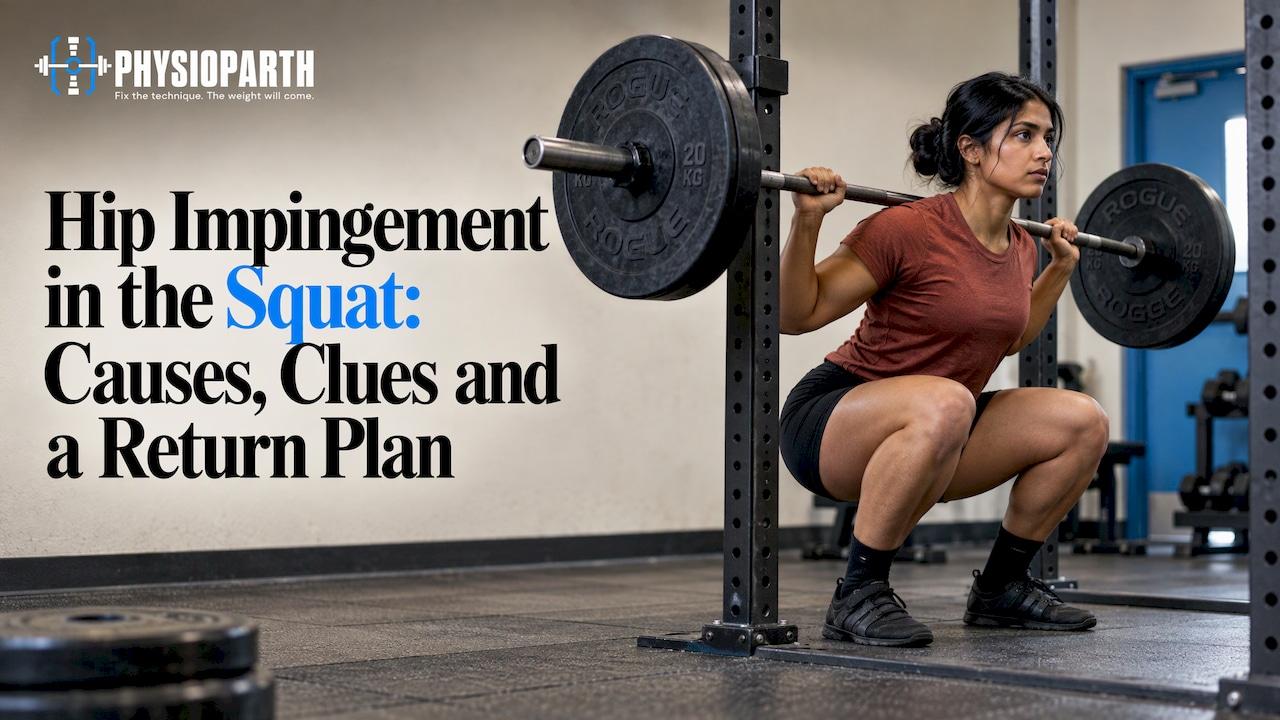
A pinch at the front of the hip at the bottom of a squat is common, and it does not automatically indicate femoroacetabular impingement (FAI). The pinch may come from the joint itself, from a tendon crossing the front of the hip, from the groin muscles, or from how you set up and load the lift. I'm Parth Suthar, a registered physiotherapist in Ontario and a former competitive powerlifter. Below I explain what may be pinching, how to tell the candidates apart, which squat variations to use while it settles, and the criteria that decide when to move forward. This is education for lifters, not a diagnosis.
TL;DR
- A squat pinch may indicate a joint-level problem (femoroacetabular impingement syndrome, or FAIS), but a painful squat alone does not establish it.
- Separate technique causes (stance, depth, pelvis position, bracing, bar position) from load-management causes (volume, intensity, frequency, recovery). Both can produce the same pinch.
- Temporarily change the position or load that provokes it, then progress with tempo, paused, pin and Safety Squat Bar work by criteria, not by calendar dates.
- Severe, rapidly worsening pain, inability to bear weight, or fever need prompt medical assessment, not a training tweak.
Table of Contents
- What a hip pinch in the squat usually feels like
- Why "hip impingement" is not the automatic answer
- Which structures may be involved, and how to tell them apart
- Technique causes: where the setup runs out of room
- Load-management causes: when the hip is not the problem, the dose is
- A criteria-based return to squatting
- What the evidence says about rehab
- Red flags: when you need in-person or medical assessment
- Perspective
- How I can help
- FAQ
- Sources
What a hip pinch in the squat usually feels like
Lifters describe a sharp or pinching sensation at the front of the hip or in the crease of the groin, usually in the bottom third of the squat. Some also feel clicking, catching, stiffness or a block to going deeper. The Warwick Agreement, an international consensus statement, describes femoroacetabular impingement syndrome as motion- or position-related hip or groin pain, sometimes with clicking, catching, locking, stiffness or restricted range of motion.
Deep flexion is the usual trigger. A professional review in the NSCA Strength and Conditioning Journal notes that symptoms are often aggravated by end-range flexion, such as deep squatting, and sometimes by adduction and internal rotation. A Canadian article in the BC Medical Journal adds that front-of-hip symptoms often worsen with loading, flexion and rotation, and that prolonged sitting can provoke them too.
Why "hip impingement" is not the automatic answer
Impingement describes bone, or bone and soft tissue, contacting at the end of a hip range. Some of that is normal anatomy: every hip runs out of room somewhere. The question is whether yours runs out of room in a range you are demanding, and whether that is what is producing your pain.
The Warwick Agreement defines FAIS as a triad: compatible symptoms, clinical signs and imaging findings. It also states that no single clinical test is sufficient. The common FADIR test (flexion, adduction, internal rotation) usually reproduces symptoms but is sensitive rather than specific, so a positive result alone cannot establish FAIS. The Canadian Chiropractic Guideline says the same in practical terms: neither a painful squat, a positive FADIR nor bone shape on imaging alone establishes the diagnosis.
So if an online video told you that your pinch proves you have deep hip sockets or a cam bump, treat that as a guess. A physiotherapist can assess you, and a physician can order imaging when it would change the plan.
Which structures may be involved, and how to tell them apart
These are the usual candidates for a front-of-hip pinch. The clues below are patterns I look for clinically. They may indicate where to look, but they do not diagnose you.
| Structure | Where you feel it | Clues that may point to it |
|---|---|---|
| Femoral head-neck junction and acetabular rim (the ball-and-socket edges, as in FAIS) | Deep front or side of the hip, often a "C" shape around the hip with your hand | A sharp pinch at a consistent depth, worse with the knee pulled toward the opposite shoulder, sometimes clicking or catching |
| Labrum (the cartilage rim of the socket) | Deep groin, sometimes with a catch | Catching or locking, pain with pivoting, pain after long sitting |
| Iliopsoas or hip flexor tendon | Front of the hip, a bit higher and more central | Pain when you resist lifting the knee, soreness after high-volume or heavy squat days, a pull rather than a pinch |
| Adductors and groin | Inner thigh and groin | Pain squeezing the knees together, wide-stance or sumo pulls irritate it, tender along the inner thigh |
| Lateral hip tendons (gluteal tendons) | Outer hip, over the bony point | Pain lying on that side, pain on single-leg stance, not a front pinch |
| Low back or sacroiliac referral | Back, buttock, sometimes the groin | Back movement or bracing changes the pain, a pinch that does not change with hip depth |
A few simple observations help sort these:
- Does the pinch appear at the same depth every rep? A consistent pinch at one hip angle may indicate a joint-level contact point. A pain that builds across sets may indicate a tendon or muscle responding to load.
- Does changing stance width or toe angle change it? If it eases when you widen your stance and turn the toes out a little, that may indicate your hip needs a different alignment for your anatomy.
- Does it hurt resisting a movement, or only at end range? Pain on resisted hip flexion or adduction leans toward muscle or tendon. Pain only at end-range flexion leans toward the joint.
- Is it worse after sitting? The BC Medical Journal article lists prolonged sitting as a provoker for nonarthritic hip pain, so a pinch that appears when you stand after a long desk day is worth mentioning in an assessment.
If your pain sits closer to the groin, my article on groin pain when squatting goes through the adductor and joint clues in more depth. For a pull higher at the front, see hip flexor strain for strength athletes.
Technique causes: where the setup runs out of room
Technique causes change how much hip flexion, rotation and pelvic position you need at the bottom. Check these first because they are the quickest to adjust:
- Stance and toe angle. A stance that is too narrow for your hip anatomy can force the thigh into a position the socket does not tolerate. Many lifters find a slightly wider stance with more toe flare gives the hip more room, though no single stance suits every hip. The NSCA article treats squat modification as a way to train in less provocative positions, not proof that one stance or depth works for every hip.
- Depth. Powerlifting depth is the hip crease below the top of the knee. Chasing depth beyond that, or beyond what your hip tolerates in training, adds end-range flexion that is not needed for competition. Be honest about whether the pinch starts before or after you hit legal depth.
- Pelvis position at the bottom. A pelvis that tucks under at the bottom, often called butt wink, changes where the femur meets the socket. It does not always matter, and I cover when it does in butt wink in the squat.
- Bracing. A brace that collapses or over-extends the lower back alters pelvic position under load, which may change where you feel the pinch.
- Bar position. Switching between high bar and low bar changes torso angle and the hip angle you need. For some lifters one is clearly kinder to the hip. A Safety Squat Bar changes it again.
- Hip shift. A shift toward one side out of the bottom can load one hip into more flexion than the other. See squat hip shift.
Load-management causes: when the hip is not the problem, the dose is
The same pinch can appear with perfect technique if the load outpaces what the tissue is ready for. Look at:
- Volume. A jump in weekly squat sets, especially high-rep work at the bottom of the range.
- Intensity. Heavy singles and grinders with a lot of time spent in deep flexion.
- Frequency. Squatting or deadlifting heavy on back-to-back days without much recovery.
- Recovery. Poor sleep, a hard block of training, or a layoff followed by a quick return.
- Non-gym load. Long sitting, which the BC Medical Journal flags as a provoker, plus commuting and desk time.
The Canadian Chiropractic Guideline recommends temporary adjustments to deep hip flexion, pivoting, prolonged sitting, training volume or other provocative loads, while maintaining feasible activity and progressing with tolerance. That is the principle behind everything that follows: change the dose, keep moving, and build back up.
A criteria-based return to squatting
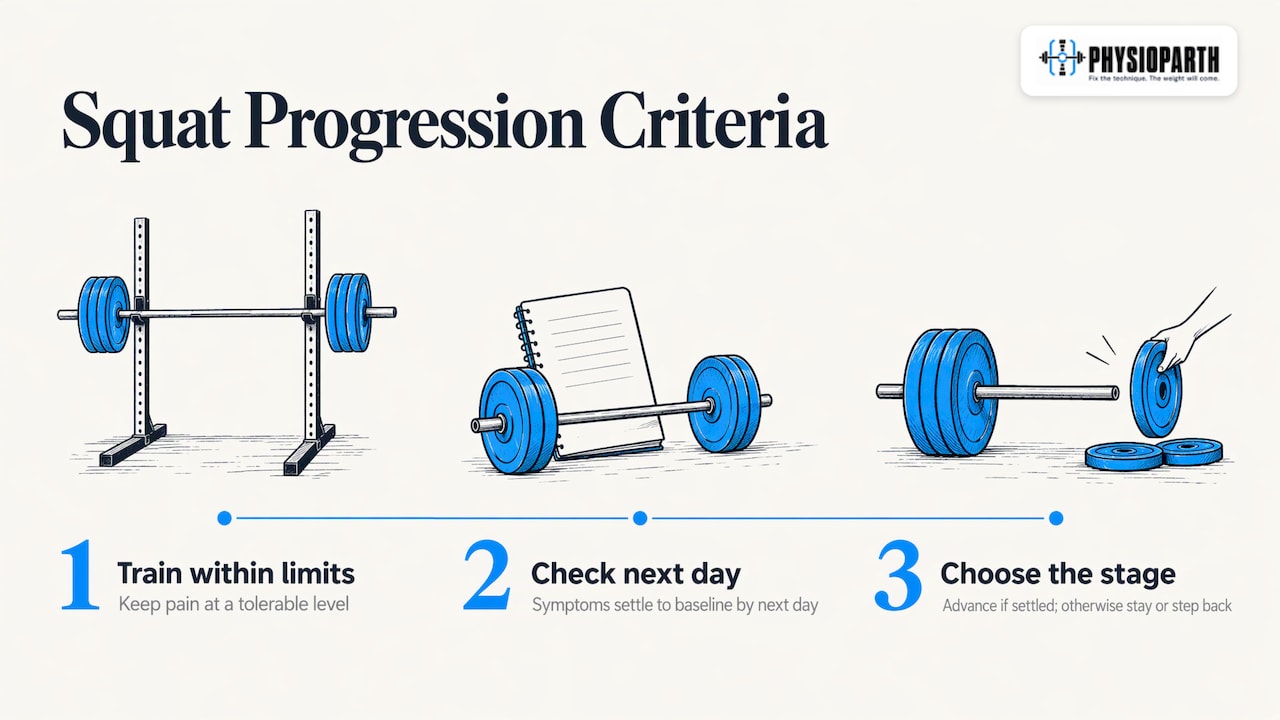
Progress by criteria, not calendar dates. Each stage has an entry variation and the criteria to move on. Pain during training should stay at a level you consider tolerable and settle back to your baseline by the next day. If it does not, stay at the current stage or step back.
Stage 1: Calm the irritated position
Reduce the provoking depth and volume. Use a box or pins set just above the depth where the pinch starts, a stance that gives you more room, and lower loads.
- Pin squats or box squats to a pain-tolerable depth.
- Safety Squat Bar squats, which shift the load forward and may let some lifters keep a more upright torso.
- Isometric holds in a tolerable range, such as a mid-range squat hold or a bridge hold.
- Keep the rest of your training moving: floor press or bench with a normal grip for the upper body, and trap bar deadlifts from a raised handle position if your hip tolerates them.
Move on when: the training movement is tolerable, the pinch does not increase from set to set, and it is back to baseline the next morning.
Stage 2: Rebuild strength and control in range
The 2021 International Society of Hip Preservation physiotherapy consensus recommends range-of-motion and strengthening exercise within a tolerable range, with hip and lumbosacral strengthening and neuromuscular control as possible targets, adjusted to symptom response.
- Tempo squats (for example, a three-second descent) to a depth that does not pinch. Slower lowering gives you information about control at the bottom.
- Paused squats just above the pinch point to build strength where it is tolerable.
- Block pulls or trap bar deadlifts at a height that keeps the hip out of its provoking angle.
- Single-leg and hip-focused strength work, such as split squats and hip thrusts, as tolerated.
Move on when: you can complete your working sets at a tolerable symptom level, tempo and paused reps are smooth, and loads are climbing without next-day flare-ups.
Stage 3: Return depth and load
Gradually lower the pins or box, or reduce the pause height, in small steps. Bring your normal bar back in, still with a pause or tempo at first.
- Paused squats at progressively deeper positions.
- Competition-style squats at submaximal loads, with a stance you have tested for your hip.
- Deadlifts from the floor once block pulls are unremarkable.
Move on when: you can reach competition depth at working loads with pain at a tolerable level, and it has stayed that way across at least a couple of consecutive sessions with different loading days.
Stage 4: Return to full training
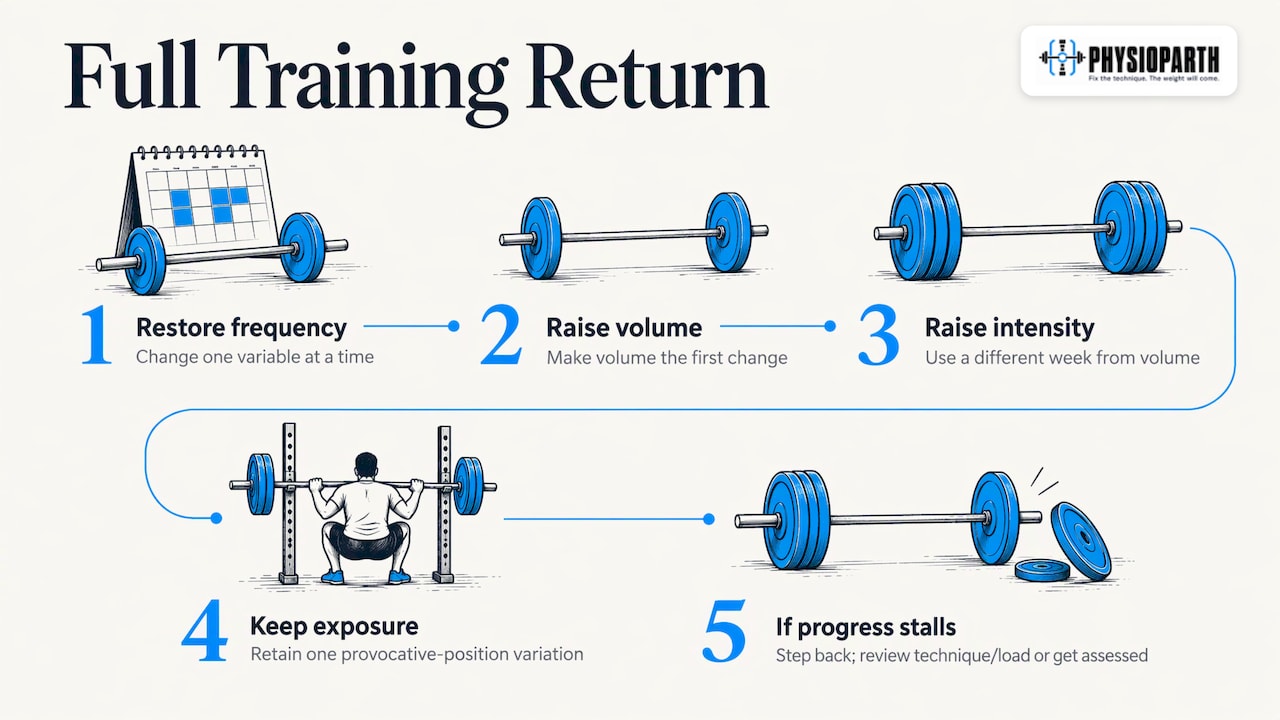
Restore your normal frequency and intensity one variable at a time. Raise volume first, then intensity, rather than both in the same week. Keep one provocative-position variation, such as paused or tempo work, in your program as a regular exposure.
If you stall at any stage, that is information, not failure. Step back one stage and reconsider technique or load, or get assessed. For a broader version of this progression, see my article on hip pain when squatting.
What the evidence says about rehab
The BC Medical Journal article recommends nonoperative first-line care for FAIS, including physiotherapy and activity modification to avoid provocative positions such as deep squats. A 2023 peer-reviewed review says care commonly combines education, activity modification and physical therapy. That review also notes that outcomes and evidence vary between studies, which is why a plan should be tailored to your response rather than copied from a template. After hip surgery, progression and restrictions depend on the procedure and the treating team's protocol, so follow that team's instructions.
Imaging is not routine for everyone. The Canadian Chiropractic Guideline says it may be used when it would clarify a diagnosis, investigate serious pathology, or affect specialist or surgical planning.
Red flags: when you need in-person or medical assessment
Some hip pain is not a training problem. Get assessed in person promptly, or go to emergency, if you have:
- Severe pain that is getting worse quickly.
- Inability to bear weight on the leg.
- Fever, feeling systemically unwell, or unexplained weight loss.
- Pain after a fall or a significant impact.
- Night pain that wakes you and does not ease with position changes.
- Numbness, loss of strength or bladder or bowel changes.
The Canadian Chiropractic Guideline lists severe rapidly worsening pain, inability to bear weight, fever or systemic illness as reasons to seek emergency or prompt medical assessment. It also advises specialist or shared-care assessment if symptoms remain limiting, the diagnosis is uncertain, or progress is not what you would expect. In Ontario you can see your family doctor or a walk-in clinic, and the emergency department if symptoms are severe.
Perspective
Most lifters with a hip pinch arrive with a label from a video: "I have impingement." What I find more useful is a question: in which position, at which load, and what changed in the weeks before it started? That question separates a setup that no longer suits your hip from a training block that outran your recovery.
As a former competitive powerlifter, I know how unappealing it sounds to be told to change depth or swap the bar. I don't build plans around rest. I aim to build a criteria-based plan with modified variations where appropriate, so you have a clear next step and a clear reason to move up or back.
The Initial Assessment aims to explain, in lifter terms, what tissue may be irritated and what your lift may be showing. If you send videos beforehand, I can also include a lift analysis of your squat.
Parth
How I can help
If a hip pinch is limiting your squat, the Initial Assessment ($130) includes a full subjective and objective assessment and a movement screen, plus a lift analysis if you send videos beforehand. It aims to explain what tissue may be irritated and to build a criteria-based return-to-lifting plan using modified variations where appropriate rather than complete rest. Follow-Up Sessions are $100. You do not need a doctor's referral to see a physiotherapist in Ontario, though some insurers require one for reimbursement, and many extended-health plans cover physiotherapy. Details are on my booking page.

If you want to check fit first, the free 15-minute consult is a fit check, not an assessment or treatment. You can also start with the free audit. To end where you started: if your hip pinches in the squat, book with me at physioparth.com and we can look at it together.
FAQ
Is it okay to keep squatting with hip pinching?
Often you can keep training with changes. Guidance from the Canadian Chiropractic Guideline is to temporarily modify the loads or positions that provoke symptoms while maintaining feasible movement. In practice that usually means raising the depth, lowering the volume or using a variation such as a pin or Safety Squat Bar squat. If the pinch is severe, worsening or limits walking, get assessed first.
Does a hip pinch in the squat mean I have FAI?
It may indicate it, but it does not establish it. The Warwick Agreement requires compatible symptoms, clinical signs and imaging findings together. Other structures, such as the hip flexor tendon or adductors, and training factors can produce a similar pinch.
Will stretching get rid of the pinch?
Stretching alone is rarely the whole answer. If the pinch comes from bone or soft tissue meeting at end range, forcing more range may provoke it further. Strength, control, stance and load changes tend to be a more useful starting point.
Should I switch from high bar to low bar?
It may help, because bar position changes torso angle and the hip angle you need. It is not a rule for every lifter. Try it in a pin or tempo variation first and see whether the pinch changes depth or intensity.
Do I need a scan?
Not always. The Canadian Chiropractic Guideline says imaging may be used when it would clarify a diagnosis, investigate serious pathology or affect specialist or surgical planning. A physician decides whether it is appropriate for you.
Sources
- Warwick Agreement on femoroacetabular impingement syndrome, BJSM 2016
- Navigating the nonarthritic hip, BC Medical Journal 2023
- Training Considerations for Individuals With Femoroacetabular Impingement, NSCA Strength and Conditioning Journal 2015
- Nonarthritic Hip Joint Pain, Canadian Chiropractic Guideline
- 2019 International Society of Hip Preservation physiotherapy consensus, 2021
- Non-operative Management and Outcomes of Femoroacetabular Impingement, 2023
Recommended
- Squat Hip Shift: Causes, Clues and a Return Plan
- Hip Pain Squatting: Causes, Fixes and Return Criteria
- Groin Pain Squatting: Causes, Clues and a Return Plan
- Ankle Mobility and Squat Pain: Causes and a Return Plan
This article is general education for strength athletes and is not a substitute for an individual assessment. Pain that is severe, worsening, or accompanied by numbness, weakness or loss of function needs prompt in-person or medical assessment. Author: Parth Suthar, Registered Physiotherapist (Ontario).