
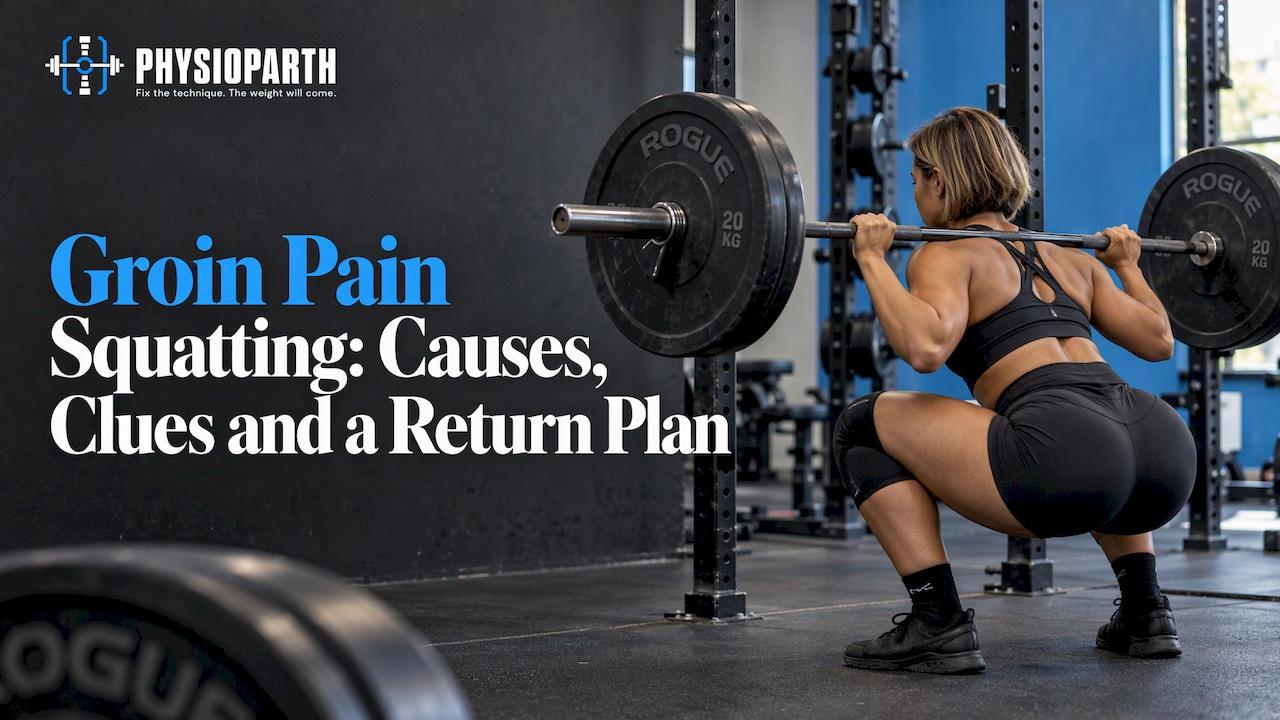
Groin pain in the squat usually shows up at one point in the rep, often the bottom or the turnaround, and where it sits tells you a lot. Pain on the inner thigh or near the pubic bone may indicate the adductors. Pain at the front of the hip crease may indicate the hip flexors. I'm Parth Suthar, a registered physiotherapist in Ontario and a former competitive powerlifter. Below I separate the likely structures, the technique causes from the load-management causes, and a progression that moves by criteria rather than by the calendar. The goal is to keep you squatting in a modified form where that is appropriate, not to rest until it goes away.
TL;DR
- Inner thigh or pubic-region pain may indicate the adductors. Front-of-hip pain that worsens when you lift the knee may indicate the hip flexors. Deep groin pinching may indicate the hip joint itself.
- Look at technique (stance, depth, bracing, bar position) and at load (volume, intensity, frequency, recovery) as two separate lists.
- Progress by criteria: low pain during the session and no flare-up over the next 24 to 48 hours before you add depth, load or frequency.
- Some symptoms need in-person or medical assessment first. They are listed below.
- If you want a plan built around your lifts, I offer a free 15-minute fit-check call.
Table of Contents
- What is actually hurting: the structures most likely involved
- Red flags: when you need in-person or medical assessment
- Technique causes versus load-management causes
- What to change right now
- Warming up for a painful squat
- A criteria-based return to squatting
- Perspective
- Working with me
- FAQ
- Ready to build a plan around your squat?
- Sources
What is actually hurting: the structures most likely involved
I can't diagnose you through an article, and a screen name or a pain location doesn't settle anything. What I can do is describe the structures that commonly show up with groin pain in athletes, so you know what to notice.
A clinical review in JOSPT notes that acute groin strains in athletes commonly occur at the musculotendinous junction and can involve adductor longus, rectus femoris and iliopsoas. The same paper adds that overuse groin injuries more often involve bone and tendons and their insertions, and rarely involve rectus femoris. That distinction matters for lifters, because a sudden tweak out of the hole and a slow ache that builds over months behave differently.

Adductors (inner thigh)
The adductor group, adductor longus in particular, attaches near the pubic bone. A 2026 clinical commentary describes adductor-related athletic groin pain as typically medial thigh or pubic region pain, usually provoked by cutting and change-of-direction tasks. In the squat, the adductors work hard in the bottom position and when you drive out of it, especially with a wide stance or a low-bar setup that pushes your hips back and your knees out.
Clues that may indicate the adductors:
- Pain on the inner thigh, sometimes up toward the pubic bone.
- Pain when you squeeze your knees together against resistance, such as pressing a ball or a rolled towel between your knees.
- Pain when you stretch the inner thigh in a wide-leg position.
- Pain that appears at the bottom of the squat or when you open the knees out.
The commentary also notes that resisted hip adduction with the hips in neutral most reliably provokes pain at the adductor longus origin, while hip-flexed positions are less specific to that spot. So a squeeze test lying flat with the legs straight may tell you more about the adductor origin than a squeeze with the hips bent.
Hip flexors (front of the hip)
Rectus femoris and iliopsoas sit at the front of the hip. They can be irritated by deep squats with a forward-leaning torso, by hard pulls out of the bottom, or by high-volume work with a lot of hip flexion under load. For a deeper look, see my page on hip flexor strain in strength athletes.
Clues that may indicate the hip flexors:
- Pain at the front of the hip crease rather than the inner thigh.
- Pain when you lift the knee toward the chest against resistance, such as a seated march with a band.
- Pain when you stretch the front of the hip by lunging forward with the back knee down.
- Pain on the way up, or at the top when you stand tall and squeeze the glutes.
Pubic region and the abdominal wall
Some lifters have pain near the pubic bone that worsens with bracing, coughing or sit-up-style movements. The non-operative rehabilitation protocol for athletic pubalgia from an orthopaedic group lists avoiding lifting and other activities that raise intra-abdominal pressure in the acute phase. If heavy bracing is what triggers your pain, that is worth noting and worth assessing properly.
Hip joint and nearby areas
A deep, pinching groin pain at the bottom of the squat can also come from the hip joint, and pain felt in the groin sometimes originates in the low back or elsewhere. If your pain behaves that way, my page on hip pain when squatting covers those patterns.
A quick comparison
| Clue | May indicate adductors | May indicate hip flexors | May indicate hip joint |
|---|---|---|---|
| Where you point | Inner thigh, near the pubic bone | Front hip crease | Deep in the groin, often a "C" grip with the hand |
| Squat position | Bottom, wide stance, knees pushed out | Turnaround or the drive up | Bottom, or when the thigh is pulled close to the chest |
| Resisted test | Knee squeeze | Resisted knee lift | Often neither is clearly provoked |
| Typical feel | Pull or sharp twinge | Pinch or tightness at the front | Pinching or catching |
These are patterns, not verdicts. Several structures can be irritated together, which is why a movement screen and a hands-on look by a clinician carry more weight than any list.
Red flags: when you need in-person or medical assessment
Stop squatting and get assessed in person if any of the following apply. Mayo Clinic advises seeking immediate medical attention for groin pain together with back, stomach or chest pain, or for sudden, serious testicle pain. It also lists nausea, vomiting, fever, chills, unexplained weight loss and blood in the urine alongside testicle pain and swelling.
The same page advises booking a doctor's visit for:
- serious groin pain, or pain that does not improve with home treatment within a few days;
- mild testicle pain lasting longer than a few days;
- a lump or swelling in or around a testicle;
- lower abdominal pain that may spread into the groin;
- blood in the urine.
I would add the lifting-specific situations where in-person assessment comes first: a sudden pop or tearing sensation with immediate loss of strength, visible bruising down the inner thigh, a bulge in the groin that appears when you strain or cough, pain that wakes you at night regardless of position, numbness or tingling down the leg, or an inability to walk without a limp. Those call for hands-on examination, and possibly imaging, before any return plan. A physiotherapist in Ontario can be seen without a referral, so you don't have to wait on a doctor to start, but these red flags go to an in-person clinician or emergency care first.
Technique causes versus load-management causes
Most groin irritation in the squat comes from one of two buckets, and they need different fixes. Keeping them apart stops you from changing everything at once.
Technique causes
- Stance width. A very wide stance with toes turned out puts the adductors under a long stretch at the bottom. A slightly narrower stance can reduce that demand.
- Depth. Squatting past the point where your pelvis tucks under, often called "butt wink", may load the front of the hip and the adductors differently. Depth that you own is more useful than depth you fall into.
- Bar position. A low-bar setup shifts the torso forward and the hips back, which changes hip flexion and adductor demand compared with a high-bar squat.
- Bracing. Holding your breath and bracing hard on every rep raises intra-abdominal pressure. If the pain sits near the pubic bone, how you brace is worth reviewing.
- Knee path. Knees that cave in or are forced out hard at the bottom change the pull on the inner thigh. My page on knee cave in the squat goes into that.
- Foot pressure. Rolling to the inside or outside of the foot can change how the hips rotate under load.
Load-management causes
- Volume. A jump in weekly squat sets, especially at depth.
- Intensity. A block of heavy singles after a long stretch of lighter work.
- Frequency. Adding a squat day, or pairing squats and deadlifts on consecutive days.
- Recovery. Poor sleep, a stressful week, or cutting rest between hard sessions.
- Accessory change. New wide-stance lunges, sumo pulls or side-to-side conditioning work that overlaps with your squat days. If your deadlift also bothers the groin, see my page on groin pain with deadlifts.
A useful exercise: write down what changed in the four weeks before the pain started. If the answer is mostly in the second list, load adjustments may do most of the work. If your training was steady but the pain sits at one point in the rep, technique deserves a closer look. The free Lifter's Hip & Lower Back Toolkit can help you organise this.
What to change right now
You don't need to stop training. You need to find what you can do that doesn't provoke the pain.
- Find the trigger. Note the exact position, load and rep where pain starts.
- Stay below the pain ceiling. The acute-phase precautions in the athletic pubalgia protocol are less than 2/10 pain with exercises and manual muscle testing. That is a sensible ceiling to borrow while symptoms are fresh.
- Remove the provocative position, not the whole lift. Raise the box, shorten depth, narrow the stance or change the bar, as described in the progression below.
- Keep moving. Montreal-based sports physiotherapy guidance advises adjusting activities early and says walking can continue within comfort. It also suggests avoiding crossing your legs or lying on the sore side for tendon-type problems.
- Handle the first couple of days sensibly. For adductor strains, Sport Medicine Ontario-hosted guidance supports rest, ice, compression and elevation during the first 48 hours, with passive motion kept within comfort.
Warming up for a painful squat
A warm-up for a sore groin should raise tissue temperature, then expose the area to the movements you plan to squat with, gradually. The Barrie-based sports physiotherapy article hosted on the Sport Medicine Ontario education site recommends about 20 minutes, including 3 to 5 minutes on a stationary bike, adductor stretching and adductor-specific work such as sumo squats and side lunges.
A practical version for a lifter with a sore groin:
- Bike or brisk walk for 3 to 5 minutes, easy effort.
- Hip range of motion within comfort: gentle rocking in a quadruped position, controlled leg swings.
- Light isometric adduction: a ball or rolled towel between the knees, squeezing gently and holding. Montreal guidance notes that isometric holds ease pain for some people.
- Bodyweight or goblet box squats to a depth that stays below your pain ceiling.
- Empty bar and then ramp-up sets, stopping the ramp if pain climbs past your ceiling.
If warm-up sets feel clearly worse as you add load, that is the signal to switch to a variation from the progression, not to push through.
A criteria-based return to squatting
Progress by criteria, not by dates. The general criterion in the 2022 clinical concepts paper on groin injuries is that athletes should have no or minimal pain during the exercise and during the following 24 to 48 hours, and should move through strengthening and functional milestones before returning to sport. I use that as the gate between stages: if either the session or the next day is worse, hold or step back one stage.
For adductor strains, the Sport Medicine Ontario-hosted guidance places sports-specific training after passive motion matches the uninjured leg and adductor strength reaches 75% of the same-side abductors. Measuring that takes a dynamometer or a clinician, so treat it as a target to discuss in assessment.

Stage 1: calm it down and keep a base
Aim: pain at or below your ceiling in everyday movement and in the exercises below.
- Isometric adductor holds with a ball between the knees, then isometric hip flexion against a band or a hand.
- Walking and easy bike work. The athletic pubalgia protocol lists walking, elliptical, bike and pool treadmill as early cardio options.
- Upper body training as usual, avoiding anything that provokes the groin.
Move on when: isometrics are comfortable, walking is comfortable, and there is no flare-up the next day.
Stage 2: squat patterns with the trigger removed
Pick one variation that stays below your ceiling.
- Box squat to a high box. Reduces depth, which may reduce adductor and hip flexor stretch.
- Tempo squat. A 3-second lowering phase to a depth you can control, which teaches you where the trouble starts.
- Paused squat above the sore range. Short pause at a comfortable depth to keep position honest.
- Pin squat. Starting from pins set at a comfortable height removes the stretch-reflex bounce out of the hole.
- Safety Squat Bar squat. The camber and handles change torso position and can reduce the hip flexion and shoulder demands for some lifters.
- Trap bar deadlift or block pulls. If you need heavy hip-hinge work, a trap bar or elevated pulls shorten the range and may let you load the pattern while the groin settles.
The athletic pubalgia protocol's second phase includes functional work such as squats, a lunge matrix and Romanian deadlifts with progressive resistance, which is a similar idea of adding load once the early phase is comfortable. Montreal guidance describes early two-leg strength work, hip movement within comfort and gradually longer walks.
Move on when: you can complete your working sets at the chosen variation with pain at or below your ceiling, and the next 24 to 48 hours stay quiet.
Stage 3: rebuild depth, stance and load, one variable at a time
Change only one variable per session or week:
- Depth: lower the box, or drop the pin height, by a small step.
- Stance: widen gradually toward your usual setup.
- Load: add weight once depth and stance are tolerated.
- Tempo and pauses: keep them in your warm-up and back-off sets to hold position quality.
- Frequency: add the second squat day last.
Add adductor strengthening on separate days, such as side-lying adduction and copenhagen-style progressions, starting with short levers. Gauge them by the same criteria.
Move on when: your usual stance and depth feel comfortable at your working weights, your pain is at or below the ceiling during and after, and your adductor and hip flexor tests are not provoking pain.
Stage 4: return to your regular programme
Reintroduce your competition-style squat gradually: heavy sets first at moderate volume, then peaking work. Keep one or two of the variations as accessory work. If symptoms return, step back one stage rather than starting over.
This is a general framework, not a prescription. If your pain doesn't follow the pattern above, if a stage stalls for more than a couple of weeks, or if tests point to something other than the adductors or hip flexors, an individual assessment is the better route.
Perspective
I lifted competitively for years, and the pattern I notice most often in lifters with groin pain is that they treat it as one problem. The adductors, the hip flexors, the pubic region and the hip joint can all produce pain in roughly the same place, and each one points to a different adjustment. Squat technique and training load also get blended together, so everything gets changed at once and nobody learns what helped.
My approach to virtual care aims to separate those pieces. In the Initial Assessment I take a full history, run an objective assessment and movement screen, and, if you send squat videos beforehand, add a lift analysis. The aim is to explain, in lifter terms, what tissue may be irritated, and to build a criteria-based return-to-lifting plan that uses modified variations where appropriate rather than complete rest.
The decision to move forward should come from how you feel during and after a session, not from a date on the calendar.
Parth
Working with me
The Initial Assessment is $130. It includes a full subjective and objective assessment, a movement screen, and a lift analysis if you send videos beforehand. Follow-up sessions are $100. Care is delivered by video, you don't need a referral to see a physiotherapist in Ontario, and many extended-health plans cover physiotherapy. Some insurers require a referral for reimbursement, so check your plan. You'll get a receipt for submission. You can see the options on the main booking page.

If you want to see whether we're a fit first, the free 15-minute consult is a fit check, not an assessment or treatment. If you'd like a place to start on your own, the Lifter's Hip & Lower Back Toolkit and the lift audit page are free.
FAQ
Why does my groin hurt only at the bottom of the squat?
The bottom is where the adductors and hip flexors are most stretched and where hip flexion is highest. Pain there may indicate adductor irritation, hip flexor irritation or hip joint pinching, depending on where you feel it. Raising depth slightly, narrowing the stance or using a pin or box variation can help you see which factor matters.
Is it hip flexor pain or groin pain?
Hip flexor pain tends to sit at the front hip crease and may be provoked by resisted knee lift. Adductor-related pain tends to sit on the inner thigh or near the pubic bone and may be provoked by a knee squeeze. The two can overlap, so a hands-on assessment gives a more reliable picture.
Can I keep squatting with groin pain?
Often you can adjust rather than stop, as long as pain stays low during the session and doesn't increase over the next 24 to 48 hours. Use tempo, paused, pin, box or Safety Squat Bar variations and reduce depth or load. If you have any of the red flags above, get an in-person assessment first.
How should I warm up when squats hurt?
Spend about 20 minutes: a few minutes on a bike, gentle hip movement, light adductor isometrics, then box squats and ramp-up sets. Stop ramping when pain climbs past a low ceiling, and switch to a variation.
Ready to build a plan around your squat?
If your groin or hip flexor pain keeps showing up in the squat, book with me for a free 15-minute consult at physioparth.com.
Sources
- Clinical Examination, Diagnostic Imaging, and Testing of Athletes With Groin Pain (JOSPT)
- Adductor-Related Athletic Groin Pain: A Clinical Commentary
- Groin pain (male): When to see a doctor, Mayo Clinic
- Rehabilitation Protocol for Athletic Pubalgia, Non-Operative Management
- Prevention and Treatment of Groin Strains in Athletes, Sport Medicine Ontario education
- Current Clinical Concepts: Exercise and Load Management of Groin Injuries
- Hip and Groin Pain Physiotherapy in Montreal
Recommended
- Groin Pain With Deadlifts: Causes, Modifications, Return
- Hip Pain Squatting: Causes, Fixes and Return Criteria
- Knee Cave in the Squat: Causes, Tissue Clues and a Return Plan
This article is general education for strength athletes and is not a substitute for an individual assessment. Pain that is severe, worsening, or accompanied by numbness, weakness or loss of function needs prompt in-person or medical assessment. Author: Parth Suthar, Registered Physiotherapist (Ontario).