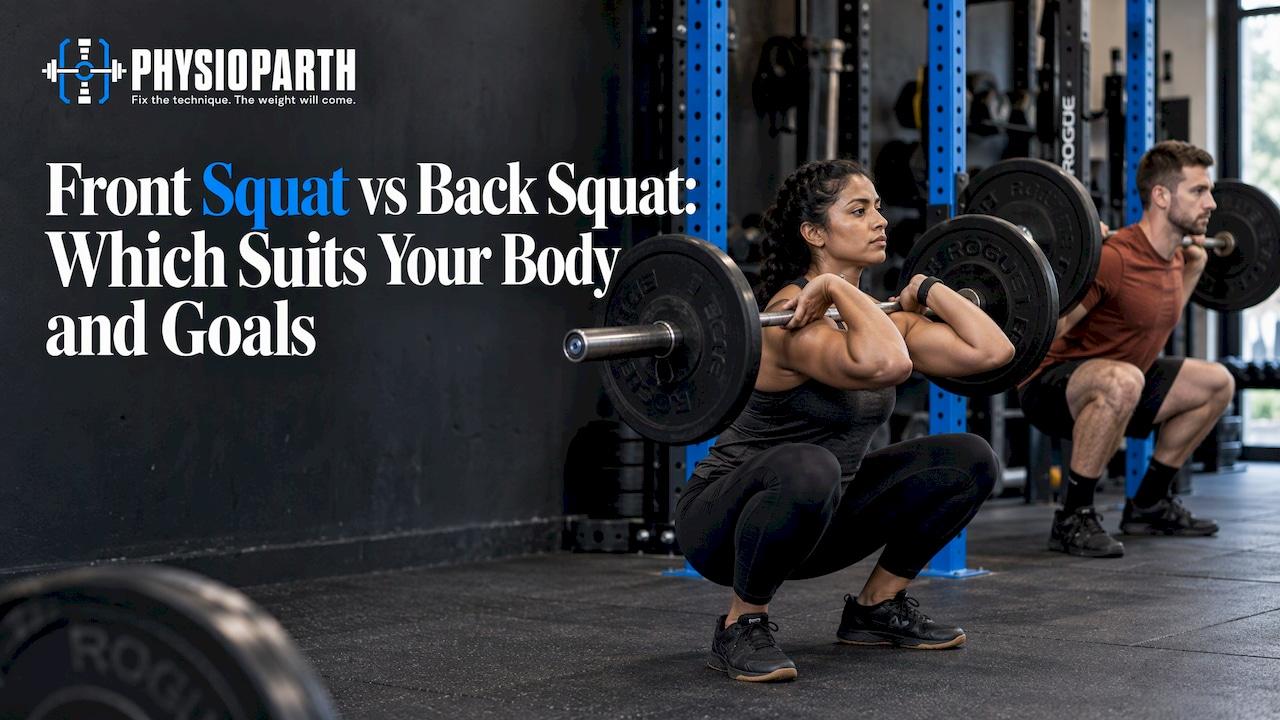
The front squat and the back squat train the same pattern, but they load your body differently. The front squat keeps you more upright and may reduce knee compression. The low-bar back squat usually lets you lift the most and leans on the hips and low back. The right choice depends on your goal and on what hurts. I'm a registered physiotherapist in Ontario and a former competitive powerlifter, and that is the lens I use below.
TL;DR
- Front squat: bar on the front of the shoulders, more upright trunk, lighter loads, and in one study less knee compression than the back squat.
- Low-bar back squat: more forward lean, more hip and erector spinae demand, and usually the heaviest load. High-bar sits between the two.
- Muscle activity is broadly similar across variations. Joint loading is what differs, and that is where pain decisions are made.
- Stance and toe angle change which joint takes the work. Small changes are enough to test.
- If a variation hurts, you may not need to stop squatting. A criteria-based progression below shows how to move between variations.
Table of Contents
- How the two lifts differ
- What the research says about muscles and joints
- High bar vs low bar
- Foot position and stance width
- Technique causes vs load-management causes
- Which structures are involved, and how to tell them apart
- Criteria-based return to lifting
- Red flags: when to get in-person or medical assessment
- Which should you choose?
- Perspective
- Working with me
- FAQ
- Sources
How the two lifts differ
In a back squat the bar sits across the upper back. Biomechanics researchers describe it on the trapezius, slightly above the rear deltoids, while the front squat bar rests across the front of the shoulders and collarbones with the elbows high and upper arms parallel to the floor.
That bar position changes your torso angle. A Canadian CSEP lecture document from the University of Alberta lists trunk targets of 30-45° for the back squat and 20-30° for the front squat. A load held in front of the body tends to pull you upright, as a 2024 biomechanical review notes. The same review warns against judging knee demand from shin angle alone. The relationship between trunk and shin is the better guide.
What the research says about muscles and joints
Muscle activation is not the big difference. In a crossover study of 15 trained people, bar position did not change quadriceps, hamstring or erector spinae activity. The back squat did produce higher knee compressive forces and knee extensor moments, and the authors suggested the front squat may suit people with knee problems such as meniscus tears.
A 2026 systematic review of 24 studies reached a similar picture: similar overall muscle activity, a more upright trunk in the front squat and, in the single kinetic comparison, less knee compression. Certainty of evidence was very low and the studies were in healthy people, so treat this as a reasonable starting point, not a rule.
Load is the other difference. In the first study, lifters averaged 88.3 kg for the back squat 1RM versus 69.2 kg for the front squat. Expect your front squat to sit well below your back squat.
The lower back is not simply spared. In a 2020 study of 18 lifters, more anteriorly placed loads reduced trunk flexion and pelvic tilt but increased low-back extension moments. An upright torso may feel kinder to your back, but it may not load it less.

High bar vs low bar
Both are back squats, and the difference matters for powerlifters. A 2017 review in the Journal of Strength and Conditioning Research found:
| High bar | Low bar | |
|---|---|---|
| Torso | More upright | More forward lean |
| Knee flexion | Greater | Lesser |
| Hip flexion | Lesser | Greater |
| Depth | Deeper | Less deep |
| Greater activity | Quadriceps | Erector spinae, adductors, glutes |
| Load | Typically lower | May allow more |
A 2025 study of 19 strength-trained people found 1RM load was significantly higher with the low bar. In Swedish national-class lifters, powerlifters using the low bar had higher peak hip moments (324 Nm versus 230 Nm at depth) and lower knee moments than weightlifters using the high bar.
The practical read: if you compete in powerlifting and chase maximal load, the low bar fits. If you want more quad work and an upright position, as in CrossFit or Olympic lifting carryover, the high bar or front squat fits better.
Foot position and stance width
There is no single correct stance. The evidence gives ranges:
- A 2014 back squat assessment protocol co-authored by Stuart McGill suggests heels about shoulder-width apart with toes forward or up to 10° out for initial instruction. It notes a very wide stance may raise knee compressive forces by up to 15% on the way down, and a very narrow one increases forward knee travel.
- In the 2024 biomechanical review, 30° of toe-out reduced the knee valgus moment by 50% without changing quadriceps or hamstring activation, and hip external rotation of 30° to 50° raised hip adductor activity by 17% to 23%.
Change one thing at a time, use a stance your hips and ankles tolerate, and keep your knees tracking over your toes. If you cannot reach depth without your heels lifting, see my guide on ankle mobility and squat pain. If your knees drift inward, knee cave in the squat covers it.
Technique causes vs load-management causes
When a squat hurts, two different problems can look the same.
Technique causes: set-up, bar path, bracing, grip, stance and depth. Examples are a low-bar grip that irritates the shoulder or elbow, a stance too wide for your hips, or a brace that collapses at the bottom.
Load-management causes: volume, intensity, frequency and recovery. Examples are a jump in weekly sets, too many heavy days close together, or poor sleep during a heavy block.
A quick way to separate them: if pain appears at the same point in the lift regardless of weight, technique is a likely contributor. If it builds with total weekly volume and eases with rest, load may be the driver. Either way, I would not diagnose you from an article. That is what an assessment is for.
Which structures are involved, and how to tell them apart
Pain in a squat may involve different structures. These patterns may indicate where to look:
- Patellar tendon (front of the knee, below the kneecap): often aggravated in the deep knee-bent position and when pushing out of the bottom. See patellar tendonitis and squats.
- Patellofemoral joint (around or behind the kneecap): tends to be a diffuse ache with stairs or sitting, and may worsen with depth or a wide stance. See knee pain when squatting.
- Hip joint and surrounding tissue (front or side of hip, sometimes pinching at depth): may be sensitive to stance width and toe angle. See hip pain squatting.
- Adductors (groin): a pull or ache on the inner thigh, often in wide stances. See groin pain squatting.
- Lumbar extensors (low back): a muscular ache on either side of the spine that may build as forward lean increases. The 2026 review cautions that low-bar, wide-stance squatting combines greater trunk inclination with higher lumbar demands.
- Shoulder, elbow, wrist: the low-bar position needs shoulder abduction and external rotation, which an existing shoulder injury may restrict. Front rack position loads the wrists and elbows instead.
The clues that help most are location, the depth at which it starts, and whether load, stance or bar position changes it.
Criteria-based return to lifting
Progress by criteria, not calendar dates. Move to the next stage only when you meet every criterion at your current one, and drop back a stage if symptoms flare.
Stage 1: Isometrics and tempo. Isometric holds in a tolerable squat position, then tempo squats (for example a 3-second descent) with a lighter load. Criteria to move on: pain stays low and settles back within a day, and you can repeat the same session without a rise in symptoms. My post on tempo squats and knee pain goes deeper.
Stage 2: Pin and paused work, with a bar that suits you. Pin squats from a comfortable height, paused squats to a depth you control, or a Safety Squat Bar if the straight bar bothers your shoulders or elbows. A front squat or high-bar position may be a useful modified variation if the low bar aggravates your back or hip. Criteria: no pain during the pause or the drive, and consistent depth and bracing across all sets.
Stage 3: Return to your main squat. Build back the bar position, stance and depth you compete with, starting at reduced load and volume. Criteria: you tolerate your usual working weights across a full week without symptoms climbing, and technique holds on your last rep.
The same logic applies elsewhere in your training: a floor press or a trap bar deadlift can replace a bench or conventional pull while an irritated area settles, and block pulls reduce range. The free squat, bench and deadlift guides and my lifter's hip and lower back toolkit are good places to start.
Red flags: when to get in-person or medical assessment
See a physician or go to emergency care, in person, if you have:
- numbness in the groin or saddle area, new bladder or bowel changes, or leg weakness that is worsening;
- pain after a significant fall or impact, or an inability to bear weight;
- a visibly swollen, hot or locked joint, or a sudden pop with immediate loss of function;
- night pain or constant pain unrelated to movement, unexplained weight loss, or fever;
- pain that does not ease with rest or modification over time.
These need examination, and sometimes imaging, that a video session cannot provide.
Which should you choose?
- Competing in powerlifting: train the low-bar or your competition squat as your main lift, and use the front squat as a supplement.
- Knee-dominant pain: a front squat or high-bar squat may reduce knee compression, based on the evidence above.
- Low back or hip sensitivity: test a more upright option and shorter depth, and keep tempo or pause work in the mix.
- Shoulder, elbow or wrist limits: consider a Safety Squat Bar, or a front squat with a cross-arm or strap-assisted grip.
- CrossFit or strongman: the front squat carries over to cleans, and the high bar to upright positions.
The common thread is that your best squat is the one your tissues tolerate and that fits your sport.
Perspective
I lifted competitively before I became a physiotherapist, so I know how tempting it is to either grind through pain or give up the squat entirely. Neither is necessary in many cases. Most squat pain I see comes down to a mismatch between bar position, stance and what a joint can currently handle.
The research on front versus back squats shows similar muscle activity but different joint loads, which is why I look at your set-up and your training load together. My Initial Assessment aims to explain what tissue may be irritated, in lifter terms, and to build a criteria-based plan with modified variations where appropriate rather than complete rest.
If you want a second pair of eyes on your own lift, the audit page is a good place to begin.
Parth
Working with me
My virtual Initial Assessment is $130 and includes a full subjective and objective assessment and a movement screen, plus a lift analysis if you send videos beforehand. Follow-up sessions are $100. No referral is needed to see a physiotherapist in Ontario, though some insurers require one for reimbursement, and many extended-health plans cover physiotherapy. You can see everything on the booking page.

The free 15-minute call is a fit check, not an assessment or treatment. It is a chance to tell me what your squat looks like and whether virtual care suits you.
FAQ
Is the front squat better than the back squat?
Neither is better in every case. The front squat may reduce knee compression and keep you more upright, while the back squat, especially low bar, usually allows heavier loads. Your goal and your pain pattern decide.
Is the low-bar or high-bar squat better for powerlifting?
Low-bar squatting was linked to higher 1RM loads in a 2025 study of recreational lifters, which is why many powerlifters use it. The high bar suits lifters who want more quad work and an upright torso.
How wide should my squat stance be?
A reasonable starting point is heels about shoulder-width with toes forward to roughly 10° out, then adjust to your hips. Change one variable at a time and note how it feels.
Can I keep squatting with knee or hip pain?
Often a modified variation is an option, such as tempo, pause, pin or Safety Squat Bar work, using the criteria above. Persistent or worsening pain needs an individual assessment.
If you want help sorting out which squat suits you, book with me for a free 15-minute consult at physioparth.com.
Sources
- Gullett et al., A Biomechanical Comparison of Back and Front Squats (JSCR, 2009)
- Chiu, CSEP lecture document, University of Alberta (2008)
- Straub and Powers, A Biomechanical Review of the Squat Exercise (2024)
- Alqahtani and Almalki, Effects of Squat Exercise Variations on Lower Limb (2026)
- Goršič et al., Biomechanical comparisons of back and front squats (2020)
- Glassbrook et al., High-bar vs low-bar biomechanics review (JSCR, 2017)
- Comparative Analysis of Performance in the High-Bar vs. Low-Bar Squat (Applied Sciences, 2025)
- High- and low-bar squatting techniques (Medicine & Science in Sports & Exercise, 1996)
- Myer et al., The Back Squat: A Proposed Assessment (2014)
- Technical Aspects and Applications of the Low-Bar Back Squat (NSCA SCJ, 2020)
Recommended
- Patellar Tendonitis and Squats: A Lifter's Return Plan
- Front Rack Mobility: Fix Wrist Pain in the Front Squat
- Groin Pain Squatting: Causes, Clues and a Return Plan
- Squat Bracing for Ontario Lifters: Progress by Criteria, Not Dates
This article is general education for strength athletes and is not a substitute for an individual assessment. Pain that is severe, worsening, or accompanied by numbness, weakness or loss of function needs prompt in-person or medical assessment. Author: Parth Suthar, Registered Physiotherapist (Ontario).