
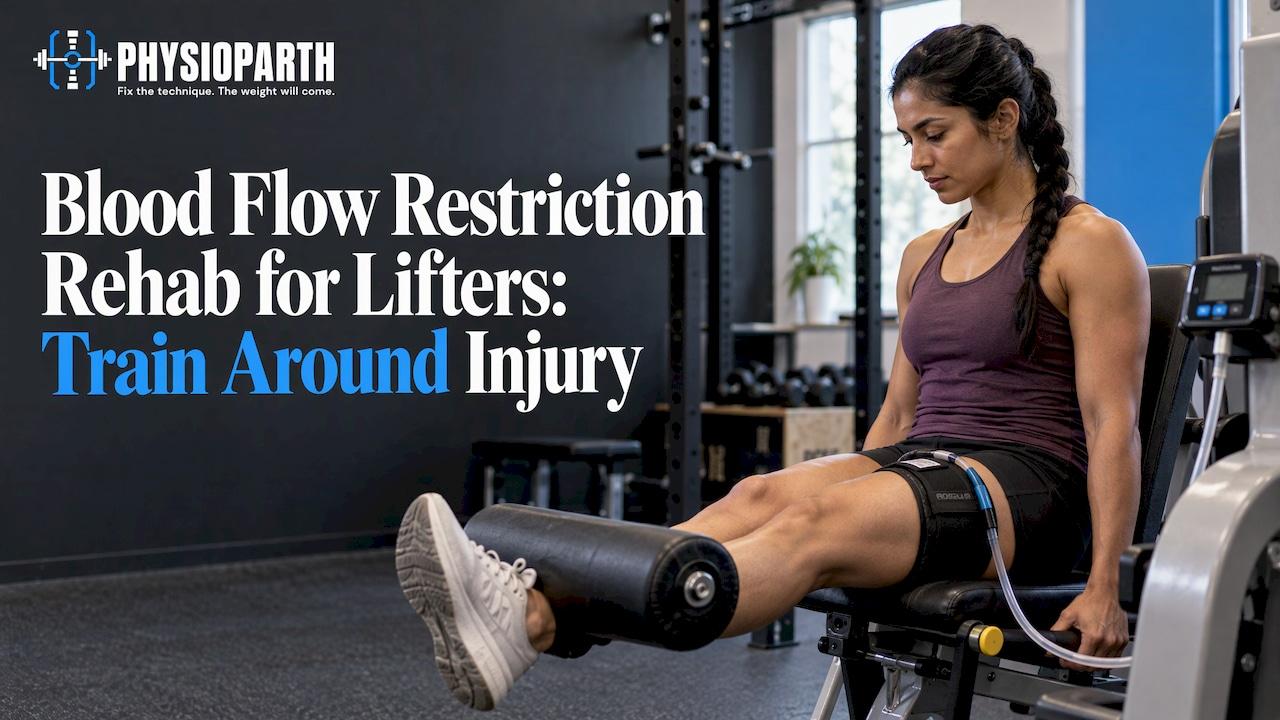
Blood flow restriction (BFR) rehab uses a cuff on the upper arm or thigh to partly restrict blood flow while you train with light loads. For an injured lifter, the appeal is simple: it may let you keep stimulating the muscle when heavy squats, benches or deadlifts are not tolerable yet. It is a tool inside a rehab plan, not a replacement for one. This guide covers when it may fit, how it is typically dosed, who should avoid it and how to slot it around your main lift days.
TL;DR
- BFR pairs light loads (typically 20 to 40% of 1RM) with a cuff, so you may be able to load a muscle during a rehab block when heavy work irritates the injury.
- In a 2023 review of randomized trials, BFR and high-load training produced comparable results in clinical populations, though the certainty of the evidence was low to very low.
- Cuff pressure should be individualized from a measured limb occlusion pressure, not guessed or copied from someone else.
- Some conditions rule BFR out and others need a medical review first. Numbness, faintness or unusual pain mean you stop.
- Progress back to heavy lifting by criteria (pain response, strength, tolerance of variations), not by calendar dates.
Table of Contents
- What BFR rehab is and how it works
- What the evidence says for injured lifters
- Which injuries may suit BFR
- Technique causes vs load-management causes
- How BFR is typically applied
- Who should avoid BFR and when to stop
- A criteria-based return to lifting
- Fitting BFR around squat, bench and deadlift days
- Perspective
- Work out your plan with me
- FAQ
- Sources
What BFR rehab is and how it works
A pneumatic cuff or similar device is placed high on the working limb. It is inflated enough to restrict venous return and, depending on pressure, partly limit arterial inflow, while you perform an exercise with a light load. Clinical descriptions of the method describe brief, intermittent restriction of blood flow with a cuff during exercise, which is why the loads can stay low.
The practical reason lifters care: a review of the topic notes that BFR can bridge earlier phases of rehabilitation when higher loads may not be tolerated. If a sore patellar tendon, a post-surgical knee or an irritated elbow cannot take 85% on the bar, light work with a cuff gives the muscle something to respond to in the meantime.
It works on the limb under the cuff. Cuffs go on the thigh for quads and hamstrings, and on the upper arm for biceps, triceps and forearm work. It does not train your back or your trunk directly.
What the evidence says for injured lifters
The honest summary: BFR looks like a reasonable option when heavy loading is not yet possible, and it does not appear to do worse than heavy loading in the trials we have.
- A review of seven randomized trials in clinical musculoskeletal populations found BFR resistance training and high-load training produced comparable follow-up scores for strength, quadriceps cross-sectional area, function and patient-reported outcomes. The certainty was low to very low, so treat it as encouraging, not settled.
- In a study of athletes after surgery, those using BFR training had similar changes in quadriceps strength and gait mechanics to those receiving standard-of-care rehab at 6 months.
- For trained people, the Australian Institute of Sport's guidance offers the perspective that combining traditional resistance training with BFR may suit trained athletes.
One gap matters for strength athletes. A 2026 review of BFR in musculoskeletal rehab notes that return-to-sport clearance measures were not assessed in the included studies. BFR can help maintain muscle, but it does not decide when you go back to heavy squats. That is why the criteria below matter.
Which injuries may suit BFR
I am not diagnosing anyone here. These are common situations where lifters and their clinicians discuss BFR, and the structures usually involved.
Knee. Pain at the front of the knee may indicate irritation of the patellar tendon, the quadriceps tendon or the patellofemoral joint. A tendon often points to a specific spot just below the kneecap that hurts with loading and jumping or deep knee flexion. Patellofemoral pain tends to be more diffuse around or behind the kneecap and worse with stairs or sitting. My articles on patellar tendonitis and squats and knee pain when squatting go through how to tell them apart.
Hip. Pain at the front of the hip that flares with hip flexion under load may indicate the hip flexor muscles or tendons. Pinching at the end range of a deep squat may point more toward the joint itself. See hip flexor strain for strength athletes for the grades.
Elbow. Pain on the outer elbow that is worse with gripping may indicate the forearm extensor tendons. Pain on the inner elbow may indicate the flexor-pronator group. Pain at the back of the elbow during lockout may indicate the triceps tendon. Pressing, pulling and heavy deadlift grip all load these.
After surgery. Quad, hamstring or arm size often drops quickly when a limb is protected. Here BFR is discussed mainly because early loading is limited, and the surgeon's protocol sets the rules.
BFR has the most logic for tendon and muscle problems where load tolerance is the limit. It does not address a technique fault, which is why I separate causes below.

Technique causes vs load-management causes
BFR keeps muscle working, but it does not explain why the injury happened. Before you rely on it, sort the likely drivers.
Technique causes
- Set-up: bar position, foot placement or shoulder blade position that shifts load to one structure.
- Bar path: drifting forward in the squat or deadlift, or flaring in the bench.
- Bracing: losing trunk pressure under load. See my guide to the Valsalva manoeuvre for lifting.
- Grip: a grip width or hand position that overloads the elbow or wrist.
- Stance and depth: a width or depth beyond your current hip or ankle mobility, which can stress the hip or knee at the bottom.
Load-management causes
- Volume: a sudden jump in weekly sets.
- Intensity: too many near-max singles in a block.
- Frequency: hitting the same pattern too often to recover.
- Recovery: poor sleep, a heavy work period or a short deload.
If the cause was a volume spike, BFR plus a drop in sets may do a lot. If it was a bar path fault under fatigue, a lift analysis from video matters more than the cuff. Most injuries involve both.
How BFR is typically applied
This section describes what the literature reports. It is not a prescription for self-application.
- Pressure: typically 40 to 80% of limb occlusion pressure (LOP), which is the pressure at which blood flow in the limb stops.
- Load: 20 to 40% of 1RM.
- Volume: commonly four sets of 30-15-15-15 repetitions, with 30 to 60 seconds of rest between sets, which is about 75 repetitions in total.
- Measurement: pressure should be based on measured arterial occlusion pressure, because using systemic blood pressure may not give a consistent reduction in blood flow.
That last point is why a cuff from the internet with a number someone posted is a poor plan. Limb size, cuff width and your own blood pressure all change what a given setting does. A trained clinician measures LOP with a device built for it.
The sets are not meant to end in failure. The reps are light, the rests are short and the burn is high, which can feel hard even at a trivial weight. Stay well short of exhaustion.
Who should avoid BFR and when to stop
The Australian Institute of Sport guidelines state that people with peripheral vascular disease, previous vascular surgery to the affected limb, or an arteriovenous fistula to that limb should not undertake BFR. A history of venous thromboembolism, hypertension and other listed conditions need medical review first. The same guidance advises practitioners to have a low threshold for referring to a medical doctor before starting.
Reported effects include temporary pins and needles, bruising and delayed-onset muscle soreness. Serious events such as rhabdomyolysis have been linked to inappropriate use or overexertion, and that review found no evidence of increased thromboembolic risk. Another review describes adverse events as statistically rare when BFR is used correctly, with training to exhaustion raising the risks.
Red flags: get in-person or medical assessment
Do not train through these. Stop the session and arrange an in-person or medical assessment:
- Numbness, a cold or pale limb, or tingling that does not settle soon after the cuff is released.
- Faintness, chest pain or shortness of breath.
- Calf or arm swelling, warmth and tenderness, especially in one limb.
- Dark urine or severe, out-of-proportion muscle pain after a session.
- A pop with sudden weakness, a visible deformity, or inability to bear weight or move the joint.
- Night pain that is constant, unexplained fever, or loss of bladder or bowel control with back pain.
- Known vascular disease, a clotting history or uncontrolled high blood pressure before you start.
In Ontario you can see a physiotherapist directly, and a family doctor, walk-in clinic or emergency department are the next steps for the symptoms above. For BFR, a clinician with training in it should apply the cuff and set the pressure. A US review of physical therapy adjuncts says BFR sits within the professional scope of practice for physical therapists, with certification strongly encouraged. Ask any provider about their training and how they measure LOP.
A criteria-based return to lifting
BFR is one layer. Heavy loading returns by criteria, not weeks. Move to the next stage only when the criteria for the current one are met on consecutive sessions.
Stage 1: Calm the area and keep the muscle working
- Isometrics (for example, mid-range quad or pressing holds), BFR light work if suitable, and pain-tolerable variations elsewhere.
- Criteria to move on: pain during and the next morning is low and stable, the joint is not swelling, and daily tasks are comfortable.
Stage 2: Rebuild load tolerance with controlled variations
- Tempo squats or presses (slow 3 to 4 second lowering), paused reps, and a Safety Squat Bar for the squat if the shoulder or elbow limits a straight bar. Trap bar deadlifts and floor press reduce range at the hip, knee or shoulder. Heavy, slow work from my heavy slow resistance protocol suits tendon problems.
- Criteria to move on: you can repeat the planned sets with a pain response that settles within a day, strength on the affected side is close to the other side, and movement quality holds on the last rep.
Stage 3: Re-expose to your competition patterns
- Pin squats and pin presses at working ranges, block pulls from a height that suits your back and hip, then paused competition-style reps at submaximal loads.
- Criteria to move on: no pain or symptom increase carrying over to the next session, and bar speed and set-up feel consistent across sets.
Stage 4: Return to full programming
- Rebuild intensity, then volume, adding one variable at a time. Keep BFR on the limb as an accessory if it still helps.
- Criteria to finish: a full training week at your planned loads with a pain response that is stable, and confidence in the competition lifts.
If a step flares symptoms beyond a day, go back one stage rather than pushing through. My deadlift back pain guide uses the same logic for the spine.
Fitting BFR around squat, bench and deadlift days
- Keep it away from your hardest session. Do BFR for the injured limb at the end of a session or on a separate day, rather than right before a heavy compound lift on that limb.
- Knee or hip rehab: do BFR leg extensions or leg presses after your upper-body or lighter lower-body work. Keep the main squat day on a modified variation such as tempo or Safety Squat Bar.
- Elbow rehab: do BFR curls or triceps extensions with a cuff on the upper arm after pressing, and swap the bench to a floor press or paused version as pain allows.
- Frequency: protocols in the literature are often two to three sessions weekly, but your clinician sets that from your tolerance and recovery.
- Avoid stacking soreness. Delayed-onset soreness is a reported effect, so do not schedule BFR the day before a session that needs that limb fresh.
Perspective
I was a competitive powerlifter before I was a physiotherapist, so I know the pull to either rest completely or ignore the pain and keep grinding. Neither is a plan.
BFR is interesting to me because it fits a lifter's problem: you want to keep muscle on the limb while the tissue settles. But the cuff does not tell you why the tissue got irritated. I want a clear picture of your technique and your training load first, then a loading plan where each variation has a criterion to move on.
In my virtual assessments I aim to explain what may be irritated in lifter terms and to build a criteria-based plan that uses modified variations where appropriate rather than complete rest. If BFR may suit your situation, that is a conversation to have with a clinician who can measure LOP in person.
Parth
Work out your plan with me
If you are injured and unsure what to change in your squat, bench or deadlift, my Initial Assessment is $130 and includes a full history, movement screen and lift analysis if you send videos beforehand. It aims to explain what may be irritated and to build a return-to-lifting plan by criteria. Follow-ups are $100. No referral is needed in Ontario, though some insurers require one for reimbursement.

The 15-minute call is a fit check, not an assessment or treatment. You can book it here.
FAQ
Does BFR rehab work as well as heavy lifting?
In a review of seven trials in clinical populations, BFR and high-load training had comparable outcomes, but the certainty was low to very low. It may be a useful option when heavy loads are not tolerated. Your clinician should still progress you toward heavy loading by criteria.
Can I do BFR training on my own at home?
Pressure should be set from a measured limb occlusion pressure, and some conditions need screening or medical review first. For that reason I would not set it up on your own from a guess. Work with a clinician trained in BFR.
Do you have to be certified to do BFR?
A US review says BFR is within physical therapist scope, with certification strongly encouraged before clinical use. In Ontario, ask any provider about their BFR training and how they measure pressure.
Can BFR help me keep muscle during a knee or elbow injury?
It may help maintain muscle on the affected limb when heavy loading is limited, based on the trials above. It does not by itself clear you to return to heavy lifting. That depends on your pain response, strength and tolerance of variations.
Sources
- Effects of blood-flow restricted exercise versus high-load training in clinical populations
- The Efficacy of Blood Flow Restriction Training to Recover After Surgery
- Blood Flow Restriction Therapy and Its Use for Rehabilitation
- Blood Flow Restriction Exercise: Considerations (Frontiers in Physiology, 2019)
- Blood flow restriction training in musculoskeletal rehabilitation (2026)
- Blood flow restriction training guidelines, Australian Institute of Sport
- Blood Flow Restriction Training (PMC, 2021)
- Blood Flow Restriction in Oncological Patients: Advantages and Risks
- An Update on Physical Therapy Adjuncts in Orthopedics
Recommended
- Overhead Press Pain: Causes, Tissue Clues and a Return Plan
- Heavy Slow Resistance for Lifters: A Tendinopathy Protocol
- Deadlift Back Pain: Ontario Lifters’ Tissue Clues and Return Criteria
- Sciatica and Deadlifts: How to Train Around Leg Pain
This article is general education for strength athletes and is not a substitute for an individual assessment. Pain that is severe, worsening, or accompanied by numbness, weakness or loss of function needs prompt in-person or medical assessment. Author: Parth Suthar, Registered Physiotherapist (Ontario).