
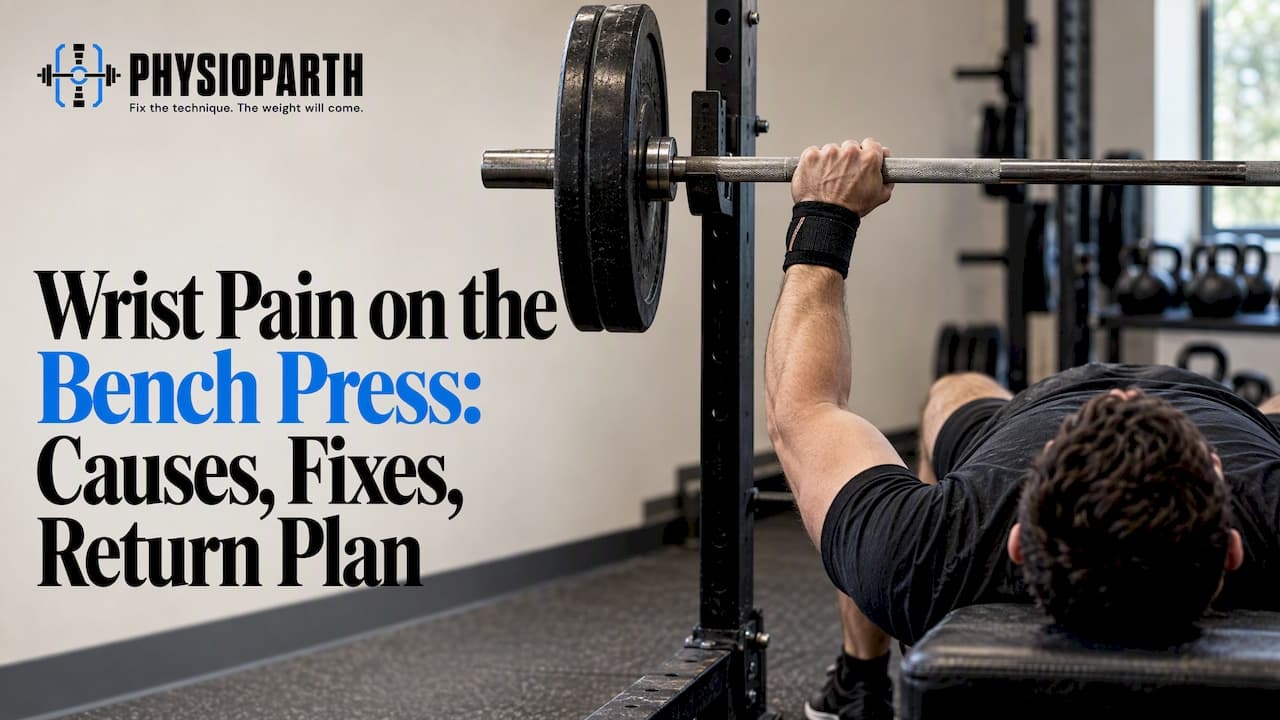
Wrist pain on the bench press is usually a bar-position problem, a load problem, or both. The bar sits too far back in the hand, the wrist folds into extension under load, or training volume jumped faster than the tissues adapted. All three can be changed without taking pressing out of your week.
I'm Parth Suthar, a registered physiotherapist in Ontario and a competitive powerlifter. This guide covers where the pain tends to sit and which structures that location may indicate. It then covers what to change in your set-up, how to separate technique causes from load-management causes, and how to return to benching by criteria rather than by calendar.
TL;DR
- Where the pain sits (thumb side, little-finger side, top of the wrist, or the palm-side crease) may indicate which structure is irritated. The table below shows how to tell them apart.
- Start with the bar. Set it low in the palm, stacked over the forearm, with the knuckles pointing at the ceiling rather than the wall behind you.
- Check load before technique if the pain arrived after a block change: more volume, more frequency or a new variation can irritate a wrist that was fine for years.
- Keep pressing with modified variations (floor press, neutral-grip dumbbells, paused and tempo work) and move up only when pain, strength and next-day response meet set criteria.
- Numbness that persists, a fall onto the hand, visible deformity or night pain are reasons for in-person assessment first.
Table of Contents
- Why the wrist takes the hit on bench
- Where it hurts: which structure may be irritated
- Technique causes: what the bar and hand are doing
- Load-management causes: what your training did to the tissue
- What to change this week
- Return to benching by criteria, not dates
- Red flags: when to be assessed in person
- My view as a lifter and physio
- If you want a second set of eyes
- FAQ
- Sources
Why the wrist takes the hit on bench
On a bench press the bar travels over your forearm, but the load is carried through your hand. If the bar rests high in the palm, near the fingers, the wrist has to bend backward (extend) to hold it. The heavier the set, the more that extended position is loaded, and the wrist is no longer a stacked column of bone under the bar. It becomes a hinge under a lever. PowerliftingTechnique frames wrist position around efficient force transfer from the chest to the bar, which is the same logic I use in assessment: a wrist that bends back leaks force and concentrates stress on a small area.
It is also very common. One strength-training article estimates that it affects roughly 8 in 10 lifters at some point, though that is a coaching estimate, not a clinical study. The practical point stands: you are not unusual, and it is rarely a reason to stop training.

Where it hurts: which structure may be irritated
I can't diagnose you from an article, and pain location is a clue, not a verdict. But location narrows the list of structures most likely involved, and that tells you what to test and what to change first.
| Where you feel it | Structure that may be involved | What tends to provoke it | How to tell it apart |
|---|---|---|---|
| Top of the wrist, a pinch when the wrist extends | Dorsal wrist joint capsule and the joint surfaces between the forearm and carpal bones (impingement-type irritation) | Bar high in the palm, wrists bent back at the bottom and in the lockout | Hurts at end-range extension even with no weight, such as in a push-up or hand-on-wall press |
| Little-finger side of the wrist | Extensor carpi ulnaris (ECU) tendon and its sheath, or the triangular fibrocartilage complex (TFCC) | Wrist drifting toward the little-finger side, rotation under load, bar tilting | Pain with turning the palm up and down or deviating the wrist toward the little finger; TFCC irritation may also click or ache with weight-bearing |
| Thumb side of the wrist | Tendons running along the thumb side (the first dorsal compartment, as in de Quervain-type irritation), or the thumb-side carpal joints | Thumbless or loose grip, very wide hand squeeze, high-volume pressing | Pain when you make a fist around your thumb and tilt the wrist toward the little finger |
| Palm-side crease or heel of the hand | Wrist flexor tendons, or carpal tunnel structures if tingling is present | Heavy grip on pressing sets, wrist wraps tightened over the nerve area | Tingling in the thumb, index and middle fingers suggests the nerve rather than a tendon; see the red flags below |
| Forearm and elbow with the wrist | Wrist extensor muscle-tendon unit, which attaches at the outer elbow | Gripping the bar hard while the wrist is cocked back | Pain over the outer elbow when the wrist extends against resistance; see my bench press elbow pain guide |
A word on the ECU, since it is the structure lifters rarely hear about. It runs in a groove on the little-finger side of the forearm bone, held by a sheath. A PubMed-indexed anatomical study on the ECU subsheath shows how much the sheath contributes to keeping that tendon stable, which is why repeated rotation or sideways drift under load can leave that area irritated. That study concerns tendon stability and surgical reconstruction, not bench press specifically, so I use it for anatomy only.
Use the table to take better notes, not to label yourself. If the same spot hurts on the same part of the rep, three sessions in a row, write it down. That pattern is useful information for any clinician.
Technique causes: what the bar and hand are doing
These are the causes I can usually see on video. I separate them from load causes because the fix is different: technique problems need a change in set-up or movement, and no amount of rest corrects a bar that sits in the wrong place.
Bar position in the hand
This is the most common fault I see. The bar sits across the palm diagonally, the low end near the heel of the hand and the high end toward the fingers. Set it on the heel side, over the base of the forearm, so the bar sits in line with the forearm bones. A cue that works: push the heel of the hand into the bar, as if you were trying to stack the bar over your elbow.
Wrist angle and knuckle direction
A neutral to slightly extended wrist is normal and unavoidable with a barbell. A wrist that folds back so the knuckles point behind you is the problem. Look at your hands from the side in a set-up video: the forearm, wrist and bar should read as close to a straight line. Many lifters find the knuckles should point more toward the ceiling than the wall behind them.
Grip width and forearm angle
Grip width changes where your forearms sit at the bottom. If the forearms lean toward your feet or your head at the chest, the wrist compensates. A PubMed study of grip widths compared narrow, medium and wide grips in novice and resistance-trained men, measuring muscle activity and six-rep-max loads. It does not address wrist pain directly, but it supports a practical point: grip width is a lever you can change that alters muscle demand. For wrist comfort, I usually test a width where the forearms are close to vertical at the bottom of the press, and I adjust from there within what your federation's rules allow.
Thumbless or loose grip
A thumbless grip lets the bar roll toward the fingers, which pushes the wrist back. A full grip, thumb around the bar, often helps the wrist hold position, and it is safer when the bar is overhead of your face. It is also required by many federations for competition, so train it.
Bracing and bar path
If your upper back is loose and the bar path drifts toward your face or away from your hips, the forearm tilts and the wrist takes the sheer load. A tight upper-back arch, shoulder blades set, and a consistent touch point keep the forearm vertical for longer in the rep. I cover the shoulder side of this in my piece on bench shoulder pain in Ontario, because a path that irritates the shoulder often loads the wrist too.
Wraps and equipment
Wrist wraps can reduce the extension at the joint and make heavy sets feel better. They also hide a poorly positioned bar. I use them as a tool once the bar position is fixed, not as the fix. Wrap over the joint, not the palm, and loosen them for warm-up sets so you can feel where the bar sits.
Load-management causes: what your training did to the tissue
Technique can be fine and the wrist can still be sore. Tendons and joint capsules adapt more slowly than muscle, so a jump in work may outrun the wrist before it outruns your chest or triceps. Ask these questions about the last four to six weeks:
- Volume: Did total pressing sets go up, especially high-rep back-off sets or push-ups and dips on top of bench?
- Intensity: Did you spend more time above roughly 85% of your max, or start a peaking block?
- Frequency: Did you add a third or fourth pressing day, or begin a CrossFit block with handstand push-ups, front rack and burpees?
- Variation: Did you change the movement, such as a close-grip bench, a thicker bar, a bar with different knurling, or a swap to dumbbells?
- Recovery: Did sleep, work stress or a heavy lower-body week make the next day's session harder?
If one of these lines up with the first day of pain, that is the likeliest lever. For strength athletes, I would rather reduce one variable by a notch than stop pressing. The American College of Sports Medicine makes the same case in plain terms: complete rest after an injury is no longer the default, and staying active in a modified way is generally preferred.
What to change this week
- Film your set-up from the side and the front. Check where the bar rests in your palm, how your wrist looks at lockout, and where your forearms sit at the chest.
- Move the bar toward the heel of your hand. Use the same grip for warm-ups and top sets so the habit carries over.
- Change one thing at a time. Grip width, wrist wraps and tempo all at once will tell you nothing about which one helped.
- Cut the most provoking variable by about a third. Pick the one load factor from the list above, and reduce it rather than removing pressing entirely.
- Track next-day response. Rate pain from 0 to 10 during the session, that evening and the next morning. A rise of two points or more that has not settled by the next day suggests the session was too much.
Pro tip: A stronger wrist is useful, but stretching alone is not the plan. Add gentle loaded work for the forearm, such as wrist curls and reverse curls, in a pain-tolerable range, plus reps of slow bar-in-hand holds at your best position. Loaded, slow work gives the tissue a reason to adapt, which flexibility work on its own does not.
Return to benching by criteria, not dates
The lists below are a framework for discussion, not a prescription. Move to the next stage only when all criteria for your current stage are met. If you cannot meet them, stay put or step back one stage. Calendar time is not a criterion.
Stage 1: Calm the wrist, keep the chest working
Use floor press with a neutral or slightly angled grip, neutral-grip dumbbell press, and landmine press if the shoulder allows. Add isometric bar holds at mid-range, 3 to 5 holds of 20 to 30 seconds, at a load where pain stays at or below 3 out of 10.
Move on when: everyday tasks, such as carrying groceries and opening jars, are pain-free or close to it, pain during the session is 3/10 or lower, and it settles within 24 hours.
Stage 2: Rebuild the bar position under light load
Bring back barbell bench with a tempo of 3 seconds down, a 1-second pause on the chest, and a lighter load than your usual working weight. Use a pin press from the safeties, starting where the bar rests lower in the range, to groove the forearm stack. Keep wraps for the heaviest sets only if they help.
Move on when: you can complete your planned sets with a consistent bar position (checked on video), pain stays at 3/10 or lower, and the next-morning response is no worse than baseline.
Stage 3: Rebuild load
Raise the load across sessions, using paused bench, close to your working weights, plus a small amount of volume. Re-introduce touch-and-go bench and your usual grip width. Keep one accessory press, such as a neutral-grip dumbbell press, as the wrist-friendly option.
Move on when: you can handle your working weights with pain at 2/10 or lower, your grip-strength check is within a similar range to the other side (if only one wrist is sore), and two consecutive sessions leave no flare-up.
Stage 4: Full training
Return to your standard bench, including heavy singles or doubles, and your usual pressing frequency. Keep the best-position checks on video every couple of weeks for the first block. If the pain returns, drop one stage and look at load first.
Red flags: when to be assessed in person
Virtual assessment is useful for most training-related wrist pain, but some situations need a hands-on examination, imaging or medical care before any lifting plan. Get assessed in person, by a physician, urgent care or an in-person physiotherapist or hand specialist, if you notice:
- Pain after a fall onto an outstretched hand, a bar dropped onto the wrist, or a sudden pop, especially if there is tenderness at the thumb-side hollow of the wrist. Some small wrist bone injuries may not be obvious at first.
- Visible deformity, marked swelling, or bruising that appeared quickly.
- Numbness or tingling that lasts, wakes you at night, or involves your thumb, index and middle fingers, which may indicate nerve involvement.
- Loss of grip strength that is clearly new, or a hand that is weak, cold or pale.
- Fever, redness and heat around the joint, or pain at rest and at night that is not linked to training.
- Pain that is steadily worsening over several weeks despite reducing load.
In Ontario, you can see a physiotherapist without a referral, and walk-in clinics and emergency departments are options if you suspect a fracture or infection. If you are unsure which category you fall into, a short conversation is a reasonable way to find out.
My view as a lifter and physio
I have benched through wrist pain, and I have watched many lifters do the same, usually for months longer than necessary. The common mistake is to treat the wrist as the problem, when it is often the last link in a chain: the bar sits wrong in the hand, the arch loosens when fatigue sets in, and the training week piled one extra pressing day onto a sore tendon.
That is why I look at the lift before I look at the joint. When I watch a video of a set, I want to see the bar position in the hand, the forearm angle at the chest, and how the bar path changes from the first rep to the last. The last rep tells me more than the first, because that is where the drift you cannot feel in the moment shows up.

I also do not believe in sending a strength athlete home to rest for six weeks. You lose strength and confidence, and the wrist still has not learned to tolerate the bar. A criteria-based plan with floor press, paused work, pin presses and isometrics keeps the pressing pattern alive while the irritated tissue settles. I can't promise an outcome, but I can promise a plan with clear checkpoints, so you always know why you are moving forward or holding.
I keep free guides for the lifts at physioparth.com/bench, and a self-check you can run on your own training at physioparth.com/audit.
— Parth
If you want a second set of eyes
If the pain has lingered, or you are not sure whether it is a technique problem or a load problem, you can send me video of your bench. The initial assessment is $130 and covers a movement review of your actual lifts, a explanation of which tissue may be irritated and why, and a return-to-lifting plan with modified variations. Follow-up sessions are $100. Many Canadian extended-health plans accept the receipts, though you should check your own plan's physiotherapy coverage. No referral is needed. Details are on physioparth.com.
FAQ
Why do my wrists hurt when I bench press?
The most common reasons are a bar that sits too high in the palm, so the wrist bends back under load, and a recent jump in pressing volume or frequency. Less often, grip width, a loose bar path or a thumbless grip contribute. Where the pain sits can narrow down which structure may be irritated.
Should I use wrist wraps for bench press?
Wraps can reduce how far the wrist extends and often make heavy sets more comfortable. They work best after you have fixed the bar position, because on their own they can hide a set-up fault. Use them for your heaviest working sets and train lighter sets without them.
How do I strengthen my wrists for bench press?
Use slow, loaded forearm work in a pain-tolerable range: wrist curls, reverse curls, and isometric bar holds at a good wrist position. Pair that with lower-intensity pressing variations so the wrist sees load every week. Stretching alone is unlikely to be enough.
Can I keep benching with wrist pain?
Often yes, with modifications such as floor press, neutral-grip dumbbells, paused and tempo work, and a lower dose of the variable that triggered it. Keep pain during the session at about 3 out of 10 or lower and make sure it settles by the next morning. If you hit any red flag above, get assessed in person first.
What is the best wrist position for bench press?
A near-neutral wrist, with the bar resting over the heel of the hand and in line with the forearm, and the knuckles pointing more toward the ceiling than behind you. A full grip with the thumb around the bar helps hold it there. Check it with a side-view video, since it is hard to feel in the moment.
Sources
- Bench Press Wrist Position: 5 Rules To Follow, PowerliftingTechnique.com
- How to Stop Wrist Pain on Bench Press, Fitness and Power
- Relative Contribution of the Subsheath to Extensor Carpi Ulnaris Tendon Stability, PubMed
- The Effect of Grip Width on Muscle Strength and Electromyographic Activity in Bench Press, PubMed
- Resting After an Injury: A Thing of the Past, American College of Sports Medicine
Recommended
- Bench Press Elbow Pain: 45° Fixes for Strength Athletes
- Bench Shoulder Pain in Ontario: When a 45° Fix Isn’t Enough
- Squat Lower Back Pain: 7 Mistakes & How to Fix Them
This article is general education for strength athletes and is not a substitute for an individual assessment. Pain that is severe, worsening, or accompanied by numbness, weakness or loss of function needs prompt in-person or medical assessment. Author: Parth Suthar, Registered Physiotherapist (Ontario).