
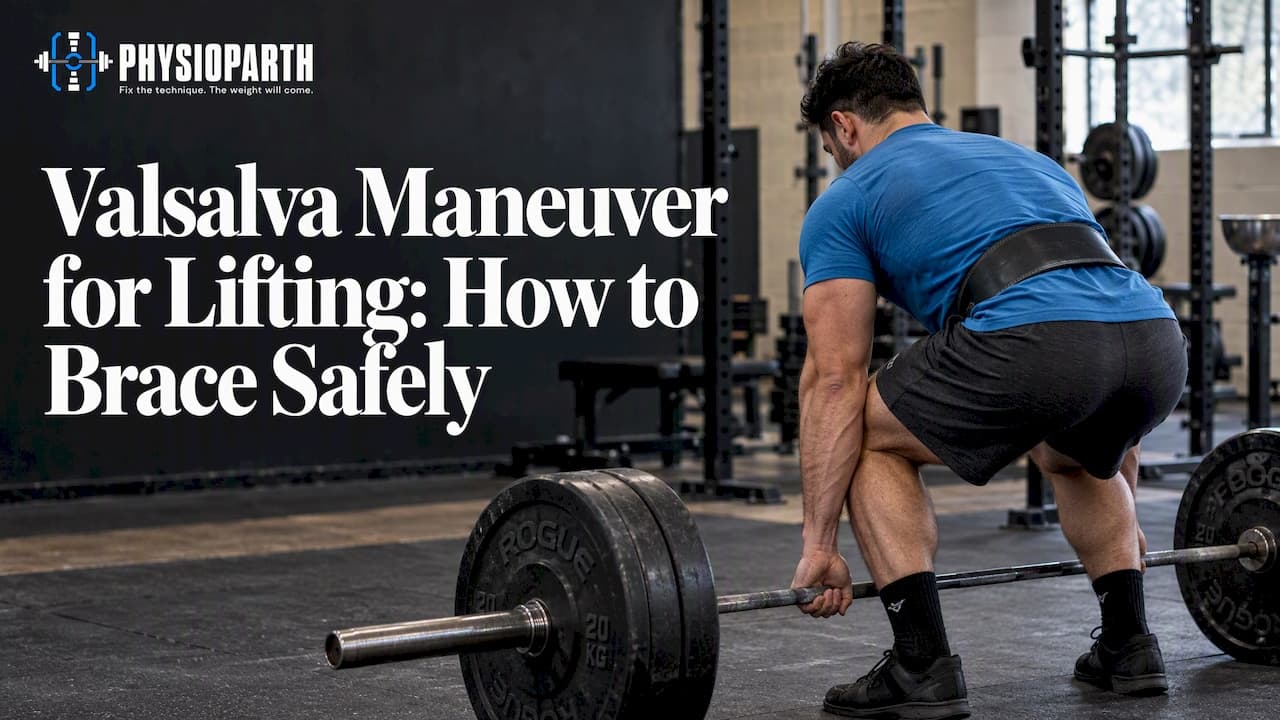
A brief, well-set Valsalva maneuver is a normal part of heavy lifting. You take a big breath into your belly, brace your trunk against it, hold for the hardest part of the rep, then exhale once you are past the sticking point. Done this way, it raises the pressure inside your trunk and stiffens your spine. Done badly (held too long, set too high in the chest, or used by someone with a cardiovascular condition), it causes problems of its own. I’m Parth Suthar, a registered physiotherapist in Ontario (PT Reg. Ont.) and a former competitive powerlifter, and this is how I teach it.
TL;DR
-
A brief Valsalva is largely unavoidable when you lift loads above roughly 80% of maximum, and trying to suppress it may work against trunk stability.
-
Breathe into your belly and sides, brace 360 degrees, hold through the hard part of the rep, then exhale. Do not hold for the whole set.
-
Blood pressure rises during a held breath. If you have high blood pressure, heart disease or a history of stroke, talk to your physician before lifting heavy.
-
Pain at the ribs, abdominal wall, pelvic floor or low back when you brace may point to a technique or load-management issue worth assessing. On its own it is usually not a reason to stop training, unless you have one of the red flags below.
Table of Contents
What the Valsalva maneuver does under the bar
The Valsalva maneuver is forced exhalation against a closed airway. In the gym that means you inhale, close your glottis, and push your abdominal wall and pelvic floor against the air you are holding. The trapped air raises intra-abdominal pressure (IAP), and that pressure acts like a rigid cylinder around your lumbar spine.
A systematic review of IAP during high-intensity resistance exercise found IAP is highest in the squat, often over 200 mmHg, with deadlifts and leg press around 161 to 176 mmHg. The bench press sat far lower, at about 79 mmHg. That pattern matches what most lifters feel: bracing demands are greatest when the bar is on your back or in your hands at your sides, and lower when you are lying on a bench with a stable surface behind you.

The same literature describes the Valsalva as brief and effectively unavoidable when you lift heavy loads or take lighter loads close to failure. It is largely a reflex. That is why I do not tell lifters to stop doing it. I teach them to do it well.
How to breathe and brace on each lift
The common mistake is breathing into the chest and shoulders. Your shoulders rise, your ribcage flares, and the lower back takes the slack. The cue I use instead: breathe low, expand 360 degrees, then push your abdomen out against your belt (or against your hands if you train beltless).
Squat
-
Unrack with your ribs stacked over your pelvis.
-
Take your breath in the walk-out, or just before descent, so the brace is set before the bar moves.
-
Hold through the descent and the drive out of the hole.
-
Exhale near lockout or after the sticking point, then reset at the top for the next rep.
Hip, back or rib pain at the bottom may reflect a bracing fault. If it shows up in your squat, my guide to squat bracing for Ontario lifters covers the set-up in more detail.
Bench press
Bench demands less IAP, but bracing still matters. Take your breath into the belly, keep your ribcage high, and use that pressure to hold your arch and upper-back position. Many lifters exhale too early and lose tightness as the bar leaves the chest. If your wrists complain on bench, read wrist pain on the bench press, and my bench press guide is a good place to start with set-up.
Deadlift
This is the lift people ask about most, so here is a clear answer: yes, in a heavy deadlift you generally want to hold your breath through the pull. Set your breath as you bring your chest up and take the slack out of the bar, brace, then pull. Exhale at lockout, or just after. Reset your breath at the floor for every rep in a set rather than trying to breathe through the pull on heavy work. If your back is sore after pulling, see deadlift back pain: tissue clues and return criteria.
Overhead press
Brace the same way, but avoid using the breath to hyperextend your lower back. Squeeze your glutes, keep the ribs down, and hold the breath through the drive off the shoulders.
Keep it brief: how long to hold
Keep the hold short: long enough to cover the hardest part of the rep, then exhale. No trial sets an exact number of seconds, but a shorter hold may help limit the cardiovascular cost.
For higher-rep sets, you do not need to hold your breath for the whole set. Breathe and rebrace at the top of each rep. Respiratory muscles also fatigue: one study found that a high-volume session reduced respiratory muscle strength acutely. That is one reason bracing can feel worse late in a long session.
What happens to blood pressure
Holding a Valsalva during resistance exercise causes a short spike in blood pressure and heart rate. A 2026 study on breathing technique during squats in healthy females reported systolic pressure rising by roughly 16 to 23% with breath-holding compared with controlled breathing. For healthy individuals, these spikes are generally transient and within a non-critical range, but they matter more when cardiovascular disease is already present.
This was also seen in older work: a study of novice male lifters compared three breathing techniques and their blood pressure responses to resistance exercise.
Who should get medical clearance first:
-
Anyone with high blood pressure that is uncontrolled or untreated.
-
Anyone with known heart disease, an aneurysm, or a history of stroke.
-
Anyone who has fainted, felt dizzy, or had a severe headache during or right after a heavy lift.
For these lifters, a more controlled breathing approach may be safer, and the decision should come from your physician. This is not a reason to avoid the barbell by default. It is a reason to have the conversation before maxing out. Men’s Health summarizes the same caution in its guide to the Valsalva and forced exhalation.
Pelvic floor: avoid the shortcut
If you have pelvic floor symptoms such as leaking, heaviness or pressure when you lift, it is tempting to conclude that the Valsalva is the culprit and to ban it. A paper on Valsalva, bracing and the pelvic floor argues that managing these symptoms often involves improving bracing mechanics rather than simply avoiding the maneuver, since it is an unavoidable response at heavy loads. Research on intra-abdominal pressure and pelvic floor health also invites us to think about this relationship differently. If you have these symptoms, a pelvic health physiotherapist can assess you in person.
When bracing hurts: which structure may be involved
I cannot diagnose you from an article. What I can do is name the tissues most often involved and the clues that may help you tell them apart. These patterns may indicate a certain structure, and an assessment is how you confirm it.
| Area | Structure that may be involved | Clues |
|---|---|---|
| Sharp, localized pain on the side or front of the ribs | Intercostal muscles or the costochondral joints | Tender to press, worse with a deep breath or twisting, pain is easy to point to with one finger |
| Pain along the front of the abdomen | Rectus abdominis or the abdominal wall | Worse when you brace hard or do a sit-up motion, often after a heavy singles day |
| Dull ache across the low back, worse late in sessions | Lumbar erector spinae | Eases with rest, aggravated by loss of brace or lumbar extension at lockout |
| Pressure, heaviness or leaking in the pelvis | Pelvic floor | Present during or after heavy lifts, not related to a specific spot of tenderness |
| Bulge in the groin or abdomen under strain | May indicate a hernia | Visible or palpable lump that appears when bracing |
A bulge, or pain that is not mechanical, belongs in the red flags section below.
Technique causes versus load-management causes
When bracing is uncomfortable, I sort the causes into two groups. They need different fixes, so it helps to keep them separate.
Technique causes
-
Set-up: ribs flared, pelvis tipped, or the breath taken before the position is stable.
-
Bar path: the bar drifting forward in the deadlift or squat, which forces the trunk to fight a bigger lever.
-
Bracing: chest breathing, no abdominal push, or exhaling too early.
-
Grip and stance: a grip or stance that stops you from keeping tension through the trunk.
-
Depth: reaching depth by losing the brace at the bottom.
Load-management causes
-
Volume: too many heavy sets in a week, so tissues have no chance to recover.
-
Intensity: too many reps above roughly 85% without a plan.
-
Frequency: hard squats and deadlifts on consecutive days.
-
Recovery: poor sleep or a sudden jump in training after time off.
If pain appears only on your heaviest sets, it may suggest a load issue. If it shows up on every rep even with light weight, the cause may be technique. Filming your lifts from the side and from the front helps you see which one you are dealing with. My free toolkit and the audit are useful starting points.
Return to lifting by criteria, not by dates
If bracing or breathing under load has become painful, you usually do not have to stop training entirely. You move through stages, and you advance when you meet the criteria, not when a calendar says so. Here is the framework I use. Adjust it with a clinician if you are managing an injury.
Stage 1: Calm it down and keep the pattern
-
Variations: isometrics (a 20 to 30 second brace hold at a mid-range position), tempo squats with a 3-second descent, and floor press for bench.
-
Move on when: resting pain is gone, you can set a full brace without pain, and everyday movements no longer provoke symptoms.
Stage 2: Load the pattern with control
-
Variations: paused squats and paused bench, pin squats or pin presses to remove the stretch reflex, and a Safety Squat Bar to reduce demand on the upper back and shoulders.
-
Move on when: pain stays at or below 2 out of 10 during the session, settles within 24 hours, and you can repeat the session twice without a flare.
Stage 3: Bring the heavy pull back
-
Variations: trap bar deadlifts, block pulls, and then deficit or standard pulls.
-
Move on when: block pulls at working weight feel stable, the bar path is consistent on video, and you can hold a brace through a full rep with no pain.
Stage 4: Return to your competition lifts
-
Variations: competition squat, bench and deadlift at submaximal loads first, then heavier work.
-
Move on when: you complete a full week of programmed training with no pain spike, and you can handle heavy singles without a bracing breakdown.
If pain climbs above your set limit, drop back one stage and reassess. For tendon-type problems, heavy slow resistance is a tool I use, and for hip involvement see hip pain when squatting.
Red flags: get in-person or medical assessment
Get assessed in person, or seek urgent care, if you notice any of the following:
-
Chest pain, pressure or tightness, or an irregular heartbeat during or after lifting. Call 911 or go to the nearest emergency department.
-
Fainting, near-fainting, a sudden severe headache, or sudden changes in vision, speech or strength on one side.
-
A bulge in the groin or abdomen that appears when you brace or strain.
-
Numbness, tingling or weakness in the legs, or any change in bladder or bowel control, especially with back pain.
-
Pain that wakes you at night, is constant regardless of position, or comes with unexplained fever or weight loss.
-
Pelvic floor symptoms that are getting worse, such as heaviness, leaking or pain.
-
Pain after a significant impact or a sudden pop with immediate loss of function.
Virtual physiotherapy is not suitable for these situations. Your family physician, a walk-in clinic, an emergency department or a pelvic health physiotherapist is the right first stop, and I will tell you so if something I see on video points that way.
Working with me on your bracing
Bracing is hard to judge from the inside. The initial assessment ($130) includes a full subjective and objective assessment and a movement screen, plus a lift analysis if you send videos beforehand, where I look at your set-up, bar path, bracing and depth. It aims to explain which tissue may be irritated and why, in lifter terms, and to build a return-to-lifting plan with modified variations where that’s appropriate. Follow-up sessions are $100. You don’t need a doctor’s referral to see a physio in Ontario, though some insurers ask for one before reimbursing. Many Canadian extended-health plans cover physiotherapy, so check yours. If you are not sure whether virtual care fits, book with me for a free 15-minute consult at physioparth.com. It’s a fit check, not an assessment or treatment.
My view on the Valsalva
I hear two bad pieces of advice about the Valsalva. One says never hold your breath, which ignores that it is a reflex at heavy loads and may leave your spine less stable. The other says hold it as hard and long as you can, which ignores blood pressure and the fact that most bracing problems are about where the air goes, not how much of it you hold.
My approach is practical. Most lifters with bracing pain do not need to stop the maneuver. They need to move the breath lower, set the position before they inhale, and look honestly at weekly volume. Beginners should learn technique with lighter loads, where the maneuver is not essential, and let it arrive naturally as the weights get heavier. Lifters with cardiovascular conditions should have the medical conversation first. And pain should usually lead to a modified variation, not a long break.
— Parth
FAQ
Should you hold your breath when deadlifting?
For heavy pulls, a brief hold is standard. Set your breath and brace as you take the slack out of the bar, hold through the pull, and exhale at or just after lockout. Reset at the floor for each rep. If you have a cardiovascular condition, check with your physician first.
Can you overdo the Valsalva maneuver?
Yes. Holding for an entire high-rep set, or pushing as hard as you can on every rep, adds cardiovascular strain with little benefit. Keep the hold brief, breathe between reps, and save maximum bracing for your heaviest efforts.
When should you not use the Valsalva maneuver?
Talk with your physician before using it if you have high blood pressure, heart disease, an aneurysm or a history of stroke. A controlled breathing approach may be safer for you. Stop lifting and seek care if you get chest pain, dizziness or a severe headache.
Is the Valsalva maneuver bad for your pelvic floor?
It raises pressure on the pelvic floor, but it is also a reflex at heavy loads, so avoiding it entirely is rarely realistic. Working on bracing mechanics usually matters more. If you have leaking or heaviness, see a pelvic health physiotherapist in person.
Sources
-
Breathing technique-dependent acute cardiopulmonary responses during squats in healthy females
-
Effect of breathing techniques on blood pressure response to resistance exercise
-
High-Volume Resistance Training Session Acutely Diminishes Respiratory Muscle Strength
-
How to Use the Valsalva Maneuver and Forced Exhalation to Lift
Recommended
This article is general education for strength athletes and is not a substitute for an individual assessment. Pain that is severe, worsening, or accompanied by numbness, weakness or loss of function needs prompt in-person or medical assessment. Author: Parth Suthar, PT Reg. Ont.