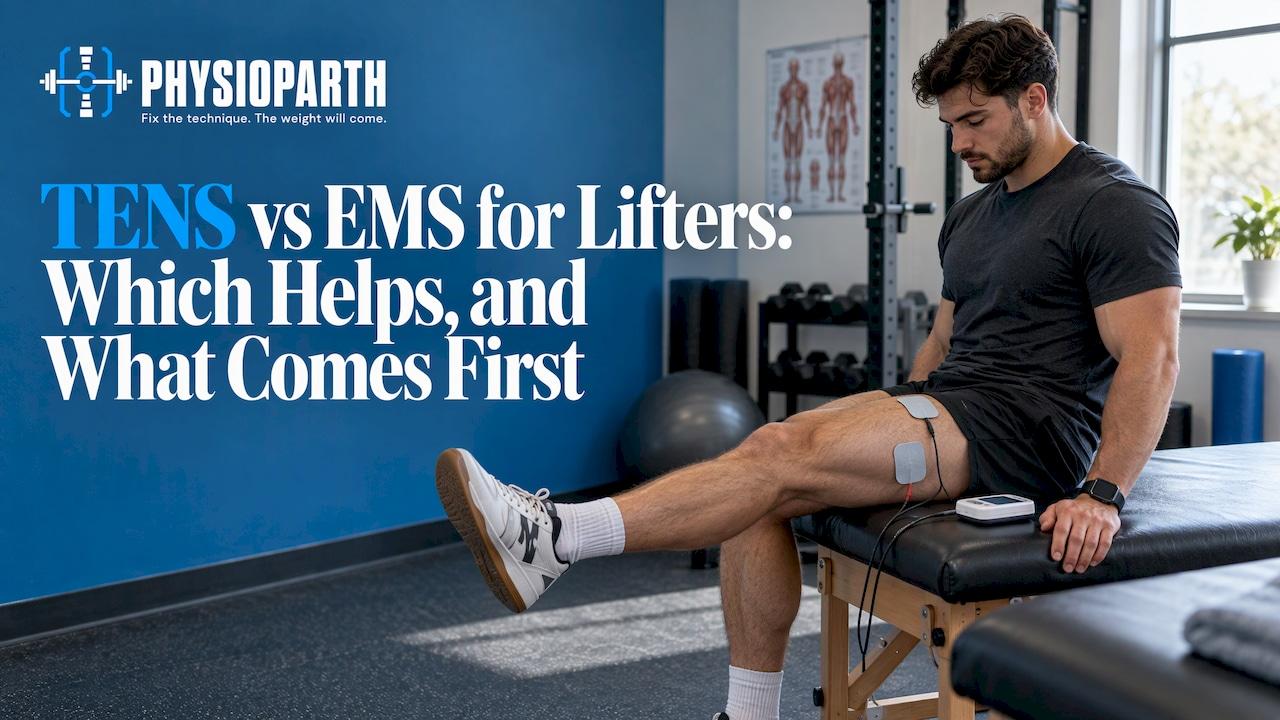
TENS and EMS are different tools. TENS uses electrical current on the sensory nerves to dampen pain for a while. EMS (also called NMES) uses stronger current to make the muscle itself contract. Neither one tells you why your squat, bench or deadlift hurts. A device may take the edge off, but the lasting change comes from working out which tissue is irritated and loading it in a way it can tolerate. That is the job I do as a registered physiotherapist and former competitive powerlifter, and the reason this comparison ends with a plan, not a purchase.
TL;DR
- TENS targets sensory nerves and is used for short-term pain relief. EMS/NMES targets muscle and is used for activation and recovery.
- Guideline-level evidence for TENS is conditional and low-certainty. It may reduce acute pain from some musculoskeletal injuries, but the size of the effect is uncertain.
- Kinesiology tape and braces are support and symptom tools. The evidence is stronger for some joints (lateral elbow) than others (patellofemoral pain, Achilles).
- Pain relief is a window, not a plan. Use it to train a modified variation, and progress by criteria, not calendar dates.
- Pregnancy, pacemakers, epilepsy, blood clots and undiagnosed persistent pain are reasons to speak to a doctor before any stimulation device.
Table of Contents
- TENS vs EMS at a glance
- What the research says about TENS
- What EMS can and cannot do for you
- Kinesiology tape vs brace
- Choosing a device in Canada
- Safety: who should not use stimulation
- Technique causes vs load causes
- Which structure is likely involved
- A criteria-based return to lifting
- How I can help
- FAQ
- Book with me
- Sources
TENS vs EMS at a glance
| TENS | EMS / NMES | |
|---|---|---|
| Target | Sensory nerves | Motor nerves and muscle |
| Goal | Short-term pain relief | Muscle activation, recovery |
| Feel | Tingling or buzzing | Rhythmic muscle contraction |
| Typical use for lifters | Pain that limits a session | Muscle that is hard to switch on, such as after surgery |
| What it does not do | Fix the cause of the pain | Replace heavy, progressive loading |
A TENS unit sends pulses through pads on the skin. The explanation commonly given is that this competes with pain signals travelling to the brain. EMS uses stronger pulses to recruit the muscle directly. Many consumer units offer both modes, so check the mode list and the safety manual of any device you consider.
What the research says about TENS
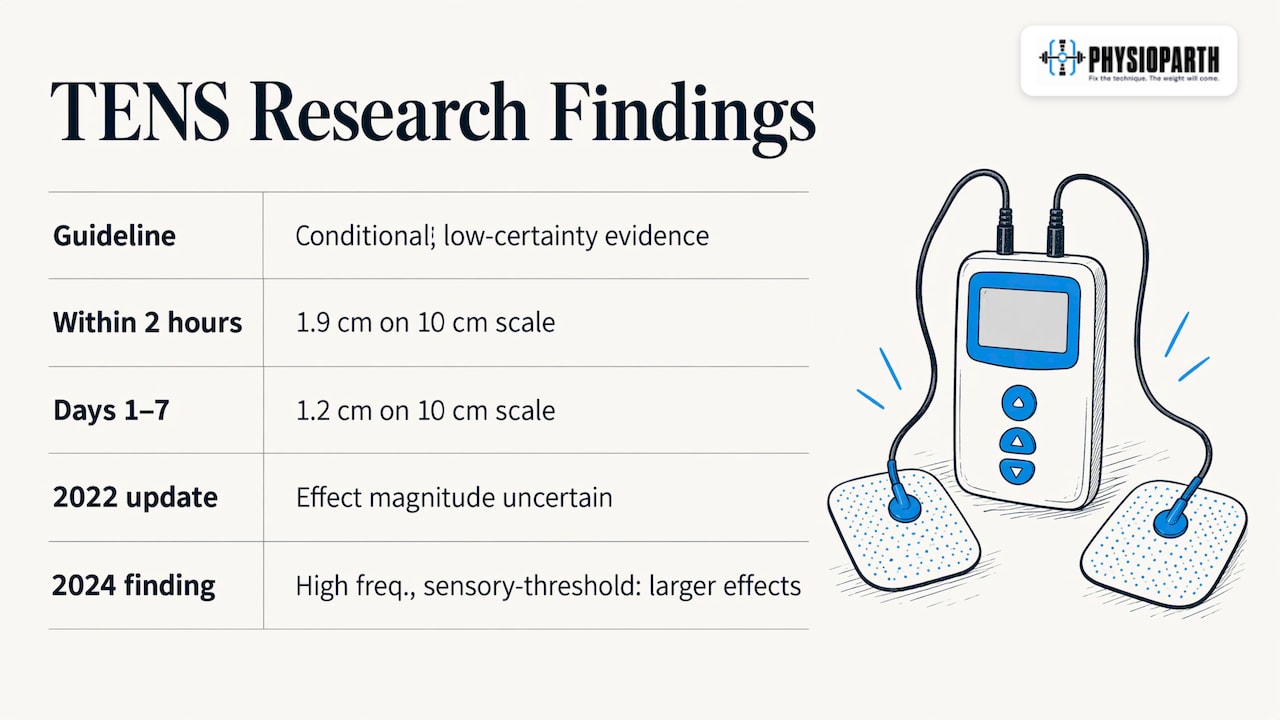
The American College of Physicians and AAFP guideline suggests TENS for acute pain from non-low-back musculoskeletal injuries. It is a conditional recommendation based on low-certainty evidence. The accompanying analysis found a pain reduction versus placebo of about 1.9 cm on a 10 cm scale within two hours, and about 1.2 cm at one to seven days.
A 2022 evidence update concludes that TENS may work across acute and chronic pain, but the magnitude of the effect remains uncertain because of low-quality trials. The authors point to stimulation intensity as critical: a strong but comfortable sensation matters.
For lifters, one finding stands out. A 2024 systematic review of TENS applied during exercise or functional activity found that high frequency at sensory-threshold intensity produced larger analgesic effects, with no significant adverse effects reported, though the authors say firm conclusions are premature. Pain relief is useful only if you use it to move better.
What EMS can and cannot do for you
EMS is typically used when a muscle will not activate well, for example after surgery or when pain inhibits a muscle you need to train. It is not a substitute for loading. Strength comes from lifting progressively heavier work, and the tissue adapts to the tension it is given. For a lifter, I see EMS as a short-term option to help wake a muscle up before you return it to real barbell work.
The lower-limb review in JOSPT found that evidence for electrical muscle stimulation in patellofemoral pain was not established. So expecting a device to carry a knee through a return to squatting is optimistic.
Kinesiology tape vs brace
The question comes up often for the elbow, knee and wrist.
- Rigid tape or a brace limits or offloads a structure. It can reduce pain enough to train.
- Kinesiology tape is elastic and does not restrict motion. Any benefit is mostly sensory and short term.
The best evidence is for the lateral elbow. The 2022 APTA clinical practice guideline recommends rigid taping for short-term pain relief in irritable lateral elbow tendinopathy, and kinesiology tape as part of a multimodal programme. It also supports TENS for short-term pain relief there. The same guideline cites a meta-analysis in which kinesiology tape improved lateral elbow pain and grip strength compared with control, with no increased skin irritation.
Elsewhere the evidence is thinner. In the JOSPT review, braces for midportion Achilles tendinopathy and taping for patellofemoral pain were not established. My practical read: choose a brace or tape by what it lets you do. If it lets you perform a modified variation with less pain, it is doing its job. If it lets you keep the same painful technique, it is hiding the problem.
For elbow-specific detail, see my pieces on bench press elbow pain and golfer's elbow from lifting.
Choosing a device in Canada
If you do buy a TENS unit, compare these points:
- Modes and controls: the TENS 7000 2nd Edition lists dual channels, 0 to 100 mA intensity, 2 to 50 Hz pulse rate and a 2 to 60 minute timer. It is TENS only and costs $52.99 in the US listing.
- Canadian pricing: Physio Supplies Canada lists the same unit, renamed InTENSity 7, at CAD $64.95, with a one-year warranty.
- TENS plus EMS: the Nampad Pro is sold as a TENS and EMS unit at $349.99 with 10 strength levels and USB-C charging. It is contraindicated for people with pacemakers or heart monitors.
- Batteries and pads: check the type, and whether replacement electrodes are available.
Prices move often, so check the live listing before you buy.
Safety: who should not use stimulation
A Canadian manufacturer's manual lists pregnancy, bleeding risk, DVT or blood clots, the front of the neck, chest, eyes, and undiagnosed persistent pain as contraindications. It also advises against placing pads on open wounds or infected or inflamed skin, and suggests sitting or lying down for the first five minutes. The NHS advises against TENS with epilepsy, a pacemaker, or pregnancy unless your doctor or midwife says otherwise.
Red flags: get in-person or medical assessment
Pain with these features may indicate something other than a muscle or tendon problem. Get assessed in person promptly, and go to emergency care for the first two:
- Loss of bladder or bowel control, or numbness in the saddle area
- Chest pain, shortness of breath, or a hot, swollen, painful calf
- Progressive weakness, or numbness spreading down an arm or leg
- Pain after a significant fall or impact, or with fever, or unexplained weight loss
- Constant night pain that does not change with position or movement
Technique causes vs load causes
A device does nothing about why the tissue got irritated. Sort the cause first.
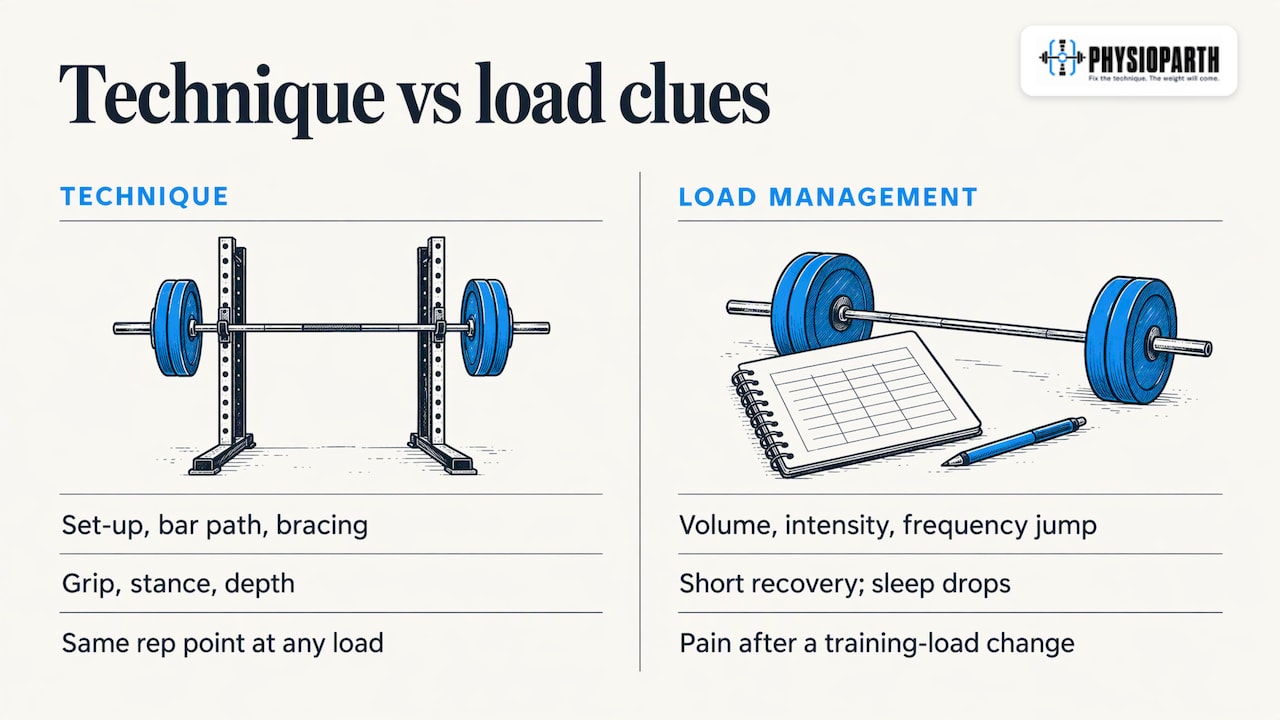
Technique causes: set-up, bar path, bracing, grip, stance and depth. For example, a wide bench grip or flared elbows may increase elbow load, and a loss of brace at the bottom of a squat may change where force goes.
Load-management causes: a jump in volume, intensity or frequency, or short recovery. A common pattern is adding a heavy block or new variation while sleep drops.
If pain started after a change in training load, look there first. If it shows up at the same point in a rep regardless of load, look at technique. Filming your sets helps. My free guides for the squat, bench and deadlift walk through what to look for, and the toolkit covers the hip and lower back.
Which structure is likely involved
I cannot diagnose you in an article, but these patterns may help you describe what you feel:
- Tendon (e.g. lateral or medial elbow, patellar): pain at a specific spot that is sharp under load and warm-up often eases it. It may indicate tendinopathy.
- Muscle: a more diffuse ache or pulling, often after a hard session, which may indicate a strain.
- Nerve (e.g. ulnar nerve at the elbow, sciatic nerve): tingling, burning or numbness that travels, often with certain positions. See cubital tunnel exercises or sciatica and deadlifts.
- Joint: pinching, catching or end-range pain.
These overlap, which is why an assessment of movement and loading matters.
A criteria-based return to lifting
Progress by criteria, not dates. Move to the next stage when you meet the criteria for the current one.
- Calm it down. Isometrics: a 30 to 45 second hold at a position where the pain is low. Criterion: pain during and after stays low and settles the same day.
- Rebuild tolerance with control. Tempo variations (three-second lowering) and paused reps at lighter loads. Criterion: you can do your working sets with consistent technique and no next-day flare.
- Change the demand. Swap the painful position for a friendlier one: Safety Squat Bar or box squat, floor press or pin press, trap bar or block pulls. Criterion: pain stays at a level you are comfortable with and does not build across sets.
- Load it heavily and slowly. Heavy slow resistance has a good track record in tendon problems; see my heavy slow resistance protocol.
- Return to the competition lift. Reintroduce the full movement at submaximal load, then build. Criterion: repeatable technique, symptoms settled within 24 hours, and tolerance of your usual volume.
A TENS unit, tape or brace can sit alongside stages 1 to 3 if it helps you complete the work. Use the relief to train, not to push through.
I have written this the way I would explain it to a lifter on a call. TENS and EMS can have a place, but I start with a movement screen, a look at your lift videos and a plan you can follow by criteria. Modified variations are part of that plan where appropriate, instead of complete rest.
Parth
How I can help
The Initial Assessment is $130 and includes a full subjective and objective assessment and a movement screen, plus a lift analysis if you send videos beforehand. It aims to explain what tissue may be irritated and to build a criteria-based return-to-lifting plan, using modified variations where appropriate. A Follow-Up Session is $100. No doctor's referral is needed to see a physiotherapist in Ontario, and many extended-health plans cover physiotherapy; I provide receipts. You can start at the Initial Assessment page, or check the audit and resources.

The free 15-minute call is a fit check, not an assessment or treatment.
FAQ
Is a TENS 7000 also an EMS unit?
The TENS 7000 is listed as a TENS unit. Its listed specs describe pulse rate, duration and intensity, not muscle-contraction programs. If you want both, look for a unit that lists TENS and EMS modes.
Which is better for muscle knots, EMS or TENS?
Neither is a reliable way to release tightness. TENS is used for short-term pain relief and EMS for muscle activation. A load-based approach to the sore area is more likely to help.
Can I use TENS on my legs while pregnant?
Pregnancy is listed as a contraindication in a Canadian device manual, and the NHS advises against TENS unless your doctor or midwife says it is fine. Speak to your doctor or midwife first.
Kinesiology tape or a brace for lifting?
Braces and rigid tape restrict motion, while kinesiology tape does not. Use whichever lets you perform a modified variation with less pain, and keep working on the cause.
Book with me
If pain is limiting your squat, bench, deadlift or press, book with me: a free 15-minute consult at physioparth.com.
Sources
- ACP/AAFP guideline on acute pain management
- Using TENS for Pain Control: Update on the State of the Evidence
- Effects of TENS applied during exercise, systematic review
- JOSPT review of physical agents for lower-limb soft tissue injuries
- APTA lateral elbow pain clinical practice guideline
- TENS 7000 2nd Edition specifications
- InTENSity 7 listing, Physio Supplies Canada
- Nampad Pro product page
- Stim-Medic manual, Electro-Medic
- NHS: TENS
Recommended
- Heavy Slow Resistance for Lifters: A Tendinopathy Protocol
- Overhead Press Pain: Causes, Tissue Clues and a Return Plan
- Forearm Pain When Lifting: Ontario Lifters Modify, Not Quit
- Deadlift Back Pain: Ontario Lifters’ Tissue Clues and Return Criteria
This article is general education for strength athletes and is not a substitute for an individual assessment. Pain that is severe, worsening, or accompanied by numbness, weakness or loss of function needs prompt in-person or medical assessment. Author: Parth Suthar, Registered Physiotherapist (Ontario).