
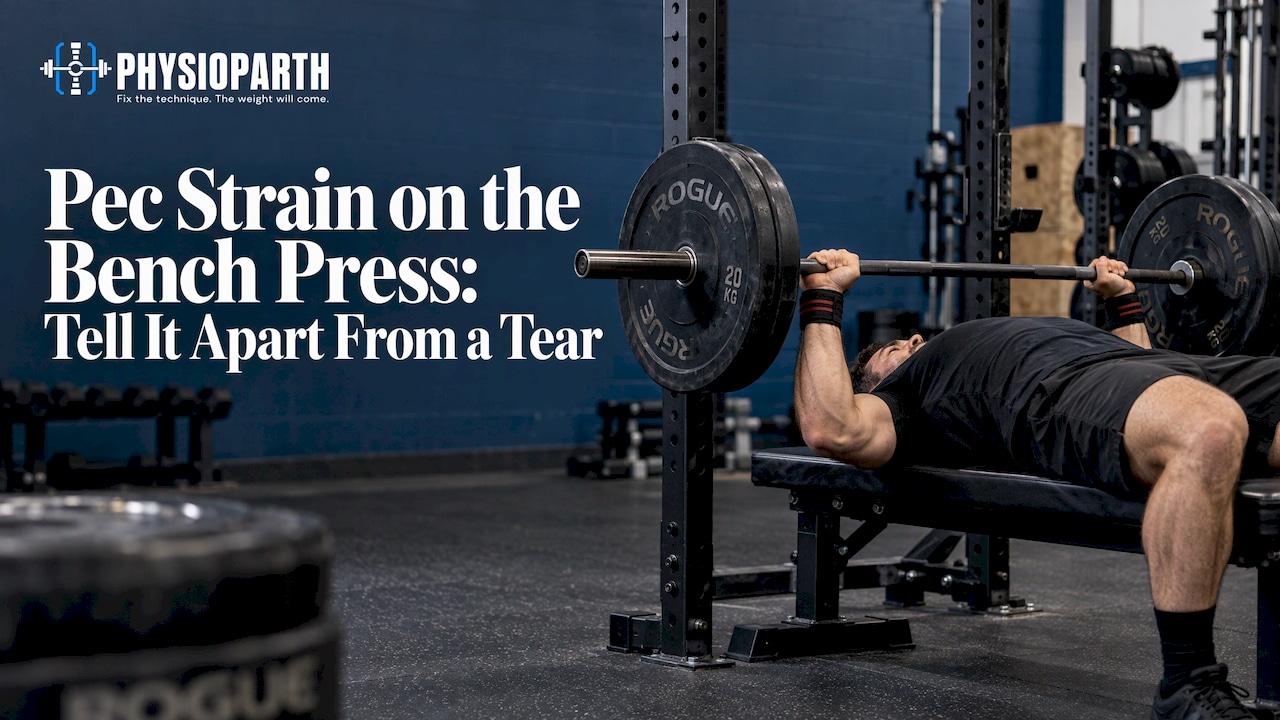
A pec strain on the bench usually shows up as a sharp or pulling pain in the chest or front of the shoulder, often near the bottom of the rep. A tear is a different problem. A pop, rapid bruising or a visible change in the chest contour may indicate a rupture, and that needs prompt medical assessment, not a training tweak. This article covers how the two may differ, which structures are usually involved, what to do in each case, and how I progress lifters back to benching by criteria rather than by calendar.
I'm Parth Suthar, a registered physiotherapist in Ontario and a former competitive powerlifter. I can't diagnose you from a web page, and nothing below replaces an in-person exam. It is meant to help you decide what to do next.
TL;DR
- A pop, a tearing feeling, fast bruising or weakness pressing the arm inward may indicate a pectoralis major rupture. Get assessed promptly, because delay can make repair harder.
- A dull, localized, load-related ache without those signs may be a strain or tendon irritation. Those cases are often managed with modified training.
- Technique (set-up, flare, depth, grip width) and load management (volume, intensity, frequency, recovery) are separate causes. Check both.
- Return by criteria: pain, range, strength and tolerance on a given variation, not a number of weeks.
- After a surgical repair, your surgeon's protocol leads. The published guidelines are slow and avoid 1RM testing.
Table of Contents
- What the pec actually is, and where it gets hurt
- Which structure may be involved, and how to tell them apart
- Red flags: when you need in-person or medical assessment
- What happens if it is a tear
- Why it happened: technique causes versus load-management causes
- Criteria-based return to benching
- How I work with lifters
- Perspective
- FAQ
- Sources
What the pec actually is, and where it gets hurt
The pectoralis major is a fan-shaped muscle with a clavicular head (upper) and a sternal head (lower). Both converge into a flat tendon that attaches to the humerus, the upper arm bone. On the bench, the muscle lengthens under load as the bar descends, then shortens to press. The injury risk is highest in that lengthened, loaded position.
The research describes the usual mechanism: the muscle is under very high tension during a maximal eccentric (lowering) contraction, particularly in the last 30 degrees of arm extension with external rotation, which is the bottom of a wide, deep bench (PMC review of pectoralis major injuries). Most of these injuries are reported during bench pressing.

Which structure may be involved, and how to tell them apart
The location and the story matter more than how "bad" it feels. These are the usual candidates. They are patterns that may indicate a structure, not a diagnosis.
| Structure | What it may feel like | Clues that may point to it |
|---|---|---|
| Pec major muscle belly (strain) | Pulling or sharp pain in the chest, worse at the bottom of the press or with a cross-body squeeze | Tender in the muscle itself, mild bruising at most, strength mostly intact |
| Pec major tendon at the humerus (partial or complete tear) | Sudden pain, often with a pop, near the front of the armpit | Bruising in the chest and armpit, swelling, weakness pushing the arm inward, sometimes a visible or palpable gap |
| Pec minor insertion | Deep ache at the front of the shoulder, below the collarbone | Tender near the coracoid process, often a gradual overuse pattern (Bhatia et al., bench-presser's shoulder) |
| Anterior deltoid or long head of biceps | Pain at the front of the shoulder, worse with lockout or lifting the arm forward | Tender over the groove at the front of the shoulder, pain with curling or reaching |
| Costochondral or rib area | Sharp, localized pain at the breastbone or ribs | Pain with deep breaths, coughing or pressing on the joint |
A few practical ways to separate them:
- Onset. A single moment with a pop leans toward the tendon. A gradual build over weeks leans toward irritation of the muscle, the pec minor or the biceps.
- Bruising. Bruising across the chest and into the armpit within days is a recognised sign of rupture, along with swelling and weakness in adduction and internal rotation (PMC review).
- Shape. On examination, a clinician may find a palpable defect in the front of the armpit and extra fullness over the pec (PMC review of upper extremity weightlifting injuries). Compare both sides in a mirror with your arms relaxed.
- Strength. Squeeze your hands together in front of your chest, then press one palm into the other. A clear drop on one side compared with the other is worth reporting.
- Breathing. Pain that changes with a deep breath more than with arm movement may indicate a rib or cartilage source, not the pec.
I can't tell which of these you have from here. An in-person exam, and imaging when needed, does that. My job in a virtual assessment is to listen to the story, test your movement and strength on video, and tell you whether your picture needs to be seen in person first.
Red flags: when you need in-person or medical assessment
Stop benching and get seen promptly, in person, if any of these apply:
- You felt or heard a pop or tearing sensation during a rep.
- Bruising appears across the chest, armpit or inner upper arm.
- There is a visible change in chest or armpit shape, or a gap you can feel.
- You have clear weakness pressing your arm inward or rotating it inward, compared with the other side.
- Swelling that keeps increasing, or pain that is severe at rest.
- Chest pain with shortness of breath, pain spreading into the jaw or left arm, sweating or light-headedness. That is an emergency: call 911.
- Numbness, tingling or colour change in the hand or arm.
AAOS guidance on pectoralis tendon tears says to seek medical care right away with these symptoms, and notes that rest, ice and anti-inflammatories may ease pain and bruising but will not heal a tear (OrthoInfo).
Seeing someone is not the only step. In Ontario, you don't need a doctor's referral to see a physiotherapist, though some insurers require one for reimbursement. A walk-in clinic, your family doctor or an emergency department can arrange imaging. In the meantime, stop loading the pec, keep the arm comfortable and note the date, the lift and the position it happened in.
Timing matters. Delayed presentation of a suspected pectoralis major tear can make surgical repair more technically difficult and lead to poorer outcomes compared with early intervention (PMC review). The mistakes people make by delaying orthopedic treatment are worth reading if you're tempted to wait and see.
What happens if it is a tear
Treatment depends on where the tear is and how much is torn. Partial tears, or complete tears without weakness, may be managed conservatively. Tendon avulsions from the bone are generally managed with surgery (PMC review of weightlifting injuries).

For high-demand athletes, the literature leans toward repair for complete acute tears, to restore strength and function (PMC review). Non-operative care is often unfavourable for them because of lost peak torque and ongoing weakness in shoulder adduction. Orthopedic experts also note that pain may settle without surgery while the chest deformity and weakness tend to persist (OrthoInfo). A systematic review found that 90% of patients who had a repair returned to sport, at a mean of 6.1 ± 1.7 months (Outcomes and return to sport review). That is an average from a study population, not a promise or a schedule for you.
The decision between repair and conservative care belongs to an orthopedic surgeon or sport medicine physician after an exam and imaging. If you have surgery, I work alongside your surgeon's protocol, not against it.
Why it happened: technique causes versus load-management causes
Whether you have a strain or a tear, the next question is the same: what put the pec in that position? I separate the causes, because the fixes are different.
Technique causes
- Set-up. A loose upper back lets the shoulders roll forward and the arm drift behind the torso at the bottom. Retract and depress the shoulder blades and keep them there. The bench press technique guide covers grip, shoulder blades and bar path.
- Grip width. A very wide grip puts the arm in more horizontal abduction and stretches the pec further under load. The guideline for post-repair rehab specifically avoids a wide grip on early dumbbell work for this reason (Wexner Medical Center guideline).
- Depth and bar path. Touching lower than your shoulders tolerate, or a bar that drifts toward the hips, may increase the stretch on the lower pec fibres.
- Elbow flare. Elbows flared at 90 degrees from the torso load the front of the shoulder and pec differently than a tucked angle of roughly 45 degrees. See my elbow pain on the bench article for the angle work.
- Bracing and grip. Losing leg drive or tightness mid-rep, or an uneven grip that lets one side lag, may overload one pec.
- Uncontrolled descent. Dropping into the bottom, especially with a bounce or a missed touch point, loads the pec in its most vulnerable position.
Load-management causes
- Volume spikes. Adding sets or a high-rep block quickly, especially with dips and flyes in the same week.
- Intensity. Frequent heavy singles or overload work above your typical top sets, without a ramp-up.
- Frequency. Benching hard on consecutive days, or stacking bench, overhead work and dips.
- Recovery. Poor sleep, a heavy training block with no deload, or returning to full load after time off.
If the story is a gradual build in pain with a technique drift under fatigue, I look for both. If it was a single heavy rep with a pop, load management is rarely the main story and the red flags above apply.
Criteria-based return to benching
These stages apply to a suspected mild strain or irritation cleared by a clinician, or as a framework alongside medical guidance. They don't replace a surgeon's protocol after repair. You move on when you meet the criteria for the current stage, not when a number of weeks passes. If pain flares or a gate isn't met, you stay at that stage or step back.
Stage 1: calm it down
- Gate to enter: red flags ruled out, resting pain settling.
- Work: pain-free-range movement, light scapular work, isometrics at mid-range (a gentle press into a wall or a light band hold, held 20 to 30 seconds), keeping the lower body training with a Safety Squat Bar squat or trap bar deadlift if your shoulder tolerates the set-up.
- Gate to move on: daily activities comfortable, isometric holds within a low pain level and not worse the next morning.
Stage 2: rebuild tolerance
- Work: floor press with light dumbbells (the floor limits the stretch at the bottom), tempo variations with a slow 3-second lowering, and higher-rep, controlled sets. Block pulls and trap bar deadlifts can keep pulling strength moving.
- Gate to move on: floor press with a clean tempo, no sharp pain, no increase in symptoms the next day, side-to-side strength looks similar.
Stage 3: bring the barbell back
- Work: pin presses from a mid-range start, paused bench with a short pause on the chest at a reduced load, and a narrower grip than usual. Use the 45-degree elbow angle.
- Gate to move on: reps are smooth at the same bar speed you expect, and pain stays at or below a low, stable level during and after.
Stage 4: full-range loading
- Work: full-range paused and tempo benching, building load across sessions, then your competition grip.
- Gate to move on: full range and your normal grip tolerated, no next-day flare-up, and you reach prior working weights over several sessions.
Stage 5: heavy and testing
- Work: heavy doubles and triples before anything near a max.
- Gate: strength within a close range of the other side on clinical testing, and confidence under load.
For post-repair rehab, the published guideline holds back active adduction, horizontal adduction and internal rotation early on, builds scapular and rotator-cuff strength, then moves to light, high-repetition dumbbell bench presses without a wide grip. It places return-to-sport preparation at 6 to 9 months, suggests isokinetic or one-arm hop testing, and discourages bench press 1RM testing (Wexner Medical Center guideline). Those timelines belong to that protocol and your surgeon.
If your pain feels more tendon-like and persists with load, the heavy slow resistance protocol uses similar principles. My free bench guide, the toolkit and the audit can help you check your set-up in the meantime.
How I work with lifters
If your red flags are clear and you have been cleared to train, a virtual physiotherapy visit may be a good next step. The Initial Assessment is $130 and includes a full subjective and objective assessment, a movement screen, and a lift analysis if you send videos beforehand. It aims to explain what tissue may be irritated and to build a criteria-based return-to-lifting plan, using modified variations where appropriate rather than complete rest. A Follow-Up Session is $100. Many extended-health plans cover physiotherapy, and I provide receipts for reimbursement. See the offers and booking details.

The free 15-minute call is a fit check, not an assessment or treatment. It helps us both decide whether virtual care suits what you're dealing with, or whether you should be seen in person first.
Perspective
Most lifters with chest pain on the bench ask the same thing: can I keep training? Sometimes the answer involves modified work, and sometimes it is a firm stop and an in-person exam. The skill is telling those apart early, and that is why I put red flags before exercises.
I benched for years as a competitive powerlifter, and I know how tempting it is to "test it" with a heavy single. A pop or bruising is not the time. A dull ache that builds with volume is different, and there I aim to look at your set-up, grip, depth and weekly load together, rather than prescribing rest by default.
That is what my virtual assessments aim to do: explain in lifter terms what may be irritated, and build a plan you can follow by criteria.
Parth
FAQ
Can I keep benching with a pec strain?
It depends on what you have. If you had a pop, bruising or clear weakness, stop and get assessed first. For a mild, load-related ache, many lifters modify training with floor press, tempo or pin variations at a pain level a clinician considers acceptable. I would check your technique and weekly volume at the same time.
How long until I can bench after a pec tear?
It depends on the tear and the treatment. After surgical repair, one guideline places return-to-sport preparation at 6 to 9 months, and a systematic review reported a mean return of 6.1 months (review). Your surgeon's protocol and your testing results decide, not a calendar.
Will a torn pec heal on its own?
Pain may settle with rest, ice and anti-inflammatories, but OrthoInfo notes they will not heal the tear itself (OrthoInfo). Partial tears may be managed without surgery, so get a clinical exam and imaging to know which situation you're in.
Do I need a referral to see a physiotherapist in Ontario?
No. You can book directly with a physiotherapist in Ontario, though some insurers require a referral for reimbursement. If your symptoms match the red flags above, the first stop should be in-person medical assessment.
Is a pec strain different from "bench-presser's shoulder"?
They may overlap in feel. Pec minor insertional tendinopathy from bench pressing has been described as an overuse problem at the front of the shoulder, unlike a sudden major tear. The location and onset help sort them out, but only an exam can confirm.
If you want a plan built around your lifts, book with me for a free 15-minute consult at physioparth.com.
Sources
- Injuries of the Pectoralis Major: Diagnosis and Management (PMC)
- Pectoralis Tendon Tear, OrthoInfo (AAOS)
- Upper extremity weightlifting injuries: Diagnosis and management (PMC)
- Outcomes and Return to Sport After Pectoralis Major Tendon Repair (PMC)
- Pectoralis Major Tendon Repair Clinical Practice Guideline (Wexner Medical Center)
- Bench-presser's shoulder: pectoralis minor insertional tendinopathy (PMC)
Recommended
- Wrist Pain on the Bench Press: Causes, Fixes, Return Plan
- Bench Press Technique: Grip, Shoulder Blades and Bar Path
- Bench Shoulder Pain in Ontario: When a 45° Fix Isn’t Enough
- Bench Press Elbow Pain: 45° Fixes for Strength Athletes
This article is general education for strength athletes and is not a substitute for an individual assessment. Pain that is severe, worsening, or accompanied by numbness, weakness or loss of function needs prompt in-person or medical assessment. Author: Parth Suthar, Registered Physiotherapist (Ontario).