
For most strength athletes the answer is both, with the ratio set by your goal and by how your shoulders, elbows and wrists tolerate the bottom of the rep. The paused bench builds control off the chest and matches how a meet is judged. Touch-and-go lets you accumulate more heavy volume at a higher bar speed. If you are managing pain, the pause also becomes a tool: it lets you modify load without stopping benching altogether.
I'm Parth Suthar, a registered physiotherapist in Ontario and a former competitive powerlifter. Below I cover what actually differs between the two, what the research says about the gap, how to choose, and how to step back toward your normal bench by criteria rather than by calendar.
TL;DR
- Touch-and-go means lowering the bar to the chest and pressing immediately. A paused rep holds the bar still on the chest first, which removes most of the rebound.
- In one study of 113 adults, touch-and-go 1RM was about 7.6 to 8.3% higher than the paused (concentric-only) 1RM. Expect your paused max to be lower.
- If you compete, you need to train the pause. Meet rules require the bar to be motionless on the chest before the press command.
- If you are managing pain, the pause or a lighter, slower variation may be an option that lets you keep benching. Progress by criteria, not by dates.
- Chest pain with a sudden pop, numbness, or night pain needs in-person or medical assessment first. See the red-flags section.
Table of Contents
- What actually differs between the two
- How big is the strength gap?
- Paused bench: what it trains and where it fits
- Touch-and-go bench: what it trains and where it fits
- What the rulebooks require
- How to choose: a simple decision guide
- Technique causes versus load-management causes
- Which structures are most likely involved, and how to tell them apart
- A criteria-based return-to-bench progression
- Red flags: when you need in-person or medical assessment
- Where virtual physio fits
- Perspective
- FAQ
- Sources
What actually differs between the two
In the research, touch-and-go meant lowering the bar to the chest and immediately pressing it, while the paused version meant waiting with the bar on the chest for two seconds first. The difference sounds small. Mechanically it is not.
On the way down, the muscles around the shoulder and chest lengthen under load and store elastic energy. If you press right away, some of that energy returns. If you wait, it dissipates. A classic 1991 study of experienced weightlifters pressing at 95% of their maximum found that the benefit from the prior stretch faded as the pause got longer, with a half-life of about 0.85 seconds. That is a small sample of 12 men, so treat it as an explanation of why the pause feels harder, not as a rule about exact timing.
Three practical consequences follow:
- The bottom position is where you work. With a pause, you start the press from a dead stop, so leg drive, upper back tension and the exact bar position over the forearms all get tested.
- Faults show up sooner. Losing tightness, flaring the elbows, or letting the bar drift toward the neck is hard to hide when you are stationary.
- Load goes down. The bar you can touch-and-go is heavier than the bar you can pause.
How big is the strength gap?
A 2021 study by García-Ramos and colleagues tested 113 adults (87 men and 26 women). Using direct 1RM testing, touch-and-go was 7.80% higher in men and 7.62% higher in women. Estimates from repetitions to failure gave similar numbers, 8.29% in men and 7.49% in women.
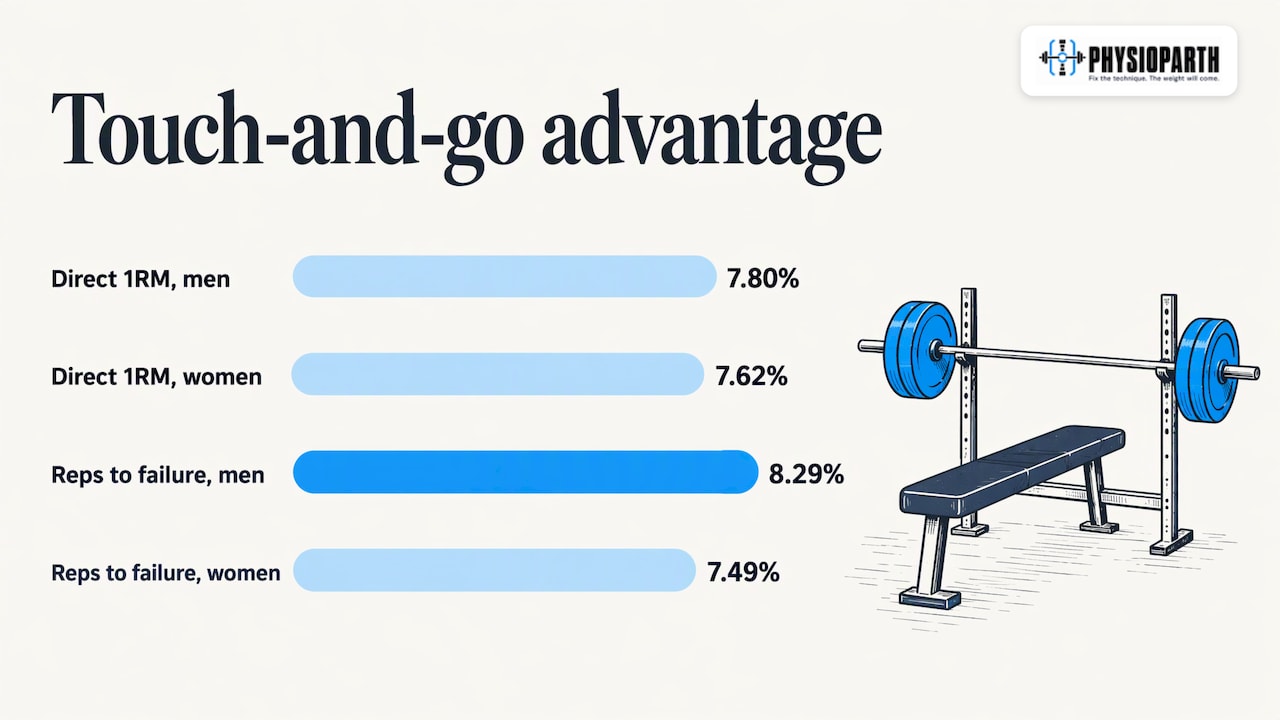
A worked example: if your touch-and-go max is 140 kg, a gap near 8% would put your paused max around 129 kg. Those are averages. Your own gap may be larger if you rely heavily on the bounce, or smaller if you already bench with a stable, controlled touch.
A big gap is useful information about technique and control, but it does not say anything about your tissues. Do not read it as a fault. It is a training signal.
Paused bench: what it trains and where it fits
Best for: lifters who compete, lifters who lose position at the chest, and lifters whose sticking point is just off the chest.
What it does well:
- Keeps your practice close to how competition lifts are judged.
- Builds off-the-chest strength and the habit of staying tight.
- Slows the rep down, which can make a modified, lighter session still feel productive.
What to watch:
- Longer time under tension at the bottom of the rep. If a shoulder is irritable, the bottom position under a long pause may be the exact spot it complains about.
- Pause length. A one-second pause is a different stimulus from a three-second pause. Choose one and stay consistent so you can compare sessions.
Touch-and-go bench: what it trains and where it fits
Best for: higher-volume work, hypertrophy, and practising bar speed and rhythm with moderate loads.
What it does well:
- Lets you do more quality reps at a given load.
- Trains the full cycle of lowering and pressing as one smooth movement.
- Is easier to repeat across multiple sets with less fatigue at the bottom.
What to watch:
- A rep that bounces off the sternum is not the same as a controlled touch. If you use touch-and-go, own the descent and make contact lightly.
- If you compete, do not let touch-and-go become your only bench. Meet rules do not reward the rebound.
What the rulebooks require
If you plan to compete in Ontario or elsewhere in Canada, the pause is non-negotiable. The IPF 2026 technical rulebook lists heaving or sinking the bar once it is motionless on the chest, in a way that aids the lifter, as grounds for disqualification. Other bodies spell it out similarly. The Powerlifting Federation Inc. general rules (revised September 2024) define the chest target as the base of the sternum, require the bar to be motionless before the chief referee signals the press, and cap hand spacing at 81 cm between forefingers. The CPAF abridged bench rules for the police and fire games say the same about a definite, visible pause.
Each federation has its own wording and command timing, so check your federation's current rulebook before a meet. The practical point is the same: train the pause that your judges will want to see.
How to choose: a simple decision guide
| Your situation | Lean toward | Reason |
|---|---|---|
| Competing in the next training block | Paused as the main bench, touch-and-go as accessory volume | Matches meet standards |
| Chest feels like your weak point | Paused, moderate loads | Builds control and tightness off the chest |
| Want volume and size, no meet planned | Touch-and-go, with a controlled touch | More reps at a given load |
| Shoulder or elbow irritated in the bottom position | Tempo or shortened-range variations first, then reintroduce the pause by criteria | Lets you modify the stress |
| Max bench is far above your paused max | Add paused sets in the 70 to 85% range | Closes the control gap |
A common structure is one paused session and one touch-and-go session per week, with the pause on the lighter-to-moderate day and touch-and-go on the heavier or higher-volume day. Treat that as a starting template, not a prescription.
Technique causes versus load-management causes
When bench pain shows up, it helps to separate two buckets. They overlap, but they are fixed differently.
Technique causes
- Set-up: loose upper back, shoulder blades not set, or hips drifting.
- Bar path: the bar landing too high toward the neck or too low toward the abdomen.
- Bracing: losing trunk and leg tension at the chest. See my notes on how and when to brace.
- Grip: wrist extended behind the bar, or a grip so wide it loads the front of the shoulder.
- Stance and arch: feet position that lets the hips float on the pause.
- Depth: touching too high or sinking the bar into the chest.
My bench technique guide walks through grip, shoulder blades and bar path in more detail.
Load-management causes
- Volume: a sudden jump in sets, especially of paused work with long time under tension.
- Intensity: too many near-max singles.
- Frequency: benching or pressing heavy on consecutive days.
- Recovery: poor sleep, stress, or an accumulating training block with no easier week.
If pain started after a change in the programme, load management may be the lead suspect. If it has been there for months despite stable training, technique deserves a closer look. A video review of your set-up and bar path is often the quickest way to sort it out.
Which structures are most likely involved, and how to tell them apart
I cannot diagnose you through an article, and pain location is only a clue. These are the structures lifters most often point to on the bench, and the patterns that may indicate each one:
- Front of the shoulder (biceps long-head tendon, anterior capsule, rotator cuff): an ache at the front of the shoulder that is worst at the bottom of the rep or on the first push off the chest may indicate irritation here. Wide grips and deep, long pauses often aggravate it. See bench shoulder pain.
- Pectoralis major (chest muscle and tendon): pain in the chest or armpit region that comes on at the bottom or with a sudden sharp event may indicate a strain. A pop, bruising or visible change needs in-person assessment. I cover how to tell a strain from a tear.
- Elbow (triceps tendon at the back, common flexor or extensor tendons at the sides): pain at the back of the elbow at lockout may indicate triceps involvement, while inner or outer elbow pain that builds with grip and volume may indicate tendon irritation. More in bench press elbow pain.
- Wrist: pain on the thumb or back side of the wrist when the bar sits too far back in the palm may indicate load through the wrist extensors or joint. See wrist pain on the bench.
- Acromioclavicular (AC) joint, top of the shoulder: a localised sore spot on top of the shoulder that flares at the bottom of the rep and with cross-body movement may indicate this joint.
To tell them apart, note three things: where exactly you can point to the pain, which part of the rep provokes it (bottom, mid-range or lockout), and what changes it (grip width, pause, tempo, elbow angle). Write those down for a week. That record is more useful than any single test.
If one side is consistently worse, my article on the uneven bench press is worth a read.
A criteria-based return-to-bench progression
This is a general framework, not a plan written for you. Move to the next stage only when you meet the criteria for the one you are in. Do not use calendar dates.
Stage 1: Calm it down
- Variations: isometric presses against pins at a pain-tolerable height, floor press with a controlled lowering, and light tempo bench (for example a three-second lowering) with a short range.
- Move on when: pain during and after the session is low and settles back to your baseline by the next day, and you can complete the planned sets without changing your technique to avoid pain.
Stage 2: Rebuild the bottom position
- Variations: paused bench at lighter loads with a short pause, pin press from the chest, tempo bench, and a Swiss or neutral-grip bar if your gym has one.
- Move on when: you can pause on the chest without pain climbing during the set or the next day, and your reps look the same from first to last on video.
Stage 3: Rebuild load
- Variations: heavier paused bench, Safety Squat Bar or trap bar work for lower-body and upper-back volume so you maintain training while the bench rebuilds, and touch-and-go sets at moderate loads with a controlled touch.
- Move on when: you can handle your planned working weights with stable bar path and symptoms that stay within your tolerance and settle within a day.
Stage 4: Return to your normal bench
- Variations: your usual mix of paused and touch-and-go, with heavier singles reintroduced gradually.
- Stay here when: you tolerate your usual volume across a full training week without a rise in symptoms.
A few notes on using it:
- Overhead press and deadlift variations like block pulls can often continue at a reduced load if they do not provoke the same pain. Pain on overhead pressing is a different problem, covered in my overhead press pain guide.
- If symptoms rise and stay up for more than a day, drop back one stage rather than pushing through.
- Modified training rather than complete rest is the goal where it fits, but it depends on what is irritated.
Red flags: when you need in-person or medical assessment
Book an in-person or medical assessment before continuing to train through any of these:
- A sudden pop or tearing sensation in the chest, shoulder or upper arm, especially with bruising or a visible change in the shape of the muscle.
- Numbness, tingling, or weakness that spreads down the arm or into the hand, or a hand that feels cold or changes colour.
- Pain at night that wakes you and does not ease with position changes.
- Chest pain, shortness of breath, or pain with exertion that is not clearly mechanical. Call 911 or go to emergency for these.
- Fever, unexplained weight loss, or a hot, swollen joint.
- A significant fall or impact on the shoulder, elbow or wrist followed by inability to move it or bear weight through it.
- Symptoms that keep worsening over several weeks despite reducing load.
A family doctor, walk-in clinic or emergency department is the right place for these. In Ontario you do not need a referral to see a physiotherapist, though some insurers ask for one for reimbursement.
Where virtual physio fits
If your bench is already sore, picking between paused and touch-and-go is not just a preference. The right variation depends on which position and which tissue is irritated. My Initial Assessment is $130 and includes a full subjective and objective assessment and a movement screen, plus a lift analysis if you send videos beforehand. It aims to explain what tissue may be irritated and to build a criteria-based return-to-lifting plan, using modified variations where appropriate rather than complete rest. Follow-up sessions are $100. I provide receipts for insurance reimbursement, and many extended-health plans cover physiotherapy.
For general lower-body and back work while the bench settles, my Hip and Lower Back Toolkit is a free place to start.
If you want to see whether it is a fit, the free 15-minute call is a fit check, not an assessment or treatment. You can book with me for a free 15-minute consult and we'll talk through what you are dealing with.

Perspective
When a lifter asks me paused or touch-and-go, I hear a different question underneath: what is my bench telling me?
As a former competitive powerlifter, I know the pause is honest. It shows where you lose tension and where the bar wants to wander. As a physiotherapist, I also know it can pile stress onto an already irritated spot if the pause is long and the load is high. Neither variation is the problem. The match between variation and tissue tolerance is what matters.
That is why my assessments aim to look at the lift itself, through your videos, alongside what you feel. The goal is a plan built on criteria, with tempo, paused, pin and floor press variations chosen to fit what is irritated, so you have something to progress against besides the calendar.
Parth
FAQ
How long should the pause be on a paused bench?
In the gym, many lifters use one to two seconds, and the research comparison used a two-second pause. Pick a duration, count it consistently, and make sure the bar is fully still. In competition, the referee's command decides, so practise with your federation's rules in mind.
If I can't pause a weight, can I bench it?
On average, touch-and-go strength is around 8% higher than paused strength in the 2021 study, so a gap is normal. In a meet, though, a bounced rep can be disqualified, so for competition the paused number is the one that matters.
Which is better for shoulder pain?
It depends on what provokes it. If the bottom position aggravates the front of the shoulder, a long pause may be the harder option, and a tempo, pin or floor press variation may be a better starting point. A shoulder that is fine at the bottom may tolerate paused work well. A physiotherapist can look at your video and symptoms to help you choose.
Can I do both in the same week?
Yes. A common approach is paused work on one day and touch-and-go on another, with the heavier day matched to how you feel. Keep total weekly volume and frequency steady rather than raising everything at once.
Sources
- Concentric-Only Versus Touch-and-Go Bench Press, PMC (2021)
- The effect on performance of imposing a delay during a push-up/bench press movement, PubMed (1991)
- IPF Technical Rulebook, effective 1 March 2026
- Powerlifting Federation Inc. General Rules, September 2024
- CPAF Bench Press/Push Pull Abridged Rules, 2023
Recommended
- Bench Press Technique: Grip, Shoulder Blades and Bar Path
- Uneven Bench Press: Causes, Fixes and a Return Plan
- Bench Shoulder Pain in Ontario: When a 45° Fix Isn’t Enough
- Bench Press Elbow Pain: 45° Fixes for Strength Athletes
This article is general education for strength athletes and is not a substitute for an individual assessment. Pain that is severe, worsening, or accompanied by numbness, weakness or loss of function needs prompt in-person or medical assessment. Author: Parth Suthar, Registered Physiotherapist (Ontario).