
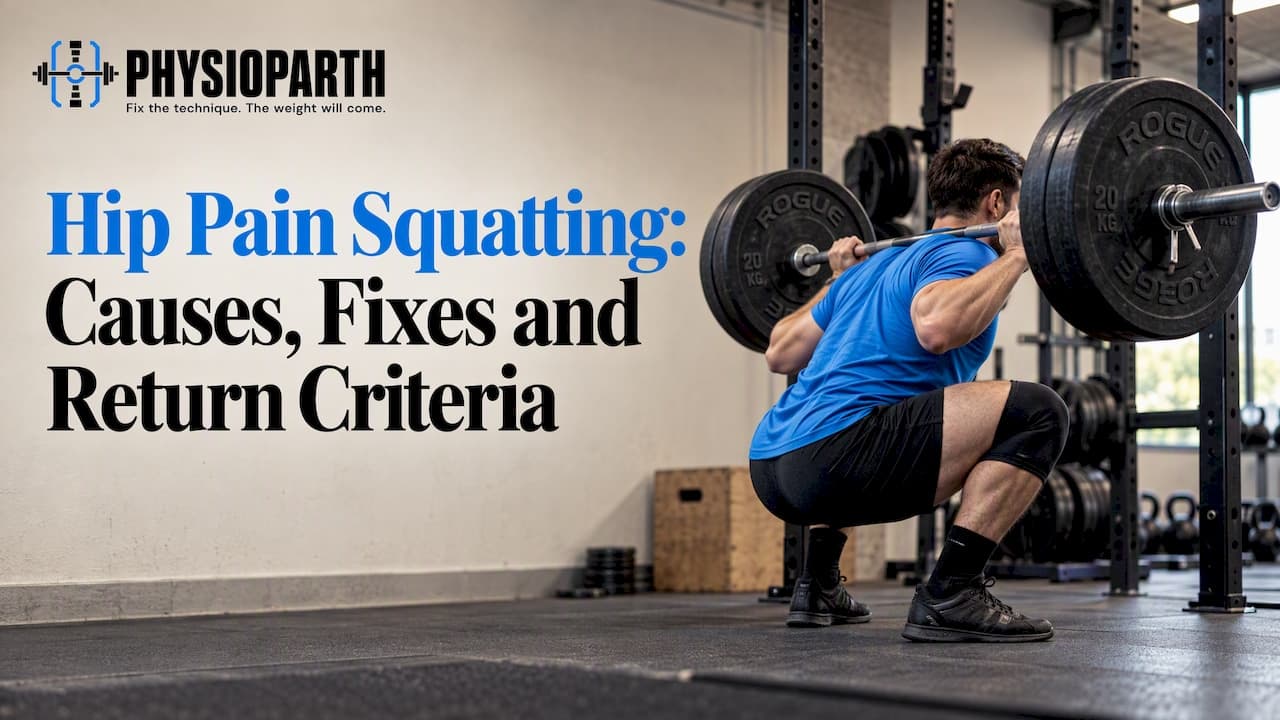
Hip pain when you squat usually comes from one of two places: how you set up and move under the bar, or how much load your hip tissues are currently ready to handle. Often it is both. The useful first step is working out where the pain sits (front, side or deep in the joint) and when in the rep it shows up. That tells you which variations to swap in while you keep training.
I'm Parth Suthar, a registered physiotherapist in Ontario and a former competitive powerlifter. This guide is written for lifters who squat heavy and want a plan, not a lecture on stretching. It is general education, not a diagnosis. I can't tell what is going on in your hip without watching you lift.
TL;DR
- Note where the pain is: front or groin, outside of the hip, or deep and pinchy. Each pattern may point to different structures.
- Separate technique causes (stance, depth, pelvis position, bracing, bar path) from load causes (volume, intensity, frequency, recovery). Fix the one that fits your pattern first.
- Rest is rarely the whole answer. Current guidelines for non-arthritic hip pain favour activity modification plus targeted strengthening.
- Progress back to your competition squat by criteria (pain, control, tolerance next day), not by calendar dates.
- Red flags such as night pain, a fall, fever or a hip that won't bear weight need in-person assessment.
Table of Contents
- Where does the hip pain show up?
- Why a heavy squat loads the hip so much
- Technique causes
- Load-management causes
- How to keep squatting: a criteria-based progression
- Red flags: when you need in-person or medical assessment
- Perspective: what I see with squatters
- Getting the lift assessed
- FAQ
- Sources
Where does the hip pain show up?
Start with location, because "hip pain" covers several different problems. These are patterns, not diagnoses. Treat them as clues to bring to a clinician or to your own training log.
| Where it hurts | Structures that may be involved | Typical clue |
|---|---|---|
| Front of the hip or crease, sometimes the groin | Hip flexors (iliopsoas), the joint capsule and labrum, or the joint itself | Pinching at the bottom, worse with deeper depth or a narrow stance |
| Outside of the hip, over the bony point | Gluteal tendons (gluteus medius and minimus) and surrounding tissue, often labelled greater trochanteric pain syndrome | Tender to press, painful lying on that side, aching after sessions |
| Deep, vague ache, sometimes into the buttock | Hip joint, deep rotators, or referred pain from the lower back or SI joint | Changes with back position or bracing more than with depth |
| Inner thigh or groin, sharp on drive out of the hole | Adductor muscles | Pain with squeezing the knees together or wide stances |
The lateral hip is a good example of why labels matter. A sports medicine resource from Ohio State Wexner Medical Center on greater trochanteric pain syndrome describes it as lateral hip pain on palpation, and stresses that treatment should address the loading problem rather than only stretching. It also notes that referred pain from the lumbar spine or SI joint has to be considered.
How to tell front, side and referred pain apart
Use these quick observations. They help you describe the problem accurately. They do not confirm anything.
- Does depth change it? Pain that arrives at a consistent depth and eases when you stop higher may indicate the front of the hip is being compressed or pinched at end range.
- Does lying on your side hurt? Outer hip pain at night on that side, plus tenderness over the bony point, may indicate a gluteal tendon that is irritated by compression.
- Does your back position change it? If pain shifts when you brace differently, tuck or flare your ribs, or sit versus stand, the lower back or SI joint may be contributing. Our squat lower back pain guide covers that overlap.
- Does it happen with a hip flexor-heavy movement? Pain when lifting the knee, in a high-knee march or when you sprint may indicate a hip flexor strain. The hip flexor strain guide walks through grades and return criteria.
- Is it a catching, locking or giving-way feeling? That pattern may indicate a labral or joint issue and is worth an in-person exam.
Why a heavy squat loads the hip so much
The hip takes a lot of force in a max-effort squat. A 2025 study of elite powerlifters in PLOS One measured joint contact forces as intensity rose, and at 90% of 1RM the hip joint contact force reached about 15.5 times body weight. That does not mean squatting is dangerous. It means the hip is working hard, and a small change in volume, intensity or position can push a tissue past what it currently tolerates.
A systematic review of hip conditions and squat performance also shows that common hip problems and squat mechanics influence each other. That is why I look at both the lift and the load history.

Technique causes
These are the things I check on video first. Film from the side and from the front at the bottom of a working set, not a warm-up.
Stance width and foot angle
Stance changes the demand on the hip. The 2023 JOSPT guideline summary notes that narrow versus wide stances alter hip joint demand, so a stance that fits one lifter can pinch another. If the front of your hip pinches at depth, a slightly wider stance with toes turned out a bit more may make room. If the outside of your hip aches, a very wide stance with forced knee drive may be the irritant.
The "knees out" overcorrection
Knees caving in is usually the fault people fix. But chasing maximal knees-out can overcorrect and push the hip into forced abduction and external rotation, which may add compression at the outer hip. Aim for knees tracking over the middle of your foot, not as far out as possible.
Depth and pelvic position
Every lifter has a depth where the pelvis starts to tuck under (often called butt wink) or the hip runs out of room. If pain appears at the same point each time, that depth may be where the joint or its soft tissue is being squeezed. Hip anatomy varies, and some people simply need a different stance or bar position to reach depth comfortably. It is not always a flexibility problem.
Bracing and rib position
A flared rib cage and an arched lower back change how the pelvis sits and how much the hip flexors work to hold you upright. If pain eases when you brace with ribs stacked over the pelvis, bracing may be part of the story. My squat bracing guide covers cues and progressions.
Bar position and bar path
A high-bar squat, low-bar squat and Safety Squat Bar each change torso angle and where the load sits relative to the hip. Moving the bar path forward of mid-foot makes the hips do more work out of the hole. Drift you cannot feel in the moment shows up clearly on a side-view video.
Load-management causes
Sometimes your technique is the same as it was six months ago and the pain still arrived. That is where load matters.
- Volume: a jump in weekly squat sets, especially at heavy percentages.
- Intensity: more reps above roughly 85% of 1RM, or a new peak block.
- Frequency: adding a third squat day without removing anything.
- Recovery: poor sleep, a heavy work period or a stacked deadlift day can reduce what your tissues tolerate.
- New stimulus: a new squat variation, a deficit, or high-volume split squats and lunges.
A useful framework is the acute:chronic workload principle in BJSM: compare the load you are doing now against your four-week average, and be wary of spikes. If your pain began after a jump in sets or a heavier block, load is a strong suspect before technique.
When the cause is load, stretching rarely solves it. If the tissue is irritated by compression, repeatedly pushing it into a stretched, compressed position can aggravate it. Strength and graded loading are generally more useful.
How to keep squatting: a criteria-based progression
The goal is to keep training while the hip settles, then rebuild toward your competition squat. Move up a stage only when you meet the criteria for the current one. There are no calendar dates. Some lifters pass a stage in a week and others need longer.
A reasonable pain guide: mild discomfort that stays low (around 3 out of 10 or less) and settles within 24 hours may be acceptable. Pain that climbs during the set, changes your movement or lingers into the next day is a sign to drop back a stage. This is general guidance, and a clinician may set a different threshold for you.
Stage 1: Calm it down and keep the pattern
- Isometrics: a mid-range wall sit or isometric split squat hold, or a hip-hinge or glute bridge hold, for 30 to 45 seconds, several sets.
- Box or pin squat to a pain-free height: squat to a box set above the depth where pain starts.
- Safety Squat Bar: the SSB shifts load and keeps the torso more upright, so it can be a useful swap if the competition bar position provokes pain.
Move on when: you can do your Stage 1 work with pain at or below your agreed ceiling, and the hip feels the same or better the next morning.
Stage 2: Rebuild tolerance with control
- Tempo squats: 3 to 4 seconds down, a brief pause above the painful depth, normal speed up.
- Paused squats at a pain-free depth: a 1 to 2 second pause builds control and shows where the pelvis and ribs shift.
- Heavy, slow resistance: the lateral hip evidence supports progressive mechanical loading rather than aggressive stretching. Think hip abduction and gluteal work, step-ups and hip thrusts, done slowly.
- Trap bar deadlift: if deadlifts irritate the hip, a trap bar or block pulls from an elevated height reduce the range the hip has to cover. For back symptoms, the deadlift back pain guide covers return criteria.
Move on when: tempo and paused squats are pain-free to your target depth for two sessions in a row, and you can keep ribs and pelvis stacked on video.
Stage 3: Return depth and load
- Lower the pins or box one step at a time toward your competition depth.
- Rebuild intensity: work back through 70%, then 80% for sets of 3 to 5 before touching heavier singles.
- Reintroduce your competition bar once the SSB or box variation feels easy and pain-free at similar loads.
- Keep a smaller dose of strength accessories (hip abduction, adductor work and single-leg work) in the program.
Move on when: you hit your working weights at competition depth, with a stable pain response in the hours and day after, for several sessions.
Stage 4: Build back to peak work
Add frequency and top-end work gradually, and avoid increasing volume and intensity in the same week. Keep the variation that helped as an off-season or deload tool. For the upper body parallel, floor press and similar swaps work the same way, as in the bench shoulder pain guide.
If you want the free squat resources, start with the squat guide and the Lifter's Hip & Lower Back Toolkit.
Red flags: when you need in-person or medical assessment
A video assessment can't replace a hands-on exam or imaging when something more serious may be going on. Get assessed in person promptly, through your family doctor, a walk-in clinic or an emergency department, if you have:
- Pain after a fall, collision or a sudden pop, especially if you can't bear weight
- Severe or escalating pain at rest or at night that doesn't change with position
- Fever, unexplained weight loss, or a history of cancer alongside hip or groin pain
- Numbness, tingling or weakness down the leg, or changes in bladder or bowel control (go to emergency)
- A hot, swollen or red hip, or you feel generally unwell
- A hip that locks, catches painfully or gives way
- Groin pain in the weeks after a hard session along with a limp, which may need a bone stress assessment
Hip pain can also be referred from the spine, and Health Canada's musculoskeletal clinical guide lists referred pain from the lumbar spine as a cause of hip pain. If your pain doesn't follow a mechanical pattern, that is another reason to be examined in person. An in-person physiotherapist or sports medicine physician can order or refer for imaging when it is indicated. I can help you work out which route fits, and I'll tell you honestly when a case is outside what a video visit can do.
Perspective: what I see with squatters
Most lifters who message me about hip pain have already tried stretching and a foam roller. When I watch their squat, the pattern is rarely a lack of flexibility. More often it is a stance that doesn't suit their hip structure, a depth they chase because a coach said so, or a block of training where sets and intensity climbed in the same fortnight.
The most common mistake is stopping squatting entirely. You lose strength, and the hip comes back to a load it is no longer ready for. The better approach is to find the variation your hip tolerates today, such as an SSB, box, tempo or paused squat, and build from it with clear criteria. I treat pain as information about load, position and capacity, not as proof that you are broken.
I also don't promise outcomes. Hip pain has several possible sources, and a good plan changes as your response changes. What I can promise is a clear explanation of what may be irritated, in lifter terms, and a plan that keeps you training.
— Parth
Getting the lift assessed
If your hip pain has hung around for more than a couple of weeks, or you can't tell whether it's technique or load, a video assessment of your actual squat will answer more than another round of mobility drills. In a session I look at your stance, depth, bar path, bracing and training history, explain which tissues may be involved, and build a return-to-lifting plan using the variations above.
The Initial Assessment is $130 and a Follow-Up Session is $100. No referral is needed, and receipts are accepted by most Canadian extended-health plans (check your own plan for physiotherapy coverage). There is also a free 15-minute consult if you want to check fit first.

FAQ
Is hip pain when squatting normal for powerlifters?
It is common, but common isn't the same as something to ignore. Heavy squatting places high forces on the hip, so occasional soreness after a hard session is expected. Pain that appears at the same depth every time, grows through a session or lingers the next day deserves a closer look at technique and training load.
Should I stop squatting if my hip hurts?
Not necessarily. Guidelines for non-arthritic hip pain favour activity modification and strengthening over complete rest. That can mean swapping in an SSB, box, tempo or paused squat at a pain-free depth. If you have any red flag listed above, stop and get assessed in person first.
Do I need to stretch my hips more?
Stretching alone is rarely the answer for squat-related hip pain, and aggressive stretching into a painful or compressed position may irritate some tissues. Strengthening and gradual loading tend to be a better use of your time. If you truly lack range, a clinician can tell you whether it is a muscle issue or the shape of the joint.
Why does my hip pinch at the bottom of the squat?
A pinch at depth may indicate the front of the hip is being compressed, which can relate to stance width, foot angle, pelvic position or individual hip anatomy. Trying a slightly different stance or a box set just above the pinch is a reasonable first experiment. If the pinch persists or comes with catching or locking, get it examined.
Can I get help without a referral in Ontario?
Yes. You can book with a registered physiotherapist directly. I offer virtual assessments with no referral required, and you can start with a free consult.
If your hip is holding back your squat, book with me: book a free 15-minute consult at physioparth.com.
Sources
- JOSPT: nonarthritic hip joint pain clinical practice guideline
- PLOS One: hip, knee and ankle joint contact forces during squats in elite powerlifters (2025)
- Ohio State Wexner Medical Center: greater trochanteric pain syndrome
- BJSM: training load and injury risk
- PubMed: hip musculoskeletal conditions and squat performance, systematic review
- Health Canada: musculoskeletal system clinical guide
Recommended
- Squat Lower Back Pain: 7 Mistakes & How to Fix Them
- Hip Flexor Strain for Strength Athletes: 3 Grades, Return by Criteria
- Squat Bracing for Ontario Lifters: Progress by Criteria, Not Dates
This article is general education for strength athletes and is not a substitute for an individual assessment. Pain that is severe, worsening, or accompanied by numbness, weakness or loss of function needs prompt in-person or medical assessment. Author: Parth Suthar, Registered Physiotherapist (Ontario).