
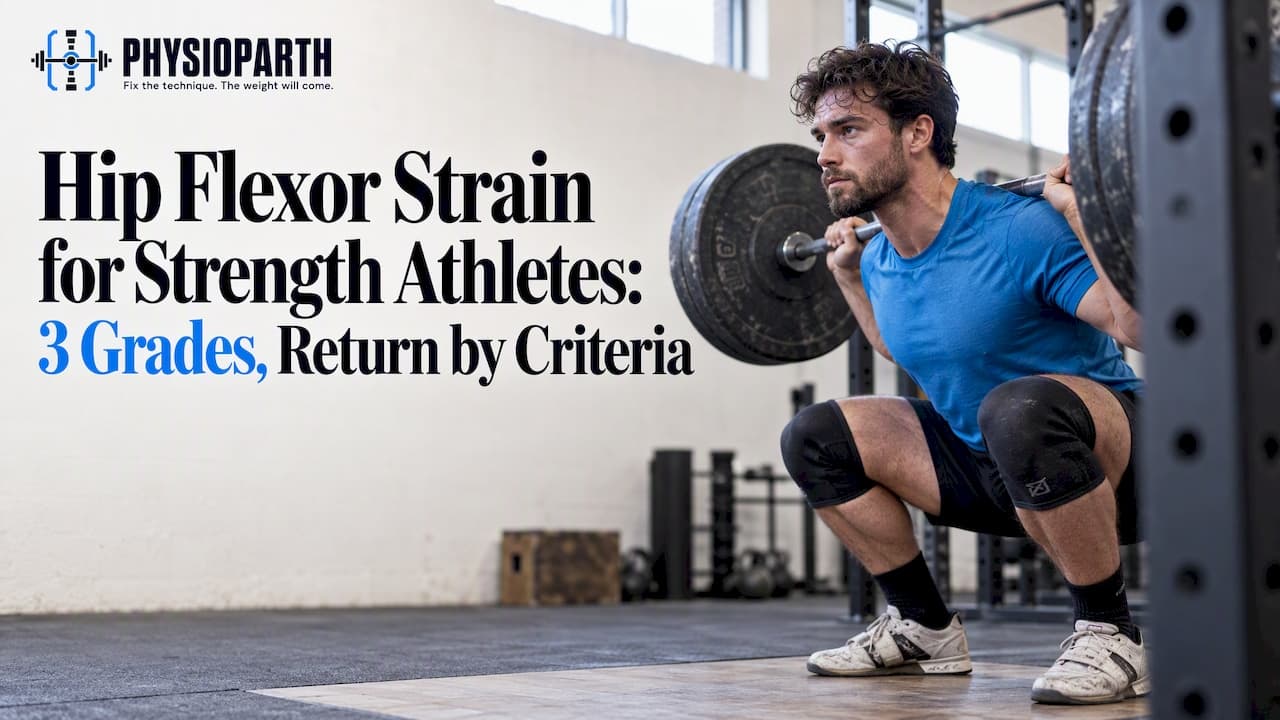
A hip flexor strain is an overstretch or tear in the muscles or tendons at the front of your hip, graded 1 to 3 by severity. Mild cases often settle with relative rest and ice within a couple of weeks, but if you can't bear weight, notice severe swelling, or lose movement suddenly, get assessed by a clinician right away.
TL;DR:
- Recovery tracks severity: grade 1 strains often settle within two weeks, grade 2 need two to six weeks, and grade 3 tears may take months.
- Progress rehabilitation by function, not a fixed calendar: clinicians check pain free motion, strength symmetry, and pain free sport specific drills before return.
- Seek urgent care for inability to bear weight, spreading swelling or numbness, or sudden loss of hip movement; these symptoms can signal serious injury.
- Clinicians usually diagnose strains through injury history and physical tests; ultrasound or MRI helps when grading, surgical planning, or return to sport decisions depend on it.
- Reduce recurrence by warming up progressively, building eccentric hip flexor and glute strength, increasing training loads gradually, and checking technique rather than treating flexors alone.
Table of Contents
- Anatomy and what a hip flexor strain means
- Common causes and risk factors
- Symptoms and clinical grading (grade 1-3)
- Diagnosis: history, exam, imaging and red flags
- Treatment and rehabilitation: immediate care and staged physiotherapy
- Recovery timeline and prognosis
- Prevention and safe return-to-activity checklist
- Physiotherapist perspective: tailoring rehab for strength athletes
- How PhysioParth can help: book a virtual assessment
- FAQ
- Sources
Anatomy and what a hip flexor strain means
The hip flexor group includes several muscles that work together to lift your knee toward your chest and stabilize your pelvis during movement:
- Iliopsoas (psoas major and iliacus): the deepest and most powerful hip flexor, running from your lower spine and pelvis to the top of your femur.
- Rectus femoris: part of your quadriceps, crossing both the hip and knee.
- Sartorius: a long, thin muscle running diagonally across the front of your thigh.
- Pectineus: a small muscle assisting hip flexion and adduction.
Strains most often occur at the musculotendinous junction, where muscle fibres transition into tendon, a zone that handles high tensile load but has less elasticity than muscle tissue itself. Repetitive hip flexion and sudden eccentric loading, such as sprinting, kicking a ball, or driving out of the bottom of a heavy squat, place concentrated stress right at this junction.
Common causes and risk factors
Hip flexor strains tend to fall into two categories: a single traumatic event or a slow buildup from repeated stress.
- Acute mechanism: a sudden overstretch or forceful eccentric contraction, such as decelerating a kicking leg or catching a heavy bar out of the hole.
- Overuse mechanism: repetitive hip flexion without adequate recovery, common in runners, cyclists, and dancers.
- Non-sport contributors: prolonged sitting and poor posture, which shorten and weaken the iliopsoas over time.
- Individual risk factors: a prior hip or groin injury, muscle imbalance between flexors and glutes, a rushed warm-up, or a sharp increase in training volume or load.
Strength athletes often see this pattern when squat depth, bar position, or hip drive mechanics shift suddenly, loading the flexors in a range they haven't conditioned for.
Symptoms and clinical grading (grade 1-3)
The hallmark symptom is a sharp, localized pain at the front of your hip or groin, often accompanied by tightness, a limp, or weakness when lifting your knee. Some people notice bruising a day or two later, or a snapping or catching sensation around the hip, which can point to psoas-related irritation rather than a simple strain.
Clinicians grade severity on a three-point scale, similar to other muscle strains:
- Grade 1: a mild stretch or microtear with little to no measurable strength loss.
- Grade 2: a partial tear with noticeable strength loss and pain on resisted movement.
- Grade 3: a complete tear, often with a visible or palpable defect and significant loss of function.
During an exam, a clinician typically checks resisted hip flexion strength, palpates for tenderness along the muscle belly or tendon, and looks for swelling, bruising, or a gap in the muscle that would suggest a higher-grade tear.
Diagnosis: history, exam, imaging and red flags
A clinician builds the diagnosis in stages, starting with how the injury happened and ending with imaging only when it changes the plan.
- History: when the pain started, the activity involved (a sprint, a kick, a heavy lift), and whether the onset was sudden or gradual.
- Resisted hip flexion test: pain or weakness with resisted knee lift toward the chest suggests a flexor strain.
- Ely test: tightness or pain when lying face down and bending the knee can point to rectus femoris involvement.
- Psoas sign and snapping hip test: pain with hip extension, or an audible snap during flexion and extension, can indicate iliopsoas irritation.
- Imaging: ultrasound or MRI is useful for grading severity, planning surgery, or guiding return-to-play decisions, though findings don't always match how limited someone feels functionally.
Seek prompt or emergency assessment if you can't bear weight at all, notice rapidly spreading swelling or numbness, or lose hip movement entirely. These can signal a complete tear, avulsion, or another condition requiring urgent care.
Treatment and rehabilitation: immediate care and staged physiotherapy
Most hip flexor strains respond well to a structured, staged approach rather than prolonged rest.
- First 48 to 72 hours: relative rest, ice, and short-term use of NSAIDs or acetaminophen if appropriate, alongside light compression and temporary activity changes. Aftercare guidance also notes that heat can help before therapeutic exercise once the acute swelling settles, and crutches may be used briefly for more severe strains.
- Pain control and mobility: gentle range-of-motion work and activities that don't provoke sharp pain, with physiotherapy recommended once initial pain starts to settle.
- Isometrics and load tolerance: static holds at various hip angles rebuild tolerance without the shearing forces of dynamic movement.
- Progressive strengthening and eccentric control: controlled eccentric loading, which research on rehabilitation strategies ties to lower reinjury rates and better long-term outcomes.
- Sport or lifting-specific loading: reintroducing the exact movement pattern, whether that's sprinting mechanics or a low bar squat, under supervision.
Criteria-based progression, clearing each phase only once specific functional tests are met rather than following a fixed calendar, is linked to faster pain-free recovery and lower reinjury rates. Clinicians might use pain-free resisted testing, matched strength between both sides, and tolerance of sport-specific drills as benchmarks before progressing.
Surgical repair or imaging-guided intervention is reserved for complete tears or avulsions, and is uncommon for the majority of hip flexor strains.
Pro Tip: If a specific lift triggers your pain, record it on video from the side. A clinician can often spot the exact point in the movement where the hip flexor is overloaded.
Recovery timeline and prognosis
Recovery time tracks closely with grade. Mild (grade 1) strains often settle within days to two weeks, moderate (grade 2) strains typically need two to six weeks of structured rehab, and severe (grade 3) tears can take months and occasionally require surgical input.

Athletes who follow a staged, criteria-based rehabilitation protocol for groin and hip-flexor-type injuries often reach pain-free milestones around two weeks for less severe grades, while grade 3 injuries commonly require a longer, often multi-month course. Returning before meeting functional benchmarks raises the risk of reinjury, which tends to extend overall time away from sport far more than a cautious, staged return would.
Clinicians judge readiness by three things: pain-free movement through full range, strength that matches side to side, and the ability to tolerate sport-specific drills, whether that's a sprint, a kick, or a working-weight squat, without pain or compensation.
Prevention and safe return-to-activity checklist
Preventing a repeat strain means addressing the whole kinetic chain, not just the flexors themselves. Clinical commentary on hip and pelvis soft tissue injuries points out that isolated treatment of the flexors is usually insufficient without also training the core and glutes that share the load.
- Warm up progressively with dynamic hip flexion and extension drills before high-intensity work.
- Build eccentric strength in the hip flexors and glutes rather than relying on static stretching alone.
- Manage training load increases gradually instead of jumping volume or intensity week to week.
- Check technique and kinetic-chain mechanics, including squat setup and bar path, rather than treating the hip in isolation.
Before resuming running, lifting, or sport, confirm pain-free daily function, strength and range matched between both sides, and the ability to perform sport-specific drills without discomfort.
Physiotherapist perspective: tailoring rehab for strength athletes
Most hip flexor strains in lifters trace back to a technique fault, not bad luck. A shift in squat depth, bar position, or hip drive timing often explains the overload better than the lift itself. Reviewing movement on video, rather than guessing from a verbal description, tends to catch the real cause faster, and early isometric and range-of-motion work lets a lifter keep training around the injury instead of stopping completely.
— Parth
How PhysioParth can help: book a virtual assessment
If you lift heavy and your hip flexor is holding you back, we built our approach specifically around strength athletes. We review your technique on video, correct the specific fault behind the overload, and build a rehab program that keeps you training safely instead of sitting out entirely.

Our services include an Initial Assessment for $130, Follow-Up Sessions at $100 each, and a Free 15-Minute Consult if you want to ask questions before booking. Everything runs virtually with no referral needed. In your first session, we walk through your training history, watch how you move, and map out a staged return to your lifts.
Ready to get your squat or deadlift back on track? Book your assessment today and start working toward a safe return to full training.
This article is general information, not a substitute for advice from a qualified doctor. Consult a qualified healthcare professional about your own circumstances before acting on anything here.
FAQ
Will a torn hip flexor heal on its own?
A mild (grade 1) strain often improves on its own with rest, ice, and gradual return to activity over one to two weeks. A partial or complete tear (grade 2 or 3) usually needs structured physiotherapy to heal properly and regain full strength, and a complete tear may need specialist input.
Should I run if my hip flexor hurts?
Running through hip flexor pain can worsen a partial tear and delay recovery, so it's best to scale back or stop until pain settles. A clinician can confirm the grade of your strain and give you a staged plan for returning to running once pain-free movement and matched strength are restored.
Why do my hips hurt after running?
Hip pain after running is often linked to overuse of the hip flexors from repetitive hip flexion without enough recovery, especially if training volume increased quickly. Poor warm-up, muscle imbalance between flexors and glutes, and prior injury are common contributing factors.
How can I tell if my hip is strained or torn?
A strain and a tear are the same type of injury on a spectrum: a strain describes any degree of damage, while a tear usually refers to a more significant grade 2 or 3 injury with noticeable strength loss. A clinician can confirm the exact grade through a physical exam and, when needed, imaging.
Sources
- Muscle strains (IT band, groin, hip flexor) - Overview - Mayo Clinic Orthopedics & Sports Medicine
- Hip flexor strain: Symptoms, treatment & recovery - Cleveland Clinic
- Psoas syndrome - StatPearls
- Criteria-based rehabilitation and return-to-sport outcomes (PubMed)