
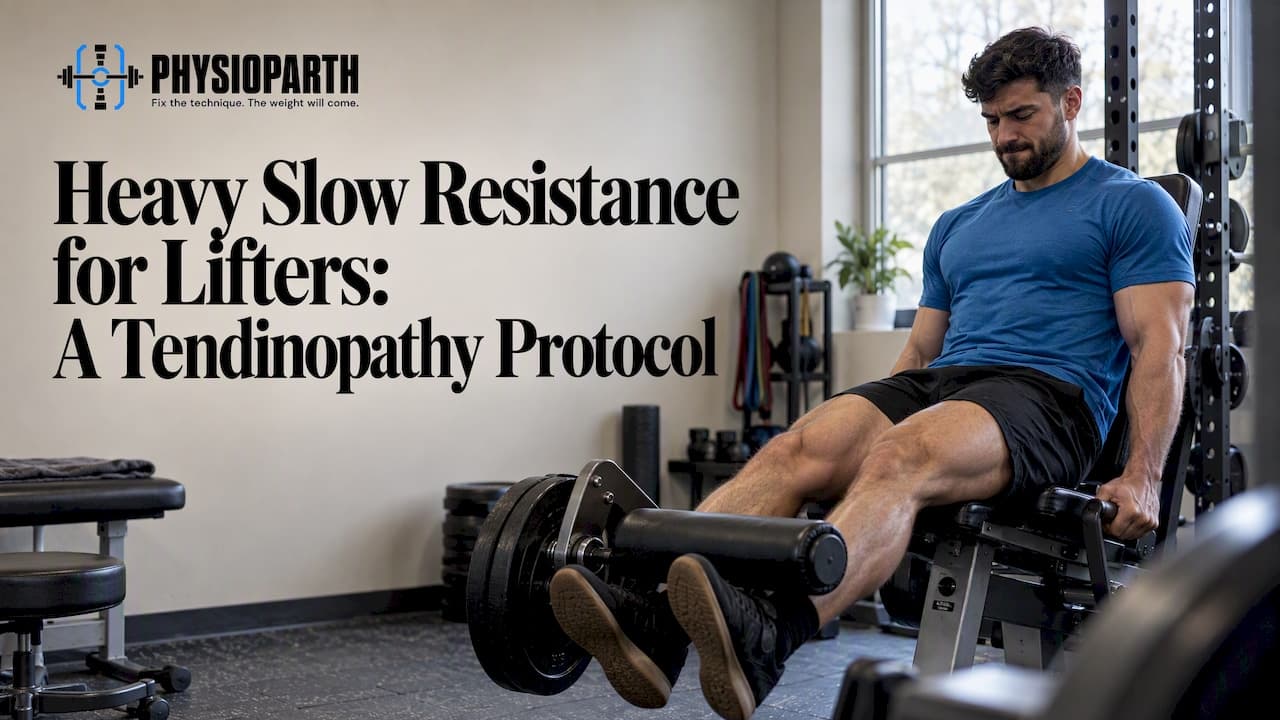
Heavy slow resistance (HSR) is a loading method for tendon pain: three or four exercises, three or four sets, loads that climb from 15RM to 6RM over 12 weeks, and a deliberate 3-second lift and 3-second lower. For a powerlifter it is useful because it asks you to keep training the tendon, not rest it. I'm Parth Suthar, a registered physiotherapist in Ontario and a competitive powerlifter. Below I cover how HSR is dosed, what the evidence says against eccentric-only work and isometrics, and how I fit it around squat, bench and deadlift days.
This is not a diagnosis. Pain at the knee, heel, hamstring origin or elbow may indicate a tendon problem, but several other tissues can produce similar pain. If you want your own lifts looked at, that is what a video assessment is for.
TL;DR
- HSR is progressive, slow, heavy resistance training for tendons: 3 to 4 exercises, 3 to 4 sets, 15RM progressing to 6RM over 12 weeks, 3 seconds up and 3 seconds down.
- Evidence shows HSR and eccentric-only programs can both help, and the program you can stick to for 12 weeks is usually the better one.
- Pain up to about 3 to 5/10 during exercise may be acceptable if it settles back to baseline within 24 hours. Spikes above that, or pain that lingers, suggest the dose was too high.
- Inside a powerlifting block, swap in tempo squats, leg press and Bulgarian split squats, and progress by criteria, not calendar dates.
- Check technique and load-management causes separately. HSR builds capacity, but it does not fix a bar path or a volume spike.
Table of Contents
- What HSR is, and what it is not
- The original HSR parameters
- HSR vs eccentric-only vs isometrics
- Which tendon is it? Structures and how to tell them apart
- Technique causes vs load-management causes
- Running HSR inside a powerlifting program
- The pain-monitoring rule
- Criteria-based return to lifting
- Red flags: when you need in-person or medical assessment
- My take as a lifter and physio
- Getting your own plan
- FAQ
- Sources
What HSR is, and what it is not
HSR is a form of strength training with heavy weights and a controlled tempo, built to load the muscle-tendon unit through the whole rep. A 2022 clinical commentary on putting "heavy" into HSR makes a point lifters often miss: the name misleads people into thinking slower is always better. A 6 to 8 second rep cuts the weight you can use, which lowers the mechanical tension you are after. If the tempo is so slow that the load no longer feels heavy, you are not doing HSR.
The other common mistake is complete rest. The 2024 JOSPT Achilles guideline recommends mechanical loading, either eccentric or heavy-load slow-speed work, to reduce pain and improve function. Tendons respond to progressive load. A tendon that has been unloaded for weeks is usually less capable when you return, not more.
I also tell lifters to drop the fear of the word. Tendinopathy is better framed as a mismatch between what the tendon can tolerate and what you have asked of it. You are not breaking anything by training around it with a plan.
The original HSR parameters
The protocol summarised in a critically appraised topic on high-load slow-velocity training in athletes uses 12 weeks, 3 to 4 sets, loads moving from 15RM down to 6RM, and a 3-second concentric and 3-second eccentric phase. A patellar tendinopathy rehab guideline shows the same structure in practice, with leg press at 6RM and a 3-second eccentric in the heavier phase.
| Parameter | Original HSR dose |
|---|---|
| Exercises | 3 (for example squat pattern, leg press, hack or split squat for the patellar tendon) |
| Sets | 3 to 4 |
| Load | 15RM progressing to 6RM across 12 weeks |
| Tempo | 3 seconds up, 3 seconds down |
| Duration | 12 weeks |
| Frequency | Studied programs range from once daily to three times weekly |
On frequency, the BJSM meta-analysis of resistance exercise dose components pooled 110 studies across rotator cuff, Achilles, lateral elbow, patellar and gluteal tendons. Effective programs ranged widely in how often they were done, so frequency does not look like the main driver of results. For strength athletes I usually start at three sessions per week with at least 24 hours between tendon-loading sessions. That 24-hour gap is a practical choice, not a rule from one trial.
On timelines, a living network meta-analysis of lower-limb tendinopathies supports expecting some early change within weeks and clearer change on VISA-P or VISA-A scores around 12 weeks. That is a process of building load capacity over months, not a quick fix, and I won't promise you a result.
HSR vs eccentric-only vs isometrics
The best-known head-to-head is the randomised trial in Achilles tendinopathy. Both groups improved significantly on VISA-A and pain, and the gains held at 52 weeks. The clinical and structural changes did not differ between groups. Satisfaction at 12 weeks tended to be higher with HSR (100% vs 80%), though that difference was not statistically significant. HSR sessions also tend to be shorter and less painful to perform, which matters for adherence.

For patellar tendons, a study of HSR in eight patients found clinical improvement alongside changes in fibril morphology after 12 weeks. It is a small sample, so I read it as a signal, not proof.
Where does that leave isometrics? I use them early, when pain is high and the tendon will not tolerate repeated reps, and as a bridge back to heavier work. I would not claim that isometrics beat or lose to HSR from the sources above, because they do not settle it. The Dutch Achilles guideline and meta-analytic work point the same way: eccentric, HSR or moderate-load isotonic work can all be reasonable, and consistency over the full 12 weeks counts most. Choose the one you will actually do.
Which tendon is it? Structures and how to tell them apart
I cannot tell you which tissue is irritated without watching you move. What I can do is name the usual suspects and the clues that separate them. Treat these as questions to bring to an assessment, not a verdict.
- Patellar tendon (below the kneecap). Pain is localised to a fingertip-sized spot at the lower pole of the patella. It typically builds during squat depth, jumps or the drive out of the hole, and is often stiff at the start of a session then eases a little as you warm up.
- Quadriceps tendon (above the kneecap). Pain sits just above the patella and tends to show at the bottom of a deep or paused squat, or when lowering from lockout on heavy leg extensions. This may indicate quad tendon load at deep knee flexion.
- Achilles (midportion or insertion). Midportion pain sits 2 to 6 cm above the heel bone, with morning stiffness and a thickened feel. Insertional pain sits right at the heel and often aggravates with deep dorsiflexion, such as a very deep squat with heels elevated or low.
- Proximal hamstring (sit bone). Deep buttock pain at the ischial tuberosity, often provoked by the bottom of a Romanian or conventional deadlift, sitting on hard surfaces, or a stiff-leg stretch position. A muscle belly strain, by contrast, hurts further down the back of the thigh. If your pain is more in the low back, my piece on deadlift back pain and return criteria covers that separately.
- Triceps tendon (back of the elbow). Pain just above the olecranon with lockout, close-grip bench, dips or overhead press. It differs from outer-elbow tendon pain, which is felt at the lateral epicondyle with gripping, and from inner elbow pain at the medial epicondyle. I go through elbow patterns in bench press elbow pain and the 45° fixes.
A useful sorting question: does the pain sit at one tendon, load-dependent and reproducible? That pattern may indicate tendinopathy. Does it spread, burn, tingle, or appear at rest and at night? That raises other possibilities, covered in the red flags below.
Technique causes vs load-management causes
HSR raises tendon capacity. It will not rescue a lift that keeps overloading the same tissue. I separate causes into two buckets so you know which lever to pull.
Technique causes
- Set-up: stance width and toe angle that push the knee past where you are strong, or a hip hinge that sits the bar too far forward.
- Bar path: drifting forward of mid-foot on the deadlift loads the hamstring origin and low back harder.
- Bracing: losing trunk position at the bottom shifts work into the hips and tendons.
- Grip: a wide bench grip or flared elbows can change elbow tendon demand.
- Depth: heel-elevated or ass-to-grass depth increases knee and Achilles tendon strain compared with parallel.
Load-management causes
- Volume: a jump in weekly sets or reps, especially on high-rebound movements.
- Intensity: too many heavy singles close to max with no off-ramp.
- Frequency: squatting and pulling on consecutive days with no tendon rest.
- Recovery: poor sleep, a heavy meet prep with no deload, or returning from a break at the old working weights.
Most cases I see are a mix. Fix what is cheap to fix first: a stance tweak or a volume cut often calms pain faster than anything else. My free squat guide and the movement audit give you a starting checklist for self-review.
Running HSR inside a powerlifting program
You do not need to leave the platform. You swap the heavy variation that irritates you for one that lets you load the target tissue with a controlled tempo, then keep the other lifts going.
Here is how I commonly structure it for lower-body tendons:
- Squat day: replace the main competition squat with a tempo squat, such as 3 seconds down and 3 seconds up to a depth that stays within your pain rule.
- Accessory 1: leg press at 3-second tempo, which gives you load without spinal fatigue.
- Accessory 2: Bulgarian split squats, again 3 seconds each way, for single-leg tendon loading and hip strength.
- Deadlift day: keep a pulling variation that does not aggravate symptoms, such as trap bar or block pulls, and treat it as a normal heavy day.
For the proximal hamstring, tempo Romanian deadlifts and hip extension patterns take the same role, and for the triceps tendon, tempo close-grip or floor press variations do. Dose them the same: 3 to 4 sets, moving from 15RM toward 6RM as tolerated.
| Phase | Typical load | Tempo | Main lift handling |
|---|---|---|---|
| Early | About 15RM, isometric holds if reps are too painful | 3 s up, 3 s down | Competition lift reduced or swapped for a tolerated variation |
| Middle | About 10 to 12RM | 3 s up, 3 s down | Paused or pin variations return at submaximal loads |
| Late | About 6 to 8RM | 3 s up, 3 s down | Competition lift builds back as pain criteria are met |
The third bucket is intensity on the competition lifts. While you run HSR, I keep competition-style work submaximal, and I cap the number of heavy singles until pain criteria are stable. Heavy lifting is not forbidden, but it counts toward the tendon's total load.
The pain-monitoring rule
You will not usually reach zero pain, and chasing it is unnecessary. The rule I use matches the patellar tendinopathy rehab guidance: during exercise, pain at or below about 3 to 5 out of 10 is acceptable, and soreness should settle back to your baseline within 24 hours.
- Green: pain stays at or below 3/10 and settles by the next morning. Progress load when you hit the rep target cleanly.
- Amber: pain 4 to 5/10 or mild next-morning stiffness that clears early in the day. Hold the load, reduce range, or shorten the set.
- Red: pain above 5/10, sharp pain, or pain that lingers beyond 24 hours. Reduce weight or range at the next session, and swap to isometrics if needed.
The 24-hour window matters because tendon collagen synthesis peaks in roughly that period after loading, and training again without those windows may risk a net loss of collagen. Rest days between tendon sessions are part of the program.
Criteria-based return to lifting
I do not progress people by calendar. A week count tells you nothing about whether your tendon is ready. Here is the ladder I use, with a gate between each step.
- Isometrics. Wall sits, leg extension holds, mid-range pin presses or mid-thigh isometric pulls, held for 30 to 45 seconds. Gate: pain 3/10 or lower, settled within 24 hours across two or three sessions.
- Tempo and HSR work. Tempo squats, leg press, split squats, tempo floor press, tempo Romanian deadlifts at 15RM, moving toward 6RM. Gate: hit target reps at each load band with the pain rule green on consecutive sessions.
- Reduced-range and alternative-bar variations. Pin squats, Safety Squat Bar squats, trap bar deadlifts, block pulls, floor press. Gate: the variation runs at about 80% of your usual working weight with no amber or red response.
- Paused variations. Paused squats, paused bench, paused deadlifts at submaximal loads. Gate: pause position is controlled and next-day pain is at your baseline.
- Competition lift at submaximal loads. Competition squat, bench and deadlift at moderate intensities and capped volume. Gate: repeated sessions with no spike and no creeping morning stiffness.
- Heavy singles and peaking. Reintroduce top sets gradually, with a plan to deload if stiffness starts to creep back.
If you miss a gate, you stay at that step or step back one. That is not failure, it is information.
Red flags: when you need in-person or medical assessment
Virtual physio is useful for load-related tendon pain, but some presentations need hands-on or medical assessment first. Get seen in person, by your family doctor, a walk-in clinic or an emergency department, if you have:
- A sudden pop or tearing feeling with immediate weakness, a visible gap or deformity, or inability to bear weight or straighten the knee or elbow (possible rupture).
- Marked swelling, heat, redness, or fever alongside the pain.
- Numbness, tingling, or weakness spreading down an arm or leg, or loss of bladder or bowel control, or numbness in the saddle area. This needs emergency care.
- Calf swelling and pain with warmth, or shortness of breath.
- Pain at rest or at night that does not change with position, or unexplained weight loss.
- Pain after a significant trauma, such as a fall or a dropped bar.
- Pain that is worsening steadily despite two to three weeks of sensible load reduction.
If you have a prior tendon rupture, steroid or fluoroquinolone antibiotic use, or inflammatory conditions, tell your clinician before starting any loading program.
My take as a lifter and physio
I have competed in powerlifting, and I have had to learn tendon rehab from the inside. The biggest barrier I see is not the exercise choice. It is that lifters either rest too long because they fear damage, or push through red-zone pain because they do not want to lose a training block.
HSR works well for lifters because it fits how we already train: heavy, progressive, logged. A tempo squat at 8RM feels like training, not rehab, and that matters for adherence. The thing I add is a decision rule, so you are never guessing whether today's session was too much.
I also push people to look at their lifts, not just their tendons. If your bar path drifts or your stance is a poor fit, HSR will help the tissue cope, but the same fault will keep presenting the bill. Treat both.
— Parth
Getting your own plan
If you want an assessment of your actual squat, bench or deadlift on video, I offer a free 15-minute consult, an Initial Assessment at $130, and Follow-Up Sessions at $100. No referral is required, and receipts are accepted by most Canadian extended-health plans. You can also start with the free Lifter's Hip & Lower Back Toolkit. The next move is simple: book with me for a free 15-minute consult at physioparth.com.
FAQ
How long does it take for tendinopathy to improve with HSR?
Research protocols run for 12 weeks, and clinical scores such as VISA-P or VISA-A typically show clearer change around that point, with some people noticing early changes within weeks. Timelines vary a lot between individuals and tendons. Progress is built over months, so I judge it by your pain rule and load tolerance, not by a date.
What are examples of HSR exercises for lifters?
For the knee: tempo squats, leg press, hack squats and Bulgarian split squats. For the hamstring origin: tempo Romanian deadlifts and hip extensions. For the elbow: tempo close-grip bench, floor press and overhead press. Each is done 3 to 4 sets, 3 seconds up and 3 seconds down.
Is HSR good for patellar tendon pain?
It is one of the best-studied options. A small study of eight patients found clinical improvement after 12 weeks of HSR, and the dosing is widely used in rehab guidelines. Your knee pain may also have other sources, so an assessment is worth having if it does not behave like a typical tendon.
Is HSR better than eccentric exercise for Achilles tendinopathy?
In the head-to-head randomised trial, both approaches improved clinical outcomes equally and the gains held at 52 weeks. HSR may be easier to stick with, since satisfaction tended to be higher at 12 weeks. The better program is the one you can complete.
Sources
- Putting "Heavy" into Heavy Slow Resistance, PMC
- Midportion Achilles Tendinopathy Revision 2024, JOSPT
- High-Load Slow-Velocity Resistance Exercise Training in Athletes With Tendinopathy, Journal of Sport Rehabilitation
- Rehab Practice Guidelines for Patellar Tendinopathy
- Effect of resistance exercise dose components for tendinopathy management, BJSM
- Exercise Treatments for Common Lower Limb Tendinopathies, Living Systematic Review and Network Meta-analysis
- Heavy Slow Resistance Versus Eccentric Training for Achilles Tendinopathy, randomised controlled trial
- Fibril Morphology and Tendon Mechanical Properties in Patellar Tendinopathy
- Dutch multidisciplinary guideline on Achilles tendinopathy, PMC
Recommended
- Deadlift Back Pain: Ontario Lifters’ Tissue Clues and Return Criteria
- Bench Shoulder Pain in Ontario: When a 45° Fix Isn’t Enough
- Bench Press Elbow Pain: 45° Fixes for Strength Athletes
- Hip Flexor Strain for Strength Athletes: 3 Grades, Return by Criteria
This article is general education for strength athletes and is not a substitute for an individual assessment. Pain that is severe, worsening, or accompanied by numbness, weakness or loss of function needs prompt in-person or medical assessment. Author: Parth Suthar, Registered Physiotherapist (Ontario).