
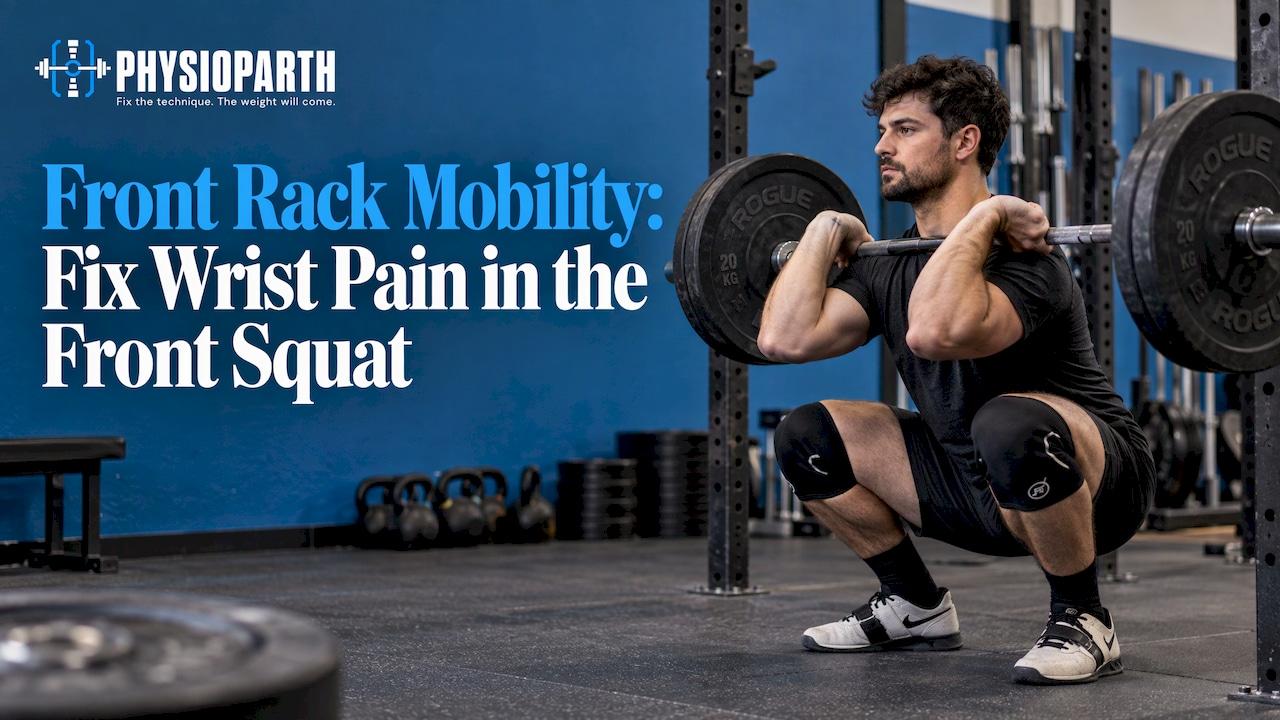
Most front rack problems are not a wrist problem alone. The position asks for wrist extension, shoulder flexion and external rotation, and an upper back that can extend, and wrist pain often shows up where the first limit was somewhere else. I'm Parth Suthar, a registered physiotherapist (PT Reg. Ont.) and former competitive powerlifter. Below I'll show you how to work out which part of the chain may be limiting you, which drills to use, and how to return to front squatting by criteria rather than by calendar. If you want a physio to look at your rack on video, I offer a virtual Initial Assessment that includes a lift analysis if you send videos beforehand.
TL;DR
- The bar should sit on your shoulders and collarbone area, with your fingers only guiding it. If your wrists are holding the load, something upstream may be limiting you.
- Wrist, shoulder, thoracic spine and elbow can each limit the rack. Where you feel the stretch or pain, and what happens when you change the grip, helps tell them apart.
- Drills help when they match the limit. Stretching alone rarely changes how the rack feels under load, so pair mobility with tempo, paused and isometric work.
- Modify the lift (crossed-arm grip, Safety Squat Bar, tempo or pin front squats) and progress by criteria, not dates.
- Numbness, a fall onto the hand, visible swelling or night pain need in-person or medical assessment first.
Table of Contents
- What a comfortable front rack actually requires
- Technique causes versus load-management causes
- Which structure is limiting you?
- Drills that match each limit
- Modify the lift, don't just stop it
- A criteria-based return to front squatting
- Red flags: when to get in-person or medical assessment
- Where a video assessment can help
- My perspective
- FAQ
- Next step
- Sources
What a comfortable front rack actually requires
The front rack is a shelf you build with your body. The bar rests on the front of your shoulders and against your collarbone area, your elbows point forward and up, and your upper back stays tall so the bar does not roll forward. Your hands are there to stop the bar rolling, not to carry it.
That shelf needs several things at once:
- Shoulder: enough flexion and external rotation to lift the elbows. Tight lats and pecs, or a shoulder that is stiff after a previous injury, can drop the elbows.
- Thoracic spine: the mid-back needs to extend. If it stays rounded, the bar drifts forward and your hands take more of the load.
- Elbow and forearm: you need to bend the elbow fully and rotate the forearm to bring the hand under the bar.
- Wrist: a clean-style grip puts the wrist into extension, with the fingers under the bar. Wrists with limited extension, or a long-fingered grip on a thick bar, make this uncomfortable.
This is why a wrist stretch on its own often disappoints. If your elbows drop because of the shoulder or upper back, the bar slides down your forearms into your hands and the wrist is asked to make up the difference.
Technique causes versus load-management causes
When front rack wrist pain appears, I separate two lists. They need different fixes.
Technique causes
- Grip: gripping the bar tightly with the whole hand, or placing the hands too far apart or too narrow for your shoulder width.
- Set-up: a bar that sits in the palms rather than on the shoulders, or a rack that is built from the hands inward.
- Elbow position: elbows that drop as the set goes on, a drift you cannot feel in the moment but which shows clearly on video.
- Bracing and bar path: losing rib position or leaning forward so the bar travels ahead of mid-foot.
- Stance and depth: a narrow stance or a depth beyond your current control can shift your torso forward and load the hands.
Load-management causes
- A sudden jump in front squat volume, for example adding sets of cleans or thrusters on top of your usual work.
- Intensity rising faster than your rack tolerance, such as heavy singles when you have mostly done lighter sets.
- Frequency: front-loaded movements several days in a row, with grip-heavy work such as pulling, hanging or kettlebell racking in between.
- Recovery: poor sleep or a busy stretch outside the gym that leaves the wrist irritated when the next session starts.
If you have a technique cause, load reduction alone may not solve it. If you have a load cause, a perfect rack may still feel sore until the volume is brought back to something the tissues tolerate.
Which structure is limiting you?
I can't diagnose you through a screen, and neither can an article. What I can do is name the structures that are most often involved and give you clues that may indicate where to look.
| Where you feel it | Structures often involved | Clues that may indicate it |
|---|---|---|
| Top of the wrist, a pinching or compressed feeling at end range | Back of the wrist joint and capsule, the tissues that get squeezed in extension | Sharp or pinchy at the bottom of the rack, eases quickly when you let go or take the hand out of extension |
| Palm side of the wrist and forearm, a deep stretch or ache | Wrist and finger flexor tendons and muscles | Feels like a stretch in the forearm, worse with a long fingers-under grip, often eases with a looser grip |
| Thumb side or little-finger side of the wrist | Tendons on the thumb side, or the cartilage disc and ligaments on the little-finger side | Pain localised to one side, worse when the forearm rotates or the hand is loaded, may linger after training |
| Front of the shoulder or armpit, with elbows dropping | Lats, pecs and the shoulder joint capsule | The elbows drop before the wrist hurts, and a light PVC pipe or empty bar rack feels better with your arms raised overhead |
| Mid-back, bar rolling forward | Thoracic spine extension and rib position | Elbows drop as you stand tall, and your chest collapses at the bottom |
| Front of the elbow or crook of the arm | Biceps and brachialis tendons, elbow joint | Soreness with deep elbow bending or forearm rotation, not just wrist position |
Two quick comparisons to run in your own warm-up, with an empty bar or a light load:
- Change the grip. Use a crossed-arm grip, where your arms cross in front and your hands rest on top of the bar. If the pain stays the same, the wrist may not be the main limit. If the pain disappears, the wrist or hand position is likely part of the story.
- Rack without a bar. Stand tall with your elbows high and your wrists in the position. If the elbows will not rise, look at the shoulders and upper back before the wrist.
If the pain is on the little-finger side, if it is sharp rather than stretchy, or if you cannot rule out an injury from a fall, don't just try more drills. Have it assessed.
Drills that match each limit
Use drills before your front squat session or in a separate short session. I would pick one or two per limit, not the whole list.
If the wrist is limiting
- Wrist extension on the floor or a bench: kneel with the palms flat and fingers forward, shift your weight gently over the hands, stop at a firm stretch that you can breathe through, and hold for several breaths. This loads the same range the rack needs, without the bar.
- Fingertip-first rack: hold a bar or dowel with only the first two or three fingers. Don't force a full-hand grip. A shorter hold may be more comfortable and puts the weight on the shoulder.
- Isometric wrist extension and flexion holds: hold a light dumbbell with the forearm supported on a bench, wrist in neutral, for a few controlled breaths. Build the time before the weight.
If the shoulder or lats are limiting
- Lat and pec opening against a wall or rack: place the forearms on a wall with the elbows high, then press the chest toward the wall.
- Elbow wall slide: forearms on the wall, slide upward without letting the ribs flare.
- Goblet or front-loaded holds: a kettlebell or dumbbell held at the chest teaches the elbow position under a lighter load.
If the upper back is limiting
- Thoracic extension over a foam roller or bench: lie with the roller under the mid-back, hands behind the head, and extend over it in small steps.
- Tall, braced front squat holds: hold a light front rack for time with the ribs down and the chest tall.
Mobility work is a means to an end. The test is how your rack feels under a bar. If a drill makes you feel looser for ten minutes but your rack still drops as soon as the load goes up, the next step is to practise the position under tension, which is what the progression below does.
Modify the lift, don't just stop it
Resting a wrist that is irritated may be appropriate for a short time, but it rarely builds a better rack. These variations let you keep loading the legs and trunk while the wrist settles. Choose the variation that keeps the pain at a level you find acceptable and stable, and that does not leave you worse the next day.
- Crossed-arm grip: removes wrist extension. It limits the bar load you can hold, so treat it as a leg and trunk tool.
- Safety Squat Bar: the handles sit in front, so the load rests on the upper back and shoulders and the wrists are not loaded in extension. Elbows can be more comfortable too.
- Tempo front squat: a slow lowering phase of three to four seconds teaches elbow height and bar path at lighter loads.
- Paused front squat: a pause at the bottom shows whether the rack holds when the bar is stationary.
- Pin front squat: starting from pins just above the bottom lets you practise the rack and a smaller range before going deeper.
- Isometrics: a static hold in the rack, or an isometric wrist extension hold, can be a way to tolerate the position at a low load.
- Trap bar deadlift and block pulls: if grip work is part of the irritation, the trap bar and block pulls let you keep hip and leg work going with a neutral wrist.
- Floor press: if the wrist is also sore when pressing, the floor press can shorten the range and reduce wrist loading. My article on wrist pain on the bench press covers that in more detail.
A criteria-based return to front squatting
There are no weeks in this progression, because tissues do not follow calendars. Move to the next stage only when you meet every criterion for the stage you are in, on more than one session.
Stage 1: calm the irritation
- Use a crossed-arm grip or the Safety Squat Bar.
- Add isometric holds in the rack with a light load.
- Move on when: the wrist feels the same or better after sessions, everyday tasks such as carrying a bag or pushing off a chair do not provoke it, and you can hold the unloaded rack position without sharp pain.
Stage 2: rebuild the position
- Use tempo front squats with an empty bar or a light load, with fingertip-first contact.
- Continue wrist and shoulder drills that matched your limit.
- Move on when: you can complete your sets with the elbows staying up, the bar rests on the shoulders and not in the palms, and symptoms are not worse the next morning.
Stage 3: add load and range
- Add paused and pin front squats, raising the load in small steps.
- Keep the Safety Squat Bar or trap bar as back-up variations for days when the wrist feels sensitive.
- Move on when: you can match your previous working load for your set and rep target with the same elbow height, without the symptoms rising during the session or carrying over.
Stage 4: return to your regular front squat
- Reintroduce the standard front squat at a load below your best recent sets, then build back up.
- Keep one irritation-tolerant variation in your week.
- Stay at this stage until: your rack is consistent across sessions, your warm-up routine is repeatable, and the symptoms have not returned for several consecutive exposures.
If you go backward, step back one stage rather than quitting altogether. A setback often points to a load-management cause, such as too much volume or too many sessions in a row.
Red flags: when to get in-person or medical assessment
Some symptoms need a hands-on exam, imaging or a physician before more drills. See an in-person clinician or a doctor promptly if you have:
- A fall onto an outstretched hand, or a sudden injury with a pop, followed by pain, swelling or bruising. Tenderness at the base of the thumb after a fall may indicate a bone injury that should be examined.
- Numbness, tingling or weakness in the hand or fingers, especially if it wakes you up or does not settle when you change position.
- Visible deformity, marked swelling, or a hot, red joint, particularly with fever or feeling unwell.
- Pain at night or at rest that does not ease, or pain that keeps getting worse despite reducing load.
- Loss of grip strength, or a hand that changes colour or temperature.
In Ontario you don't need a doctor's referral to see a physiotherapist, though some insurers require one for reimbursement. Physiotherapists assess pain and functional limitations through history-taking and tests to screen, establish a diagnosis and monitor, as the Canadian Physiotherapy Association describes. If a physiotherapist suspects something beyond their scope, they will send you to the right provider. If you have any of the symptoms above, go to a clinic, urgent care or emergency department, depending on how severe they are.
Where a video assessment can help

You can read about the front rack for hours and still not know whether your elbows fall at rep three or whether your grip is too wide. A recorded set from the front and the side can show elbow height, bar path and where the bar sits as fatigue builds.
My virtual Initial Assessment is $130. It includes a full subjective and objective assessment and a movement screen, plus a lift analysis if you send videos beforehand. It aims to explain what tissue may be irritated and to build a criteria-based return-to-lifting plan, using modified variations where appropriate rather than complete rest. A Follow-Up Session is $100. You can see the Initial Assessment and Follow-Up options here.

If you want to start with the free guides, my squat guide and toolkit are a good place to begin, and the audit page shows how I work. If your pain is spreading from the wrist toward the forearm or elbow, I also wrote about forearm pain when lifting and elbow pain when squatting. If the squat itself feels limited at the bottom, ankle mobility and squat pain may be relevant too.
My perspective
I came to physiotherapy from powerlifting, and I still think about the front rack as a lifter would. It is easy to treat wrist pain as a wrist problem, but the rack is a whole-body position. When I look at a front squat on video, I look at the elbows, the upper back and the bar path before I decide that the wrist deserves the blame.
The other thing I care about is that you don't have to stop training to improve. A criteria-based plan with modified variations, such as the Safety Squat Bar, tempo work, pin squats and isometrics, aims to give you a way to keep loading your legs and trunk while the irritated tissue is managed. That is what I aim to build with you in an assessment: a plan that matches your sport, your lifts and the tissues involved.
If you have wrist pain in the front rack and are not sure where it is coming from, I would rather look at your video than guess.
Parth
FAQ
Why does my wrist hurt in the front rack but not when I back squat?
The front rack puts the wrist into extension under load, which the back squat usually does not. The pain may indicate limited wrist extension, a bar sitting in your hands rather than on your shoulders, or elbows that drop. Try a crossed-arm grip or a Safety Squat Bar to see how the pain changes.
Can I front squat without being able to get my fingers under the bar?
Yes. The bar should rest on your shoulders, with the fingertips just guiding it. A two- or three-finger grip is a common position, and a crossed-arm grip or Safety Squat Bar are other options while you build the range.
Is stretching enough to improve front rack mobility?
Stretching may help if wrist extension is the limit, but it rarely solves the problem alone. Pair it with loaded practice such as tempo, paused and pin front squats, and check the shoulders and upper back too.
Do I need a referral to see a physiotherapist for wrist pain in Ontario?
No, a referral is not needed to see a physiotherapist in Ontario. Some insurers require one for reimbursement, so check your extended-health plan before you book.
Next step
If you want a clear plan for your front rack, book with me for a free 15-minute consult at physioparth.com. The call is a fit check, not an assessment or treatment.
Sources
Recommended
- Wrist Pain on the Bench Press: Causes, Fixes, Return Plan
- Ankle Mobility and Squat Pain: Causes and a Return Plan
- Elbow Pain When Squatting: Causes, Tissue Clues and a Return Plan
- Forearm Pain When Lifting: Ontario Lifters Modify, Not Quit
This article is general education for strength athletes and is not a substitute for an individual assessment. Pain that is severe, worsening, or accompanied by numbness, weakness or loss of function needs prompt in-person or medical assessment. Author: Parth Suthar, Registered Physiotherapist (Ontario).