
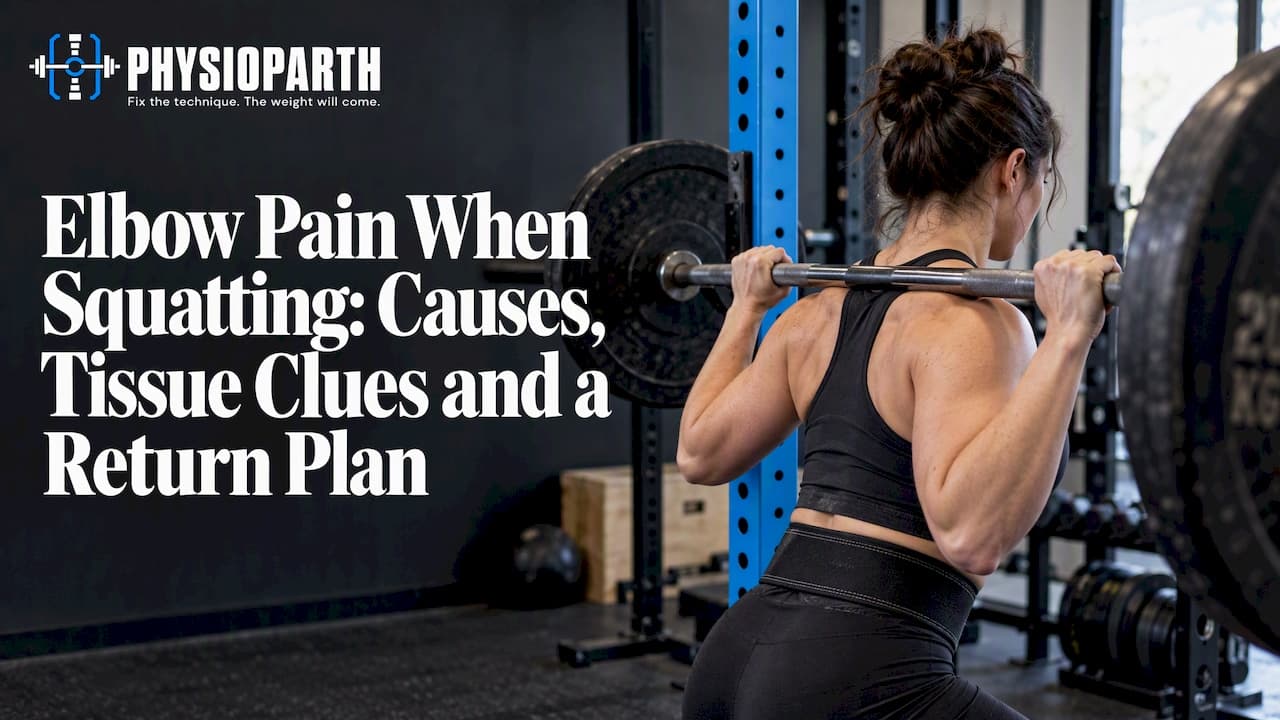
Elbow pain in the squat usually shows up when the hands end up carrying part of the bar, or when the elbows are cranked up and back to hold a low-bar position. I'm Parth Suthar, a registered physiotherapist in Ontario and a former competitive powerlifter. Below I separate the technique causes from the load-management causes, show how the structures involved tend to differ, and lay out a return-to-squatting progression built on criteria rather than calendar dates.
This is general education, not a diagnosis. Where the pain behaves in a way that needs hands-on or medical assessment, I say so in the red-flags section.
TL;DR
- Pain at the inner elbow may indicate irritation of the flexor-pronator tendon origin. Pain at the outer elbow may indicate the extensor origin. Pain at the front of the elbow or in the biceps area may point to the distal biceps. Tingling in the ring and little fingers may point to the ulnar nerve.
- Technique usually drives it first: hands too wide, bar too low, wrist bent back, elbows pulled up behind you, or a loose upper back that lets the hands take load.
- Load management matters too: a jump in squat frequency, a switch from high bar to low bar, or a heavy block with little recovery can push a tolerable elbow past its threshold.
- Modified squats (Safety Squat Bar, tempo, paused, pin) let many lifters keep training the pattern while the elbow settles. Progress when criteria are met, not when a date arrives.
- Numbness that persists, a sudden pop, visible swelling, or pain at rest need in-person assessment.
Table of Contents
- Why the elbow hurts in a lift where the hands barely do anything
- Which structure may be involved: how to tell them apart
- Technique causes
- Load-management causes
- A criteria-based return-to-squatting progression
- Red flags: when you need in-person or medical assessment
- Working with me
- My perspective
- FAQ
- Book with me
- Sources
Why the elbow hurts in a lift where the hands barely do anything
In the bench press, overhead press and deadlift, your hands connect you to the bar. In the squat, the hands are there to stop the bar rolling down your back, as Barbell Logic explains. The bar should sit on your upper back muscles, held by your shoulder blades and torso.
When it doesn't, the forearm muscles and their tendons take the difference. Every rep, they grip, the wrist extends, and the elbow sits under tension. Across a few weeks of heavy squatting, that can add up to more than the tissue was prepared for.
Low bar is the position most often blamed. PowerliftingTechnique notes that this is especially common in lifters who move from high bar to low bar. Low bar asks for more shoulder external rotation and elbow flexion behind the body, and it exposes any flaw in grip or upper-back tightness.
The literature on the medial elbow comes mostly from overhead throwers, not squatters. A review of postero-medial elbow problems in adult athletes describes how valgus and extension forces load the structures on the inner side of the elbow. I use it as a model of the structures involved, not as proof of what happens in a squat. The same review discusses the kinetic chain, and that is relevant for you: if your hips or upper back can't give you the position, the elbow may be where the compromise lands.
Which structure may be involved: how to tell them apart
I can't diagnose you from an article. What I can do is give you the pattern recognition I'd use in a video assessment, so you know what to describe.
| Where it hurts | Structure that may be involved | What tends to provoke it | Other clues |
|---|---|---|---|
| Inner elbow, bony bump (medial epicondyle) | Common flexor-pronator tendon origin | Gripping the bar, wrist extension under load, pressing your thumb-side of the hand into the bar | Tender to press on the tendon just below the bump; resisted wrist flexion or forearm pronation may reproduce it |
| Outer elbow (lateral epicondyle) | Common extensor tendon origin | Gripping hard with the wrist cocked back | Resisted wrist extension or a firm grip may reproduce it |
| Front of the elbow crease or lower biceps | Distal biceps tendon or brachialis | Elbows driven forward and up, with the forearm pulled into the bar | Pain on resisted elbow bend or forearm supination; a sudden pop or bruising is a red flag |
| Back of the elbow | Triceps tendon, or posterior joint structures | Extreme elbow flexion behind the body | Pain with resisted straightening; a pinching feel at end range |
| Inner elbow plus tingling in ring and little fingers | Ulnar nerve at the cubital tunnel (the funny bone) | Sustained deep elbow bend behind you | Pins and needles or numbness rather than ache; may be worse when the elbow stays bent |
A few self-checks help you describe what you feel:
- Press on it. Tendon origins tend to be sharply tender at one spot. Nerve symptoms tend to be diffuse and tingly.
- Resist the movement. With your elbow bent, resist your own wrist flexion, then wrist extension, with the other hand. Pain with one direction may indicate which tendon group is irritated.
- Note timing. Pain that builds during sets and eases quickly may suggest tendon irritation. Pain that lingers into the night, or tingling that persists, deserves a closer look.
The medial-versus-lateral distinction matters because the exercise selection and grip changes differ. The most-cited name for inner-elbow pain in lifters is "golfer's elbow" (medial epicondylalgia), though that label can mask other causes, including nerve involvement. Treat it as a pattern that may fit, not a verdict.
Technique causes
Start here, because it's usually the fastest lever. Check each of these on video from the side and from behind.
Grip width and hand position
A grip that's too wide forces extra shoulder and elbow work to reach the bar. Nick Delgadillo describes how hands set too wide can lead to overextension and pain in the elbow and wrist. Bringing the hands in until the upper back can tighten and the wrists stay closer to neutral is often the first change.
Also check whether you wrap your thumbs and squeeze hard. A hook-less, open grip can move you away from holding the bar with your forearms. Some lifters do better with a relaxed hand, with the bar resting in the palm and fingers.
Bar height
A bar that sits too low on the back pushes the elbows up and back, and increases tension through the arms. The 2008 postero-medial review above links excess valgus and tensile stress to this kind of loading in athletes. Moving the bar up toward the top of the rear delts, where you can still keep your torso position, may reduce the demand. For some lifters, a high-bar position removes the problem entirely while the elbow settles.
Upper-back tightness and elbow position
If your shoulder blades aren't pulled together and down, the bar migrates and your hands catch it. Think of the shelf as built by your upper back, not your hands. Elbows pointing down and slightly back, not cranked toward the ceiling, usually reduce forearm load.
Wrist angle
A wrist bent back under the bar loads the forearm extensors and flexors. Stacking the wrist over the forearm, with the bar's weight through the back rather than the hand, matters more than any specific stretch.
Bracing and bar path
A bar that drifts forward or rolls as you descend gets caught by the hands. A solid brace, a mid-foot bar path and a consistent stance make the shelf more stable. Depth matters too: if you lose upper-back tension at the bottom, the elbows are often the first to pay.
Mobility further down the chain
If you struggle to sit into a position because of hip or ankle restriction, you may compensate with a bigger forward lean, and the hands may get pulled into the bar. If that sounds like your squat, my article on hip pain squatting covers hip-related causes and return criteria.
Load-management causes
Technique can look the same for months before pain arrives. What changed is often the dose.
- Volume: a bump in squat sets, or high-rep low-bar work on top of bench and rowing, loads the same forearm tendons across the week.
- Intensity: a heavy single or a peaking block raises the bar's tendency to roll and your grip pressure.
- Frequency: squatting three or four times a week with the same low-bar setup gives the elbow fewer recovery windows.
- Recovery: poor sleep, a heavy work week and high total grip demand (deadlifts, pull-ups, carries) can stack on the same tendons.
- Position change: the switch from high bar to low bar is a common trigger, because the tissue hasn't been exposed to that position yet.
A quick audit helps. Write down the last four weeks: how many squat sessions, which bar position, what you changed, and when the pain began. Often the date the pain started lines up with one specific change. If it does, you've found the first thing to adjust.
My free guides can help you review your set-up, including the Lifter's Hip & Lower Back Toolkit.
A criteria-based return-to-squatting progression
The 2022 JOSPT clinical practice guideline on lateral elbow pain supports a phased approach that moves from lower-load isometric or isotonic work toward heavier strengthening and finally higher-level control, advancing when criteria are met. It's written for the lateral elbow, so I apply its logic of phases and criteria to the medial side and to squatting as a principle, not as a guarantee that it transfers exactly.

There are no dates below. You move on when you meet the criteria.
Phase 1: calm it down and keep the pattern
What you do:
- Squat with a Safety Squat Bar if you have access to one. The handles let your hands hang or hold lightly, so the forearms are not asked to stabilize the bar behind you.
- Use tempo squats (for example, a slow lowering phase) at a lighter load to keep the pattern without heavy bar-rolling forces.
- Add gentle isometrics for the painful tendon group: holding a comfortable wrist flexion or extension against resistance at a low effort, repeated through the day.
Move on when:
- Squatting with the modified setup doesn't increase pain above a level you can tolerate and settle by the next day.
- Daily gripping, such as carrying shopping or turning a door handle, is no longer limiting.
- Resting pain is gone or minimal.
Phase 2: rebuild tolerance
What you do:
- Progress to paused squats and pin squats (bar set on safeties at a fixed height) with the bar position you plan to return to, using a looser grip and a tight upper-back shelf.
- Add isotonic wrist and forearm strengthening, increasing resistance gradually.
- Keep deadlift variation grip-friendly: a trap bar or block pulls with straps or a mixed grip may help if forearm loading from deadlifts aggravates things. For related forearm irritation, see my piece on forearm pain when lifting.
- If you bench, a floor press reduces end-range elbow and shoulder positions while you recover. My article on bench press elbow pain covers that side.
Move on when:
- Grip strength and resisted wrist movements feel close to your other side.
- Your modified squats are consistent for two or three sessions with no next-day flare.
- You can hold your preferred bar position for a set without the hands taking load.
Phase 3: return to your competition setup
What you do:
- Reintroduce your usual bar position at a submaximal load with the narrower grip or changed hand position you worked out.
- Increase load in small steps, one variable at a time: weight, then volume, then frequency.
- Keep one or two pin, paused or tempo squats in the block as ongoing exposure.
Move on (to full training) when:
- You can complete your normal working sets without pain rising above your agreed threshold.
- The elbow settles within a day.
- You have repeated this across multiple sessions at progressively higher loads.
If pain returns in any phase, step back one phase and change one variable. That isn't failure. It's the criterion doing its job.
Pro tip: film your top set from behind. If your elbows have drifted up and your hands are doing the holding by the last reps, that drift is hard to feel in the moment, and the video shows it.
Red flags: when you need in-person or medical assessment
Seek in-person assessment, from a physiotherapist who can examine you hands-on or from a physician, if you notice:
- A sudden pop or tearing sensation, especially at the front of the elbow, followed by bruising or weakness bending the elbow or turning the palm up.
- Visible swelling, heat or redness around the joint, or fever.
- Locking, catching or inability to fully straighten the elbow.
- Numbness or tingling in the ring and little fingers that persists, or weakness in the hand grip or finger spread.
- Pain at rest or at night that doesn't ease with position change.
- Pain after a fall or direct impact.
- Neck pain with arm symptoms, or symptoms in both arms.
- No improvement after you've changed technique and load for a reasonable period.
In Ontario you don't need a doctor's referral to see a physiotherapist, according to the College of Physiotherapists of Ontario, though your insurer may require one for reimbursement. If you're unsure whether a symptom belongs on this list, book a physiotherapist rather than waiting to see if it passes.
Working with me
If you'd like someone to look at your squat video and your elbow together, the Initial Assessment is $130. It includes a full subjective and objective assessment and a movement screen, plus a lift analysis if you send videos beforehand. It aims to explain what tissue may be irritated and to build a criteria-based return-to-lifting plan, using modified variations where appropriate rather than complete rest. Follow-Up Sessions are $100. You can see both on the PhysioParth booking page. Care is delivered by video, and I provide receipts for insurance reimbursement. Check your plan's terms on physiotherapy coverage.
My perspective
Most elbow pain I hear about in squatters starts with a reasonable decision: a lifter moves to low bar because it feels stronger, and the grip and upper-back set-up don't catch up. The elbow becomes the place where that gap shows. I'd rather you change the grip, bar height or bar choice for a block than push through a position the tissue isn't ready for.
The other thing I care about is that rest isn't the only tool. Modified variations let you keep training the squat while the elbow tolerates more. And the criteria are the plan: if you're guessing by the calendar, you're guessing.
As a former competitive powerlifter, I know how annoying it is to be told to stop. That's why I write plans around what you can do.
— Parth
FAQ
Why do my elbows hurt after low bar squats?
Low bar asks for more shoulder rotation and a tighter upper-back shelf. If the hands end up bearing load, or the elbows are driven up behind you, the forearm tendons near the elbow take repeated stress. Hand width, wrist angle and bar height are the first things I'd check on video.
Where should my elbows be in a back squat?
Pointing down and slightly back, not cranked up toward the ceiling, with the upper back tight so the bar rests on muscle. The exact position depends on your shoulder mobility and bar placement. If you can't get there without pain, a Safety Squat Bar or a higher bar position are reasonable options for a while.
Can I keep squatting with elbow pain?
Often a modified version is possible: Safety Squat Bar, tempo or pin squats at a load that doesn't push pain beyond a tolerable level or leave it flared the next day. If you have any red-flag signs, such as persistent numbness or a sudden pop, get an in-person assessment first.
What are the symptoms of elbow tendinopathy?
Typically localized ache at the bony bump on the inner or outer elbow, tenderness when pressed, and pain when gripping or resisting wrist movement. Pain that behaves differently, such as tingling in the fingers, may indicate something other than tendon irritation and is worth an assessment.
Book with me
If you want to talk through your squat and your elbow before committing, book with me for a free 15-minute consult. It's a fit check, not an assessment or treatment.
Sources
- JOSPT 2022 clinical practice guideline: lateral elbow pain
- Postero-medial elbow problems in the adult athlete (PMC)
- College of Physiotherapists of Ontario: What is physiotherapy
- Barbell Logic: squat grip and elbow pain
- PowerliftingTechnique: low bar squat elbow pain
- Starting Strength: Preventing elbow pain in the squat
Recommended
- Bench Press Elbow Pain: 45° Fixes for Strength Athletes
- Hip Pain Squatting: Causes, Fixes and Return Criteria
- Squat Lower Back Pain: 7 Mistakes & How to Fix Them
- Forearm Pain When Lifting: Ontario Lifters Modify, Not Quit
This article is general education for strength athletes and is not a substitute for an individual assessment. Pain that is severe, worsening, or accompanied by numbness, weakness or loss of function needs prompt in-person or medical assessment. Author: Parth Suthar, Registered Physiotherapist (Ontario).