
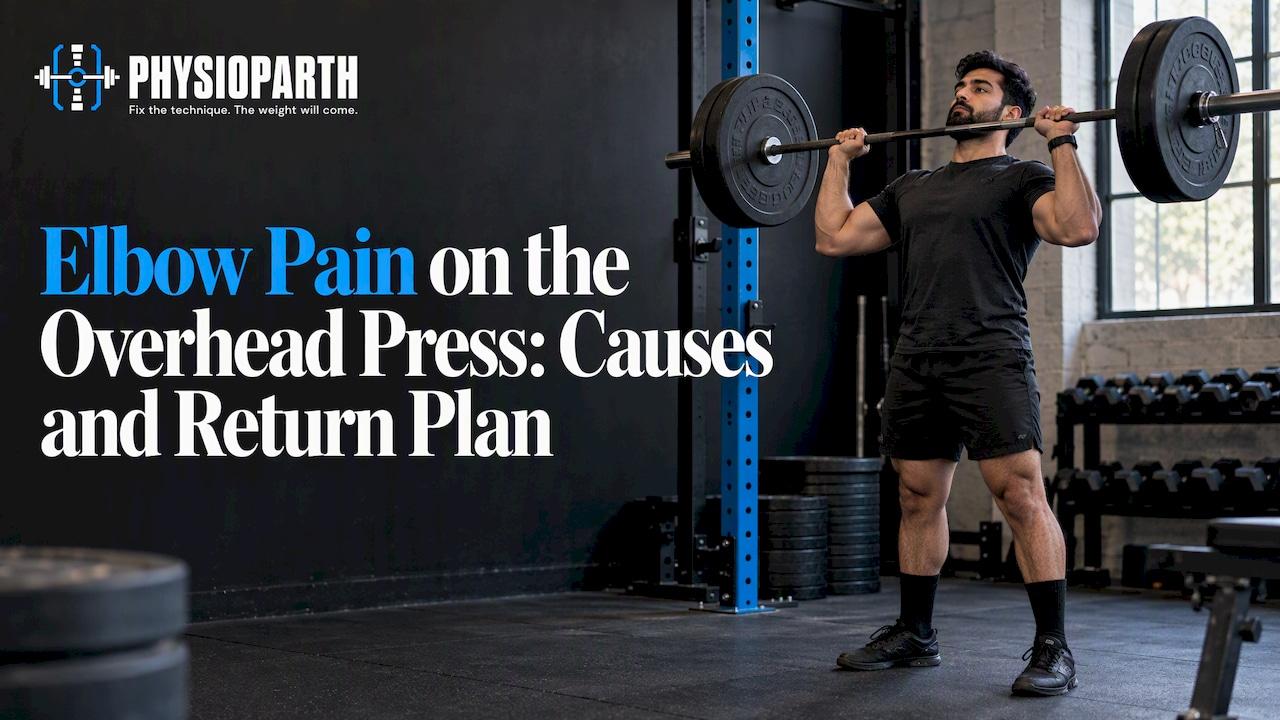
Elbow pain on the overhead press usually comes from one of two places: how the rep is set up and performed, or how much pressing you have stacked up recently. Often it is both. The location of the pain (outside, inside or back of the elbow) may indicate which tendon is irritated, and that changes what you should load. I'm Parth Suthar, a registered physiotherapist (PT Reg. Ont.) and former competitive powerlifter, and this guide is how I would work through it with a lifter in Ontario who wants to keep pressing.
This is general education. I can't diagnose you from an article, and nothing here is a promise of a result.
TL;DR
- Pain on the outside of the elbow may indicate the wrist extensors, the inside may indicate the flexor-pronator group, and the back may indicate the triceps tendon.
- Separate technique causes (elbow flare, bar path, grip, wrist position, bracing) from load causes (a jump in volume, intensity or frequency, or poor recovery). Changing the wrong one wastes weeks.
- Complete rest is rarely the plan. Tendon guidelines favour a phased return that adds load step by step, using variations such as tempo, pin and floor presses.
- Progress by criteria, not by the calendar. Move on when the current step is tolerated and settles by the next morning.
- Numbness in the ring and little finger, a sudden pop, rapid swelling, or pain at night or at rest needs in-person assessment first.
Table of Contents
- Which structure is likely involved
- Technique causes: set-up, bar path, grip, bracing
- Load-management causes: volume, intensity, frequency, recovery
- A criteria-based return to pressing
- Red flags: when you need in-person or medical assessment
- My take as a lifter and physio
- Working on this with me
- FAQ
- Sources
Which structure is likely involved
Many lifters call everything "tennis elbow" or "lifter's elbow". It helps to be more specific, because the structures are different and so is the loading. Pressing overhead puts the elbow in a position where the forearm muscles grip and stabilise the bar while the triceps drive the lockout.
| Where it hurts | Structure most likely involved | What may provoke it |
|---|---|---|
| Outside of the elbow | Wrist extensor tendons at the lateral epicondyle (lateral elbow tendinopathy) | Gripping the bar hard, wrist cocked back, resisted wrist extension |
| Inside of the elbow | Flexor-pronator tendons at the medial epicondyle | Resisted wrist flexion, forearm rotation, fast re-racking |
| Back of the elbow, above the point | Triceps tendon near its attachment on the olecranon | Lockout, deep elbow bend at the bottom, resisted elbow extension |
| Inside, with tingling in the ring and little finger | Ulnar nerve at the cubital tunnel | Sustained elbow bend, leaning on the elbow |
The AAOS describes tennis elbow as an overuse condition that affects people well beyond racquet sports, and it describes medial epicondylitis as pain on the inside of the elbow that can come from overuse or overexertion in many activities. Lifters get both.
How you can tell them apart at home
These are screening clues, not a diagnosis. Compare them gently, with the elbow supported on a table and the effort light.
- Wrist extension against resistance. Push the back of your hand up against your other hand. Reproducing pain on the outside may indicate the wrist extensors.
- Wrist flexion against resistance. Push your palm up into your other hand. Pain on the inside may indicate the flexor-pronator group.
- Elbow extension against resistance. With the arm bent, press your hand into a fixed surface as if starting a push-up. Pain at the back may indicate the triceps tendon.
- Press on the spot. Tendon problems are typically tender on or just next to the bony point where the tendon attaches. Pain that is vague, travelling or tingly is a different pattern.
If the wrist test hurts and the triceps test does not, strengthening triceps will not address the thing that is actually irritated. Mixing these up is how lifters end up doing months of the wrong rehab. If your results are unclear, that is a good reason to have a video assessment rather than guess.
If the symptoms are tingling or numbness rather than a sore tendon, jump to the red flags section below.
Technique causes: set-up, bar path, grip, bracing
Technique faults are worth looking at first because they are usually free to change. These are the ones I check on video.
Elbow position. Flaring the elbows out early in the press can reduce triceps and upper chest involvement and increase stress at the shoulder and elbow, according to BarBend's overhead press guide. That same guide recommends keeping the forearms vertical, with the elbow stacked in line with the wrist. Many lifters do better with the elbows slightly in front of the bar at the start, rather than pushed out to the sides.
Depth of the elbow bend. At the bottom, a bend of around 90 degrees is commonly recommended. Going much deeper adds a longer lever arm for the triceps tendon, which is worth knowing if your pain is at the back of the elbow.
Grip and wrist. A wrist that bends back under the bar loads the wrist extensors, which are the tendons attached on the outside of the elbow. A death grip adds to that. Check that the bar sits over the heel of the palm and the forearm stays stacked under it. If your outside-elbow pain follows heavy gripping in other lifts too, my article on forearm pain when lifting covers the overlap.
Bar path. The bar should travel close to the face, and the head moves back and then through. A bar that drifts forward creates a longer lever from the shoulder to the elbow, and you often feel it in the elbow and not at all in the shoulder in the moment.
Bracing and stance. If the ribcage flares and the low back extends to get the bar up, the shoulder and elbow end up doing a job the trunk should share. Squeezing the glutes, bringing the ribs down and taking a proper brace before each rep makes the press a full-body lift. My article on the Valsalva manoeuvre for lifting explains how and when to brace.
Upstream limits. Limited upper back (thoracic) extension or poor shoulder blade control can force the arms to compensate. If you cannot get the bar overhead without leaning back, the elbow may be absorbing a problem that starts higher up. It is worth testing, not assuming.

If your pain is similar on the bench, the same logic applies with a different position. I cover it in bench press elbow pain, and the free lifting guides and toolkit are a useful companion.
Load-management causes: volume, intensity, frequency, recovery
Sometimes the technique is fine and the tendon is simply being asked to do more than it has adapted to. Ask yourself:
- Volume. Did you add sets, rep ranges or accessory pressing (dips, close-grip bench, push-ups) in the last few weeks?
- Intensity. Have you been working at heavy percentages more often, or peaking?
- Frequency. Are you pressing overhead and benching on back-to-back days without recovery in between?
- Recovery. Has sleep, stress or general fatigue changed?
- Change of tool. New bar, new grip width, new strict-press programme, or a switch from the barbell to a CrossFit-style push press volume?
A useful sign is timing. If the pain started within a few weeks of a clear jump in load and technique has not changed, load management is the likelier lever. If it has been there for a long time, or appears at the same point in every rep regardless of load, technique deserves more attention.
The tendon research here is worth knowing. The 2015 JOSPT review on lateral elbow tendinopathy describes tendon pain as something that is rarely just inflammation needing rest, and it points to progressive loading as a way to stimulate adaptation. Stopping everything can leave you less prepared when you return. For a model of how to build that load back up, this progressive overload guide explains the principle in general training terms, and my heavy slow resistance protocol applies it to cranky tendons.
A criteria-based return to pressing
This is a framework, not a prescription for your elbow. The point is that you move up a step when you meet the criteria, however long that takes. Two lifters on the same step may be there for very different amounts of time.
The 2022 JOSPT clinical practice guideline on lateral elbow pain describes a phased approach. The earlier phases use isometrics, isotonics and eccentrics at lower intensity (roughly 20-40% of maximum voluntary isometric contraction), and the later phase moves above 40% and adds longer lever arms and more explosive, function-specific work. That is the logic behind the steps below.
Criteria that apply at every step
- Pain during the work stays low, a common guide being at or below about 3/10, and does not climb across sets.
- Pain has settled by the next morning, with no more stiffness or soreness than the day before.
- The movement looks the same on video as it did at the start of the session.
- Resting symptoms are not getting worse from week to week.
If any of these fail, you stay on the step or go back one. That is information, not failure.
Step 1: calm the tendon and keep loading it
- Isometrics. Hold the pressing position against pins or a fixed surface for 30 to 45 seconds, a few sets, at an effort you can tolerate. For wrist-extensor pain, add light isometric wrist extension as well.
- Reduce, don't remove. Cut overhead volume and heavy gripping, but keep some pressing in a position that is tolerated.
Move on when: isometrics are tolerated at a moderate effort and next-morning symptoms are no worse.
Step 2: slow, controlled pressing in a position you tolerate
- Tempo presses. Three to four seconds down, with a brief pause, then press. Light enough to keep the elbow position clean.
- Pin presses. Set the pins at a height where the elbow bend is around 90 degrees or a little less, which shortens the lever on the triceps tendon.
- Floor press. Limits the bottom range and takes the shoulder out of the equation, which can be useful if you also have shoulder irritation.
- Neutral grip or Safety Squat Bar-style variations where your set-up allows, to reduce wrist extension and rotation demand. For the lower body, you can keep training with a Safety Squat Bar or trap bar when a barbell squat or deadlift aggravates the arms or shoulders.
Move on when: you can do the planned sets and reps at a moderate load, pain stays low, and the next morning is unchanged.
Step 3: add range and load
- Paused presses at the bottom, building from lighter loads.
- Block pulls and trap bar deadlifts can keep your pulling in the programme at a reduced demand on the arms, if grip is part of the pain pattern.
- Heavier pin or floor presses with the focus on slow, tough reps.
- Return to full range only when the shorter-range work is steady.
Move on when: the heavier work is tolerated across two or three sessions in a row without a next-day flare.
Step 4: return to your normal press
- Reintroduce the standard barbell overhead press at reduced load and volume, with the corrected set-up from the technique section.
- Add speed and heavier loads gradually, in line with the explosive stage of the guideline.
- Rebuild frequency last.
You are back when: your usual working sets are tolerated, the movement looks consistent on video, and weekly volume has returned without flare-ups.
Pro tip: Film your press from the front and the side at the same working weight every week. Changes in elbow position and bar path are easy to miss while you are lifting.
Red flags: when you need in-person or medical assessment
Tendon irritation is common and often manageable with load changes. The following are different, and they need to be assessed in person before you keep training through them:
- A sudden, audible snap or pop at the elbow
- Rapid swelling or significant bruising
- A visible deformity, or being unable to actively move the elbow through its usual range
- Pain at rest, or pain at night that stops you from sleeping
- Numbness or tingling in the ring and little finger, which may indicate irritation of the ulnar nerve, as described in the AAOS overview of cubital tunnel syndrome
- Pain after a fall or direct blow, or weakness that is getting worse
- Fever, or a hot, red elbow
In Ontario you can see a physiotherapist without a doctor's referral, but some insurers require one for reimbursement, so check your plan. For these red flags, though, in-person assessment with a physician or an urgent care or emergency department is the right first step. If your symptoms are on the list but you are unsure, a virtual physiotherapy session can help decide what happens next, but it does not replace a hands-on examination or imaging.
My take as a lifter and physio
The thing I would most like a lifter with elbow pain to take from this: the elbow is usually where the symptom shows up, and not always where the cause lives. A tendon at the elbow may be irritated by a wrist position, a bar path, or simply too many presses in too few days.

I also care about the idea of "all or nothing". Many lifters I speak with assume they either have to push through or stop pressing completely. Neither is a plan. A criteria-based approach, using modified variations where appropriate, aims to keep the tendon loaded at a level it tolerates and to build from there.
What I look at in an assessment: where exactly the pain is, which resisted movements reproduce it, what your technique looks like on video, and how your recent training has changed. From that I aim to explain which tissue may be irritated and to build a plan with clear criteria for each step, so you know when to progress and when to hold.
— Parth
Working on this with me
My Initial Assessment is $130 and is delivered by video. It includes a full subjective and objective assessment and a movement screen, plus a lift analysis if you send videos of your press beforehand. It aims to explain what tissue may be irritated and to build a criteria-based return-to-lifting plan with modified variations where appropriate. Follow-up sessions are $100. Many extended-health plans cover physiotherapy, and I provide receipts for reimbursement. You can see the full details on the PhysioParth site.
If you are still working out whether this is the right fit, the free 15-minute call is a fit check. It is not an assessment or treatment.
FAQ
Should you flare your elbows on the shoulder press?
For most lifters, a heavy early flare is not the best default. BarBend notes that flaring early may reduce triceps and upper chest involvement while adding stress at the shoulder and elbow. Starting with the forearms vertical and the elbows slightly in front of the bar is a reasonable place to start, though individual limb length and shoulder mobility vary.
Will elbow tendonitis ever go away?
Many tendon problems improve with progressive loading and sensible changes to training, but how long it takes varies a lot and I can't promise an outcome. The 2015 JOSPT review describes tendon pain as an adaptive process that responds to loading, and not just rest. If it has lasted for months or is getting worse, have it assessed.
How long does lifter's elbow take to heal?
There is no fixed timeline, and that is why I use criteria rather than dates. Progress depends on which tendon is involved, how irritable it is, how long it has been there, and what is driving it. Moving to the next step when pain stays low and settles by the next morning is a better guide than counting weeks.
Can I keep training while my elbow hurts?
Often yes, with modifications. That can mean swapping the standing press for a pin or floor press, trimming volume, and keeping the lower body going with variations like a Safety Squat Bar or trap bar. Do not train through red-flag symptoms such as numbness in the ring and little finger, a pop, or night pain.
Sources
- JOSPT 2022: Lateral Elbow Pain and Muscle Function Impairments clinical practice guidelines
- JOSPT 2015: Management of Lateral Elbow Tendinopathy: One Size Does Not Fit All
- BarBend: 5 Overhead Press Mistakes, Why They Happen, and How to Fix Them
- AAOS OrthoInfo: Tennis Elbow (Lateral Epicondylitis)
- AAOS OrthoInfo: Medial Epicondylitis (Golfer's Elbow)
- AAOS OrthoInfo: Cubital Tunnel Syndrome
If you want a plan built around your own press, book with me for a free 15-minute consult.
Recommended
- Bench Press Elbow Pain: 45° Fixes for Strength Athletes
- Bench Shoulder Pain in Ontario: When a 45° Fix Isn’t Enough
- Forearm Pain When Lifting: Ontario Lifters Modify, Not Quit
This article is general education for strength athletes and is not a substitute for an individual assessment. Pain that is severe, worsening, or accompanied by numbness, weakness or loss of function needs prompt in-person or medical assessment. Author: Parth Suthar, Registered Physiotherapist (Ontario).