
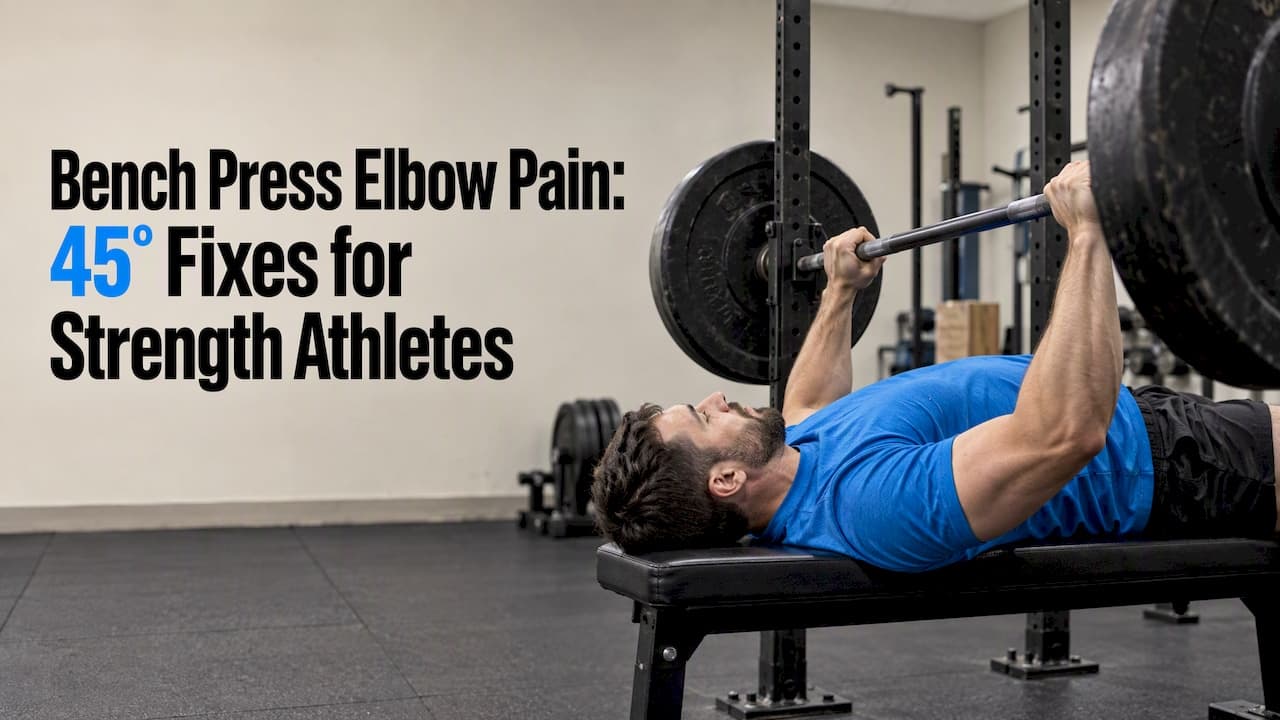
Elbow pain during bench press usually comes from tendon overload at the elbow, technique faults like excessive elbow flare or a bad wrist position, or simple fatigue late in a set. The fastest fixes are to stop the moment pain turns sharp, drop the load, tuck your elbows closer to roughly 45 degrees, and try a neutral-grip dumbbell or floor press for a session or two. If pain lingers past two weeks of smart adjustments, get a proper movement assessment.
TL;DR:
- Narrower grips increase elbow joint moments, while wider grips shift more work to the shoulders; test small changes and track next day symptoms.
- Pressing to failure raises elbow forces as fatigue degrades control, so stop sets before grinding reps and progress load or volume, not both, at once.
- Log pain on a 0 to 10 scale after training; scores above 3 that persist beyond 24 hours indicate that the session exceeded current tolerance.
- A floor press limits deep elbow flexion, while neutral grip dumbbells reduce forced forearm rotation; use whichever option does not provoke pain that day.
- Stop immediately for sharp pain, swelling, tingling, strength loss, or night pain, and seek assessment if symptoms persist despite two weeks of adjustments.
Table of Contents
- What actually causes elbow pain during the bench press
- Bench press biomechanics that matter: grip width, elbow angle and fatigue
- Concrete technique fixes to reduce elbow stress while benching
- Programming and load management: how to train through tendon irritation
- Warm-up, preload and prehab routines for protecting the elbow on press days
- Tolerated press variations and regressions you can use while rehabbing the elbow
- Rehab and strengthening exercises for elbow tendons and supporting muscles
- Red flags: when elbow pain needs physiotherapy or medical assessment
- How a movement-focused virtual assessment helps elbow pain from bench press
- Author perspective: treating bench-press elbow pain in strength athletes
- How PhysioParth can help: virtual assessment and tailored rehab for strength athletes
- FAQ
- Sources
What actually causes elbow pain during the bench press
The elbow has two bony landmarks that take most of the abuse from pressing: the lateral epicondyle on the outer side and the medial epicondyle on the inner side. Tendons attaching near these points, including the triceps tendon at the back of the elbow and the common extensor and flexor tendons at the epicondyles, absorb repeated tension every time you lower and press a bar. When that tension outpaces the tendon's capacity to recover, you get tendinopathy, a breakdown in tendon structure that causes pain, stiffness, and sometimes a dull ache that lingers after training.

Lateral elbow pain often gets labelled tennis elbow, while pain on the inner elbow is commonly called golfer's elbow, though neither label requires you to have played either sport. Both show up in lifters as a result of repetitive loading rather than any single injury moment.
Technique faults upstream of the elbow frequently show up as elbow pain. A squat-style grip, where the bar sits low in the palm, forces the wrist into extension and shifts strain onto the forearm tendons. Poor shoulder set-up or a collapsing bar path can also redirect load down the arm, making the elbow absorb stress that should be shared with the shoulder and chest.
A few causes worth ruling out before you assume it is simple overuse:
- Tendinopathy from accumulated pressing volume without enough recovery between sessions.
- Technique faults, including wrist extension, excessive elbow flare, or an erratic bar path.
- Fatigue-driven breakdown in form during the final reps of hard sets.
- Referred pain from shoulder or wrist dysfunction that only becomes noticeable at the elbow.
- Nerve irritation, less common, presenting as tingling or numbness rather than a dull ache.
Most lifters are dealing with the first three. The last two deserve more careful attention, which we cover later.
Bench press biomechanics that matter: grip width, elbow angle and fatigue
Grip width changes how much work your elbow does relative to your shoulder, and the data on this is fairly specific. A 2022 biomechanics study found that narrower grips increased elbow net joint moments by a noticeable margin compared to wider grips, which instead shifted more load onto the shoulder. There is no single correct grip width across lifters: the same research points out that the better approach is finding your own pain-free window rather than copying someone else's setup.
Elbow tuck angle works on a similar trade-off. Flaring the elbows out toward 90 degrees reduces triceps involvement but increases shoulder stress and can aggravate elbow tendons in some lifters, while tucking too tight toward the ribs shifts more tension onto the triceps tendon at the elbow. Most lifters land somewhere in the 45 to 70 degree range, but the right number for you depends on your proportions and your symptoms, not a universal rule.
Fatigue changes the picture further. A bench-press fatigue study tracked lifters pressing to the point of exhaustion and found that medial-lateral forces and internal-external moments on the elbow increased as fatigue set in, while elbow muscle strength declined across the fatigued sets. Cycle time per rep also lengthened, a sign that movement control was breaking down late in the set.
Pressing to failure measurably increases elbow joint stress, according to fatigue research on bench press mechanics, which means the last one or two grinding reps are often where elbow pain originates rather than the first clean reps of a set.
The practical takeaway: test grip width in small increments over a few sessions, track how your elbow feels the next day, and treat grinding reps near failure as a variable you can control rather than a badge of effort.
Concrete technique fixes to reduce elbow stress while benching
Small setup changes often make the difference between a pain-free session and one that flares up. Work through these in order and reassess after each one.
- Stack your wrist directly over your forearm instead of letting the bar roll back into your palm; a neutral wrist reduces strain on the forearm tendons that insert near the elbow.
- Find your tuck angle in the 45 to 70 degree range and stay there consistently rather than letting your elbows flare wider as you fatigue.
- Set your bar path to travel in a slight J-curve, lowering toward your lower chest and pressing back and up, which keeps the load travelling through your shoulder and chest rather than dumping it onto your elbow.
- Brace your upper back and leg drive before unpacking, since a stable base reduces the compensations that show up as erratic elbow position mid-rep.
- Trial a half-inch narrower or wider grip for a session and note any change in elbow discomfort against any change in shoulder strain, since the two trade off against each other.
- Cap your working sets short of failure and slow your eccentric phase to roughly two to three seconds, which lets you load the tendon without the uncontrolled bar speed that shows up late in failure sets.
Pro Tip: Film your set from the side on your phone. Watching your elbow angle and wrist position after the fact catches drift you cannot feel in the moment.
If pain shows up mid-set, do not try to grind through it hoping the next rep feels better. If the same discomfort returns at a lighter load, that is a signal to switch variations for the day rather than push volume.
Programming and load management: how to train through tendon irritation
Tendons respond to graded, tolerable loading far better than they respond to complete rest, which is why most clinical guidance on tendinopathy pushes toward active rehabilitation rather than shutting training down entirely. The goal is a stimulus your tendon can handle today while it adapts to handle more tomorrow.
A few rules make this workable in practice:
- Cap reps well short of failure on pressing days, since grinding reps are where elbow joint stress spikes according to fatigue research.
- Avoid stacking volume increases and intensity increases in the same week; progress one variable at a time.
- Prioritize small load increases over added sets when you are managing irritation, since tendons tolerate consistent moderate tension better than volume spikes.
- Log your pain on a simple 0 to 10 scale after each session; a score above 3 that lingers past 24 hours means you pushed too hard.
- Hold off on max-effort attempts until you have had several pain-free sessions in a row at your working weights.
A short-term switch to tempo bench work, controlling both the lowering and pressing phases, can let you keep training volume up while reducing the peak forces that aggravate the tendon.
Pro Tip: Keep a simple log: date, load, reps, and a pain score out of 10. Patterns show up faster on paper than in memory.
Give any adjusted programming at least two weeks before judging whether it is working. Tendon tissue changes slowly, and judging a plan after two sessions usually leads to unnecessary chopping and changing.
Warm-up, preload and prehab routines for protecting the elbow on press days
A short, targeted warm-up before pressing does more for elbow protection than static stretching ever will. The goal is to activate the muscles that stabilize the shoulder and wrist so the elbow is not left absorbing load those joints should be sharing.
- Start with band pull-aparts or face pulls, 2 sets of 15, to activate the rear shoulder and scapular muscles that support a stable bar path.
- Add light rotator cuff work, such as band external rotations, 2 sets of 12 per side, to prime the shoulder before it takes on pressing load.
- Move into wrist mobility drills, flexion and extension through a full pain-free range for 30 to 60 seconds each direction.
- Perform a light forearm preload set, such as wrist curls or reverse curls with a light dumbbell, 1 to 2 sets of 15, to get blood flow into the tendons that will be under tension during pressing.
- Finish with an empty-bar or light-weight ramp-up set at your working tuck angle and grip, treating it as a technique rehearsal rather than just a warm-up.
Keep the whole routine under 10 minutes. The point is to prepare the joint, not to pre-fatigue it before your working sets begin.
Tolerated press variations and regressions you can use while rehabbing the elbow
Switching variations temporarily is not a step backward. It is how you keep training volume on your chest and triceps while giving an irritated tendon a lower-stress option.
- Floor press: the reduced range of motion limits the stretch on the triceps tendon at the bottom of the rep, making it a reasonable short-term swap when deep elbow flexion is the trigger.
- Neutral-grip dumbbell press: a wrist-friendly option that removes the forced pronation of a barbell grip, often reducing lateral elbow discomfort.
- Machine or band-assisted presses: when available, these offer a fixed or assisted path that reduces the stabilization demand on the elbow, useful on days when free-weight pressing flares symptoms.
- Tempo bench (3 second lowering, 1 second pause, 2 second press): a useful protocol to cycle in for one to two weeks, letting you maintain barbell patterns while controlling the forces that spike late in a set.
Rotate through these based on which movement feels pain-free that day, rather than committing to one variation indefinitely.
Rehab and strengthening exercises for elbow tendons and supporting muscles
Targeted strengthening work addresses the tendon directly rather than just avoiding what hurts. The exercises below build tolerance over several weeks.
- Eccentric wrist extensor curls: 3 sets of 15 slow lowering reps, 3 to 4 times weekly, a staple protocol for lateral elbow tendinopathy that loads the tendon in the position it tends to fail.
- Pronation and supination drills with a light dumbbell or hammer, 2 sets of 12 per direction, to build rotational control through the forearm.
- Farmer's carries within a pain-free grip load, 2 to 3 sets of 20 to 30 seconds, building tendon tolerance to sustained tension.
- Triceps pressdowns or overhead extensions, moderate load, to build strength through the triceps without the compressive load of a full bench press.
- Shoulder stability work, such as single-arm carries or cable external rotations, to offload the elbow by improving how well the shoulder shares the work during pressing.
Pro Tip: *Progress load before volume on tendon work.
Expect gradual improvement over several weeks rather than a quick fix. Active, graded loading is the standard clinical recommendation for tendon recovery, well ahead of passive approaches like rest alone or injections without a loading plan.
Red flags: when elbow pain needs physiotherapy or medical assessment
Most bench-press elbow pain responds to the adjustments above within a couple of weeks. Some signs mean it is time to stop self-managing and get it looked at.
- Sharp pain during a set rather than a dull ache afterward.
- Visible swelling or warmth around the elbow joint.
- Numbness or tingling down the forearm or into the fingers.
- Noticeable strength loss in grip or elbow extension beyond normal post-training fatigue.
- Pain that wakes you up at night or persists at rest.
If you have corrected your technique, managed your load, and still see no improvement after roughly two weeks, that is also a reasonable point to bring in a professional rather than keep guessing. A clinical assessment typically involves watching how you move under load, identifying which joint or tendon is actually driving the pain, and building a loading plan specific to what they find rather than a generic rest-and-stretch protocol.
How a movement-focused virtual assessment helps elbow pain from bench press
Video movement analysis catches what a mirror cannot: the exact point in your bar path where your wrist breaks position or your elbow drifts past your intended tuck angle. A proper initial assessment reviews your pressing technique on video, maps your symptoms against your setup, and builds a graded loading plan around what is actually happening in your lift rather than a generic elbow protocol.
This matters because elbow pain in lifters is rarely just a local tendon problem. Upstream mechanics, like an aggressive squat grip or poor wrist stacking, commonly show up as elbow symptoms, and correcting the kinetic chain, not just the sore spot, tends to produce more durable recovery. Our own breakdown of how upstream faults create downstream pain in the squat follows the same logic. The goal throughout is to keep you pressing in some form while the plan addresses the root cause.
Author perspective: treating bench-press elbow pain in strength athletes
Pain is information, not a verdict. The lifters who recover fastest treat elbow pain as a signal to adjust load, not a reason to panic and stop benching entirely. The ones who struggle either ignore it until it becomes chronic or overcorrect and abandon training they did not need to abandon.
The real skill is matching the fix to the problem. A grip tweak and a tempo swap solve a different issue than a graded eccentric protocol does, and guessing which one you need wastes weeks. I would rather see a lifter make one deliberate change, track it honestly for two weeks, and adjust from there than cycle through five fixes in five days.
Short-term modification and long-term technique change are not in conflict. You can regress to a dumbbell press this week while still working toward a cleaner bar path for the long run. If two weeks of methodical adjustment does not move the needle, that is not failure, it is just the point where a proper assessment saves you more time than another round of guessing.
— Parth
How PhysioParth can help: virtual assessment and tailored rehab for strength athletes

If you have tried adjusting your grip and tuck angle and the elbow pain is still showing up, a focused assessment can save you weeks of trial and error. Our Initial Assessment runs through your bench technique on video, identifies the specific mechanical driver behind your pain, and builds a loading plan designed to keep you training rather than sitting out. Everything happens virtually, so there is no commute to a clinic and no referral required before booking.
We also offer a Free 15-Min Consult if you want to describe your symptoms before committing to a full assessment. From there, a Follow-Up Session keeps your plan progressing as your tendon tolerance improves. Book your assessment and get a plan built around how you actually press.
This article is general information, not a substitute for advice from a qualified doctor. Consult a qualified healthcare professional about your own circumstances before acting on anything here.
FAQ
What causes elbow pain from bench press?
Elbow pain during bench press usually comes from tendon overload at the lateral or medial epicondyle, technique faults like excessive wrist extension or elbow flare, or fatigue late in a set. Pressing to failure measurably increases elbow joint stress, making the final grinding reps a common trigger point.
What does tennis elbow feel like?
Tennis elbow, or lateral epicondylitis, typically feels like a dull ache or sharp twinge on the outer elbow that worsens with gripping or wrist extension movements. It often builds gradually from repetitive loading rather than appearing after a single injury, and can linger after training if the underlying load is not adjusted.
What could be causing my sore elbows?
Sore elbows during strength training often trace back to repetitive tendon loading, a grip or tuck angle that places excess stress on the joint, or fatigue breaking down your technique late in sets. Upstream issues like poor wrist stacking or shoulder instability can also redirect strain down to the elbow even when the elbow itself is not the root problem.
Why does my elbow hurt after doing pull-ups?
Elbow pain after pull-ups often comes from the same tendon overload mechanism seen in pressing, where the forearm and triceps tendons absorb repetitive tension beyond what they have adapted to handle. Grip width, hand position, and total pulling volume all influence how much load the elbow tendons take on, so adjusting any of these can reduce symptoms.
How do I relieve elbow pain from bench press right now?
Stop the set if pain turns sharp, reduce your working load, and switch to a neutral-grip dumbbell press or floor press for the session. Longer term, active and graded loading is the standard clinical approach for tendon recovery, so complete rest is usually less effective than a structured return to pressing.
Sources
- Understanding bench press biomechanics—The necessity of measuring lateral barbell forces (JSCR, 2022)
- Elbow joint fatigue and bench-press training (PMC article)
- Bench press elbow pain: How trainers should assess and adjust (NASM resource)
- Elbow tendonitis: How it occurs and what to do about it (AAOS / OrthoInfo)