
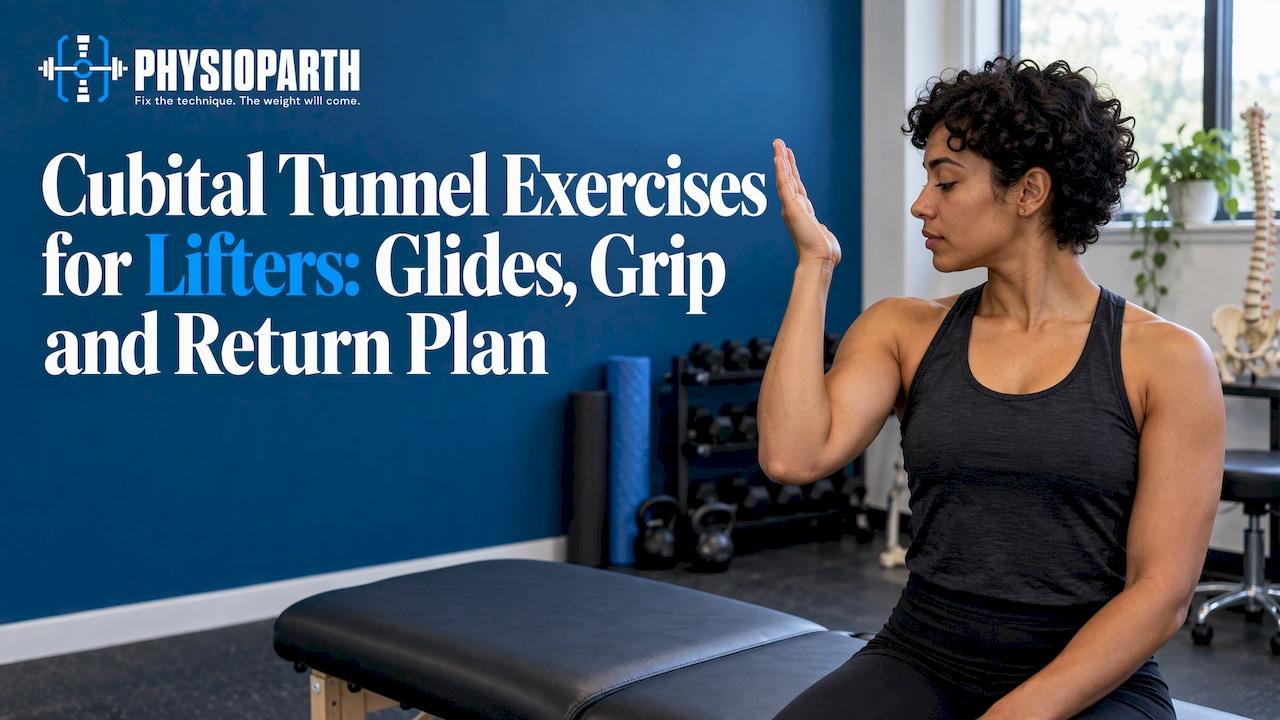
If your ring and little fingers tingle or go numb during bench, rack-position squats or heavy pulls, the exercises that tend to help are gentle ulnar nerve glides, combined with changes to how the elbow is loaded. Stretching alone rarely addresses the cause. I'm Parth Suthar, a registered physiotherapist in Ontario and a former competitive powerlifter, and this guide covers the glides, the set-up changes and a return-to-lifting progression based on criteria, not dates. It is general education, not a diagnosis.
TL;DR
- Elbow flexion under load narrows the space the ulnar nerve travels through, so bench tuck, low-bar rack position, hook grip, pull-ups and curls are the usual suspects.
- Glides are slow, relaxed and never held into a stretch. Around 10 repetitions, two to four times a day is a common range in NHS guidance.
- Medial elbow tenderness with no finger symptoms may indicate golfer's elbow. Numbness with neck symptoms may indicate a C8 nerve root problem. A physiotherapist can tell them apart.
- Return by criteria: symptom-free glides, then tempo and paused work, then load. Worsening numbness or weakness needs in-person assessment.
Table of Contents
- Why lifting can irritate the ulnar nerve at the elbow
- Telling the structures apart
- Ulnar nerve glides: how to do them
- Strength work that supports the elbow
- Technique causes you can change
- Load-management causes
- A criteria-based return-to-lifting progression
- Red flags: get an in-person or medical assessment
- My perspective
- Working it out with me
- FAQ
- Ready to book with me?
- Sources
Why lifting can irritate the ulnar nerve at the elbow
The ulnar nerve passes behind the inner elbow through the cubital tunnel. A 2022 review in PMC reports that when the elbow flexes, the arcuate ligament elongates, the volume of the cubital canal falls by about 55%, and the nerve lengthens by roughly 4.7 to 8 mm. Repeated or sustained flexion under tension is the combination that matters for us, because barbell training does both.
Where that shows up in the gym:
- Bench press: a tight elbow tuck with the elbows deeply bent at the bottom, plus a hard grip on the bar.
- Low-bar squat: the rack position pulls the shoulder back and keeps the elbow bent and loaded for the whole set.
- Hook grip and heavy pulls: a sustained, tight grip with the wrist and elbow positioned under tension.
- Pull-ups and bicep curls: repeated deep elbow flexion, often with a lot of volume.
One line on the usual non-lifting culprits: leaning the inner elbow on a desk or arm rest, or sleeping with the arms bent, can add to the load. NHS guidance suggests avoiding prolonged elbow flexion and padding or splinting the elbow at night. For most lifters the training is the bigger lever.
Telling the structures apart
I can't diagnose you through an article, and numbness in the hand has several possible sources. These clues may help you describe what you feel to a clinician.
| Structure | What you may notice | What may point away from it |
|---|---|---|
| Ulnar nerve at the cubital tunnel | Tingling or numbness in the ring and little fingers, often after sustained elbow bend, a medial elbow ache, symptoms reproduced by holding the elbow fully flexed | Pain only with resisted wrist movements and no finger symptoms |
| Flexor-pronator tendon at the medial epicondyle (golfer's elbow) | Tender spot right on the bony bump, pain when gripping, curling the wrist or pulling hard | Tingling in the fingers |
| C8 nerve root in the neck | Numbness or weakness that changes with neck position, neck or shoulder blade pain, symptoms in more of the hand than the ring and little fingers | Symptoms driven purely by elbow position |
These patterns overlap, and more than one can be present. Tendon pain tends to be a local, load-dependent ache you can press on. Nerve symptoms tend to be tingling, buzzing or numbness that spreads along the nerve's path. A movement screen that tests the neck, elbow and wrist separately is how a clinician sorts them. I do that during a video assessment, and it includes a lift analysis if you send videos beforehand.
Ulnar nerve glides: how to do them
The research on neural mobilization is modest. A systematic review of physiotherapy for cubital tunnel syndrome found that treatment most often combined manual therapy, neurodynamic techniques and electrical modalities, and the studies varied widely. AAOS OrthoInfo notes that some doctors think nerve-sliding exercises can improve symptoms and may help prevent stiffness in the arm and wrist. So treat glides as one tool, not a standalone answer.
A basic glide
- Sit or stand with the shoulders relaxed, neck neutral.
- Hold the arm out to the side, palm up, as if carrying a tray.
- Slowly bend the elbow and bring the hand toward the face, with the wrist bending back.
- Reverse slowly, straightening the elbow as the wrist moves the other way.
- Stop where you feel a pull or mild tingling, never sharp pain.
The Bexley NHS neurodynamic exercise page describes a similar tray-style glide, around 10 repetitions, two to three times per day. It warns that doing nerve glides rigidly or aggressively may increase symptoms, so stay relaxed and go only until you feel a pull, not into pain. The NHS Scotland workbook suggests little and often, for example three or four times a day, and says to stop an exercise if pain or symptoms increase until you've spoken with a health professional.
What about stretches?
Gentle wrist flexor and forearm stretches are fine for comfort, but I'd keep them short and never take the nerve into a sustained, tingling position. A nerve that is already irritated generally responds better to movement than to held tension. If a position reproduces ring-finger numbness, back off the range and don't hold it.

How hard should it feel?
Aim for a mild pull that settles within a few minutes. A short-lived tingle is acceptable. Pins and needles that linger for the rest of the day, spread, or wake you at night are a signal to reduce the range or the frequency.

Strength work that supports the elbow
The nerve is not the only structure that matters. Forearm, shoulder blade and triceps capacity affect how the elbow takes load. One caution: a surgeon at HSS notes that in some patients the triceps can contribute to symptoms, and in those patients isolated triceps strengthening would be discouraged. So choose strengthening with someone who has examined you rather than guessing.
Options often used while symptoms settle:
- Isometrics: mid-range holds with the elbow around 90 degrees or more open, low effort, symptom-free.
- Scapular work: rows and external rotation with the elbow not deeply bent.
- Grip variety: thick-handle or neutral-grip carries to avoid constant maximal flexion.
Technique causes you can change
Separate these from training load, because the fix differs.
- Set-up: on bench, a slightly wider grip and elbows at a moderate angle (not pinned to the ribs) can reduce time spent deeply bent. My bench elbow pain guide goes through the angles.
- Rack position: widen the hands on a low-bar squat, or try a Safety Squat Bar so the elbows aren't forced back. The squat elbow pain article covers this in more detail.
- Grip: a hook grip pulls the wrist and forearm into sustained tension. Straps, a mixed grip or a double overhand on lighter sets may reduce that.
- Bracing and bar path: if you lose tension, the elbow tends to drift into more flexion at the bottom. Reset the brace before each rep.
- Stance and depth: these change where the bar sits on your back and how far the elbows move, so adjust them with video review.
Load-management causes
These are separate from technique. Check them honestly:
- Volume: a jump in bench or curl sets, or added pull-up volume.
- Intensity: frequent heavy singles with sustained grip.
- Frequency: pressing three or four times a week with no variation in angle.
- Recovery: poor sleep and short gaps between heavy pulling and pressing days.
A small cut in the one or two variables that changed most recently often matters more than a full break. The forearm pain guide shows how I think about modifying rather than quitting.
A criteria-based return-to-lifting progression
Move to the next stage only when you meet the criteria, however long that takes.
| Stage | Typical variations | Move on when |
|---|---|---|
| 1. Calm it down | Nerve glides, isometrics, pin presses or floor press with a reduced range, trap bar pulls with straps | Daily glides cause no lingering tingling, and training doesn't raise finger symptoms during or after the session |
| 2. Rebuild control | Tempo bench or squat (3 seconds down), paused reps, Safety Squat Bar squats, block pulls | Symptoms stay the same or settle for two or three consecutive sessions at the same load |
| 3. Load it | Closer-to-competition variations, heavier floor press, pin squats, deficit-free pulls | Symptom-free at working weights, with grip and rack position comfortable |
| 4. Full return | Competition-style lifts, hook grip if tolerated | Symptoms haven't returned across a full training block |
If a step brings the numbness back, go back one stage and reduce the load or the range. That is information, not failure.
Red flags: get an in-person or medical assessment
See a physician or arrange an in-person assessment if you notice:
- Numbness or tingling that is worsening or constant.
- Weakness in the hand, dropping things, difficulty pinching, or muscle wasting between the thumb and index finger.
- A clawed-looking hand. An Orthopedic Reviews article describes intrinsic weakness and atrophy in chronic nerve compression.
- Symptoms after a fall, elbow trauma or surgery.
- Neck pain with arm numbness, or symptoms in both hands.
- Fever, unexplained weight loss, or severe night pain.
HSS lists persistent pain, worsening numbness or tingling and worsening hand weakness as symptoms that need evaluation. If symptoms persist despite sensible changes, ask a physician about nerve conduction testing. The same Orthopedic Reviews article cautions that nerve conduction studies can be normal even in severe disease, so the exam and history matter as much as the result.
My perspective
Most lifters I talk to assume rest is the only option. In my view, the more useful question is which position loads the nerve and which variation avoids it. A glide routine on its own is rarely enough, because the nerve meets the same bent, loaded elbow every session.
My Initial Assessment aims to explain which tissue may be irritated in lifter terms, sort nerve from tendon from neck, and build a criteria-based plan that uses modified variations where appropriate. Having competed as a powerlifter, I know how hard it is to stay away from the bar.
Parth
Working it out with me
If you'd like the elbow, neck and wrist screened and your lifts reviewed on video, my Initial Assessment is $130 and a Follow-Up Session is $100. Many extended-health plans cover physiotherapy, and I provide receipts. No referral is needed in Ontario, though some insurers require one for reimbursement. See the Initial Assessment and Follow-Up options.

The free Lifter's Hip & Lower Back Toolkit is a good companion if your low back or hips also complain.
FAQ
How often should I do cubital tunnel exercises?
NHS guidance gives a range of about 10 repetitions, two to four times a day, done slowly and relaxed. Stop if symptoms increase. Quality matters more than volume, since an irritated nerve doesn't like aggressive work.
Can I keep benching with ring-finger numbness?
Often you can modify rather than stop, for example a floor press, a pin press, a wider grip or a tempo bench at a lower load. Judge it by whether symptoms appear during or after the session. Worsening numbness or weakness needs assessment first.
Will a splint or a towel at night help?
The NHS Scotland workbook suggests wrapping a folded towel around the elbow or wearing a splint to limit bending at night. Ask a clinician about the right setup for you.
Does this help golfer's elbow too?
Golfer's elbow is a tendon problem and is usually managed with graded loading rather than glides. Both can occur together, which is why an assessment is useful.
Ready to book with me?
If your elbow symptoms are limiting your squat, bench or deadlift, book with me for a free 15-minute consult at physioparth.com. It's a fit check, not an assessment or treatment.
Sources
- A Comprehensive Review of Cubital Tunnel Syndrome (PMC)
- The Effects of Physiotherapy in the Treatment of Cubital Tunnel Syndrome: A Systematic Review (PMC)
- Cubital Tunnel Syndrome, OrthoInfo (AAOS)
- Upper Limb Neurodynamic Exercises, Bexley NHS
- Cubital Tunnel Syndrome workbook, NHS Right Decisions
- Cubital Tunnel Syndrome Symptoms, Treatment and Recovery, HSS
- A Comprehensive Review of Cubital Tunnel Syndrome, Orthopedic Reviews
Recommended
- Elbow Pain When Squatting: Causes, Tissue Clues and a Return Plan
- Forearm Pain When Lifting: Ontario Lifters Modify, Not Quit
- Wrist Pain on the Bench Press: Causes, Fixes, Return Plan
- Elbow Pain on the Overhead Press: Causes and Return Plan
This article is general education for strength athletes and is not a substitute for an individual assessment. Pain that is severe, worsening, or accompanied by numbness, weakness or loss of function needs prompt in-person or medical assessment. Author: Parth Suthar, Registered Physiotherapist (Ontario).