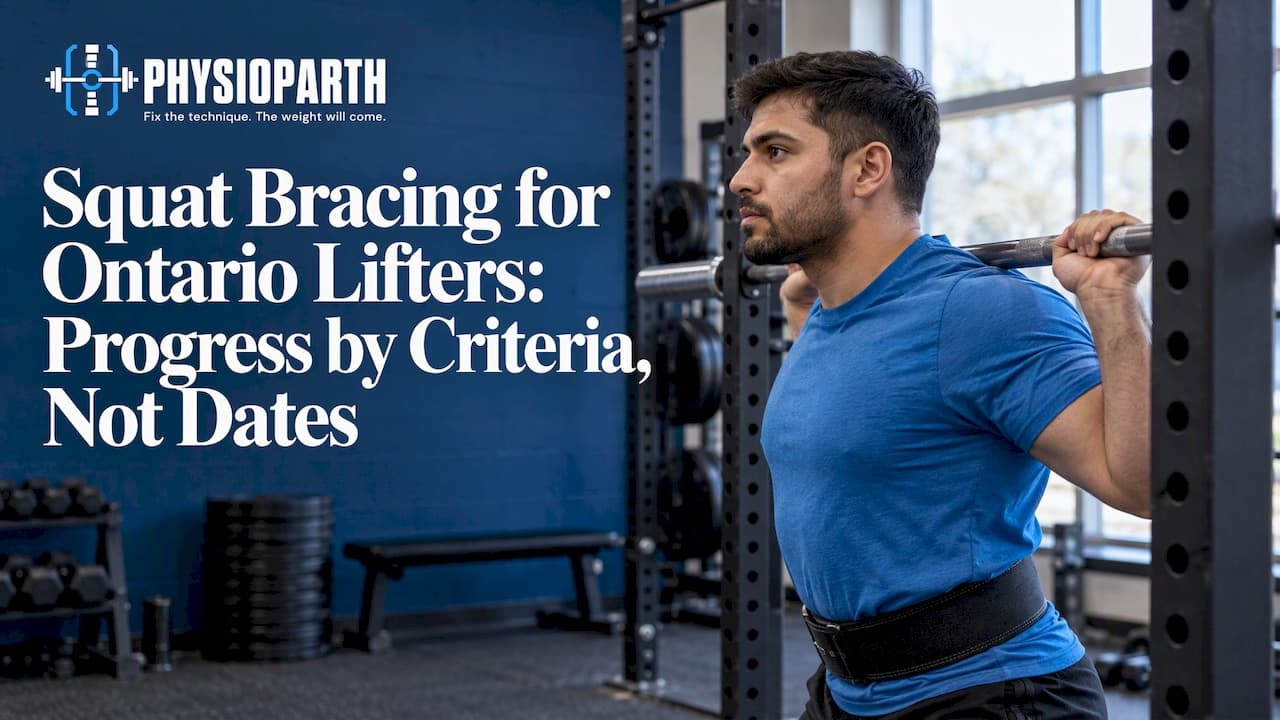
Brace for the squat by taking a deep diaphragmatic breath, creating 360° intra-abdominal pressure (IAP), and tightening your midline, then keep that tension through the descent and ascent. Set your upper back first, breathe low into the belly and lower ribs, push out against your sides, back and front, descend, drive, and reset at the top. This is how I coach it at PhysioParth.
TL;DR:
- Use a brief breath hold for singles above roughly 80% of your one rep max; for longer sets, exhale or reset between reps.
- If you have hypertension or a history of hernia, choose controlled breathing instead of heavy Valsalva work and check with your clinician first.
- A belt gives your abdomen something to push against and sensory feedback, but it cannot replace active bracing; learn the skill without one first.
- Advance from breathing drills to paused and loaded variations only after repeated working sets preserve torso position without new pain; regress if either fails.
- Seek urgent care for fever or severe chest pain during breath holding, and arrange in person assessment for spreading weakness, numbness, or persistent severe pain.
Table of Contents
- How do you brace before and during each squat rep?
- What does bracing do to your spine and trunk muscles?
- When should you hold your breath, and what are the alternatives?
- Which drills and variations teach a reliable brace?
- What are the most common bracing mistakes, and how do you fix them?
- When do you need in-person or medical assessment?
- A note from Parth on how I coach the brace
- Want eyes on your squat brace?
- FAQ
- Sources
How do you brace before and during each squat rep?
Bracing is a sequence, not a single gulp of air. Run the same sequence every set so it becomes automatic when the bar is heavy.
- Set the upper back first. Grip the bar, pull your shoulder blades together and down, and settle the bar before you breathe. A loose upper back lets the torso collapse no matter how well you brace.
- Breathe low. Inhale through the nose and mouth into the abdomen and lower ribs, so the belly, sides and low back all expand. Your chest and shoulders should barely rise.
- Create 360° pressure. Tighten the midline as if you were about to take a punch, and push your abdominal wall out against your hands or belt.
- Hold through the rep. For near-maximal singles, a brief breath hold carries you through the sticking point. For sets of multiple reps, reset your breath at the top of each rep.
- Reset deliberately. Stand tall, exhale, take a fresh breath, and rebuild the brace before the next descent. Do not grind through a faded brace.
Short cues work best under load: "ribs down, belly wide, push out." Pick one cue and keep it for a block of training.
Pro Tip: Practise the brace with an empty bar before every session. If you cannot feel pressure at your sides and low back at 60 kg, it will not appear at 200 kg.
What does bracing do to your spine and trunk muscles?
Bracing raises intra-abdominal pressure, which stiffens the trunk and helps your spine resist compression and shear under load. Research reports that IAP can exceed 200 mmHg during heavy squats, and a systematic review of high-intensity resistance exercises found squats elicit some of the highest IAP values of any lift.
Several structures work together to build that pressure. The diaphragm forms the roof of the canister, the pelvic floor forms the base, and the transversus abdominis and obliques wrap the sides and front. The lumbar extensors and deep back muscles complete the ring at the back. When one part is slack, pressure leaks and the torso softens.

The EMG evidence fits this picture. In a loaded squat study, abdominal muscle activity was significantly greater in braced conditions than in non-braced ones (p < .001), while lumbar extensor and lower limb activation did not change significantly with bracing or belt use. In practical terms, bracing recruits your abdominal wall more, but it does not make your legs or back muscles work harder.
Bracing is a stability tool, not a fix for everything. A biomechanical review of the squat found that stance, depth and trunk position all change joint loading and muscular demands, so the best squat setup depends on the individual. A perfect brace on a poorly chosen stance or an overloaded week still leaves you exposed.
If back discomfort shows up, how you describe it may help tell tissues apart. Deep, central tightness that builds late in a set may indicate fatigue in the trunk musculature. Sharp, one-sided pain that ssits in a specific spot and eases with load reduction may indicate a different structure is irritated. Neither pattern is a diagnosis, and a movement assessment is the reliable way to sort them out.
When should you hold your breath, and what are the alternatives?
The Valsalva manoeuvre is the breath hold most lifters use. A review of the Valsalva manoeuvre found it effectively increases IAP and trunk rigidity during resistance exercise, but it is also associated with increased blood pressure. The health risks remain unconfirmed, so treat it as a tool you choose, not a rule for every set.
A practical way to match breathing to the set:
- Singles above roughly 80% of your one-rep max: a brief breath hold from unrack to lockout, then exhale at the top.
- Heavy doubles and triples: hold through each rep, exhale at lockout, and take a fresh breath before the next descent.
- Higher-volume sets: use a controlled exhale through the sticking point, or reset your breath every rep, so you are not holding pressure for long stretches.
- Lighter technique work: breathe normally but keep the brace on, which teaches you to hold tension without a long breath hold.
If you have hypertension or a history of hernia, choose controlled breathing over heavy Valsalva work and check with your clinician first. Untrained lifters should also build up before attempting very heavy, high-IAP squats, as the systematic review advises caution in that group.
Which drills and variations teach a reliable brace?
Progress the skill by criteria you can measure, not by calendar dates. Move on when you meet the standard, and step back when you do not.
- Supine diaphragmatic breathing. Lie on your back with knees bent and breathe so your lower ribs and belly widen. Criterion: you can repeatedly feel the expansion at your sides and low back while breathing slowly.
- 90/90 half-kneeling brace holds and anti-rotation carries. Hold a brace while resisting a twist. Criterion: you keep your ribs down and pressure steady without drifting.
- Tempo squats. Lower slowly with a full brace. Criterion: no loss of torso position across repeated working sets.
- Paused squats. Pause in the hole, then drive. Criterion: you hold 360° pressure through the pause with your usual bar path.
- Safety Squat Bar or trap bar variations. The Safety Squat Bar reduces shoulder demand and encourages upper-back tension, while the trap bar shifts load toward the hips and makes bracing easier with less trunk flexion.
- Pin squats and isometric holds. Pins train position from a dead start, and midline holds build endurance in the brace itself.
Progress when you complete repeated sets at working weight with no new pain and no loss of mechanics. If either appears, drop back one step rather than pushing through.
Pro Tip: Film your paused rep from the side. If your belly softens or your ribs flare in the hole, that is your brace fading, not your legs failing.
What are the most common bracing mistakes, and how do you fix them?
Most failed braces trace back to a few repeat offenders. Fix the root cause, not the symptom.
- Shallow chest breathing or "sucking in" the belly. Your shoulders rise and the abdomen pulls in. Return to supine breathing drills and cue "push out, not in."
- Brace fades at the bottom. Pressure drops just as demand peaks. Build endurance with tempo reps, paused reps and isometric holds.
- Over-reliance on the belt. A belt gives your abdomen something to push against, but it does not replace active bracing. Belts add sensory feedback, so learn the skill without one first, then use the belt as feedback.
- Mistaking a bar path or stance problem for a bracing problem. Film your set and do a single paused rep. If the brace holds in the pause but you still miss, look at set-up, stance and depth. Our guide to common squat faults covers those in detail.
Keep technique causes (set-up, bar path, bracing, stance, depth) separate from load-management causes (volume, intensity, frequency, recovery). A weak brace during a heavy block may be a recovery problem, not a skill problem.
When do you need in-person or medical assessment?
Stop self-managing and get assessed in person if you notice any of these:
- New numbness, tingling or weakness in a limb, or symptoms that keep spreading.
- Severe pain that does not settle, or noticeable swelling.
- Fever, or severe chest pain when you hold your breath, which need urgent care.
- A suspected fracture after a fall or failed lift.
If you fail your progression criteria repeatedly, or pain worsens even on the regressed variations, book a clinician-led assessment instead of grinding on.
A note from Parth on how I coach the brace
I am a registered physiotherapist and a competitive powerlifter, and I test the skill before I load it. If you cannot hold a brace during a paused rep, no belt or bar will fix that. Try the drills above, and if something still feels off, get your squat looked at.
— Parth
Want eyes on your squat brace?
I offer a free 15-minute consult, and an Initial Assessment at $130 that includes video review of your squat, a tissue-level explanation of what may be irritated, and a criteria-based plan. Receipts are accepted by many extended health plans. See the squat page or send us a clip through the video lift audit.

FAQ
How do I know if I'm squatting correctly?
Film your set from the side and check three things: a stable torso with no loss of rib position, a bar path over mid-foot, and consistent depth. A biomechanical review shows ideal squat setup varies with the individual, so judge it by repeatable control rather than one perfect position.
Do you work your abs when squatting?
Yes, especially when you brace. In a loaded squat EMG study, abdominal muscle activity was significantly greater in braced conditions than in non-braced ones, while lumbar extensor and lower limb activation did not change significantly.
How do I strengthen my squat?
Build the skill first: practise the brace, then use tempo, paused, pin and Safety Squat Bar variations to train position under load. Progress by criteria such as repeated clean sets with no pain or loss of mechanics, and manage volume and recovery around them.
Should I always hold my breath when I squat?
No. A brief breath hold suits heavy singles, while longer sets can use a controlled exhale or a reset each rep. The Valsalva review notes it raises blood pressure, so use it selectively.
Sources
- Pmc
- Changes in muscle activation in response to abdominal bracing and stabilization belt use during a loaded squat - PubMed
- The Valsalva Maneuver
- Systematic review of intra-abdominal and intrathoracic pressures initiated by the Valsalva manoeuvre during high-intensity resistance exercises
- A Biomechanical Review of the Squat Exercise: Implications for Clinical Practice
Recommended
- Morning Back Stiffness in Ontario Lifters: The 30–60 Minute Clue
- Bench Shoulder Pain in Ontario: When a 45° Fix Isn’t Enough
- Hip Flexor Strain for Strength Athletes: 3 Grades, Return by Criteria
- Squat Lower Back Pain: 7 Mistakes & How to Fix Them
This article is general education for strength athletes and is not a substitute for an individual assessment. Pain that is severe, worsening, or accompanied by numbness, weakness or loss of function needs prompt in-person or medical assessment. Author: Parth Suthar, Registered Physiotherapist (Ontario).