
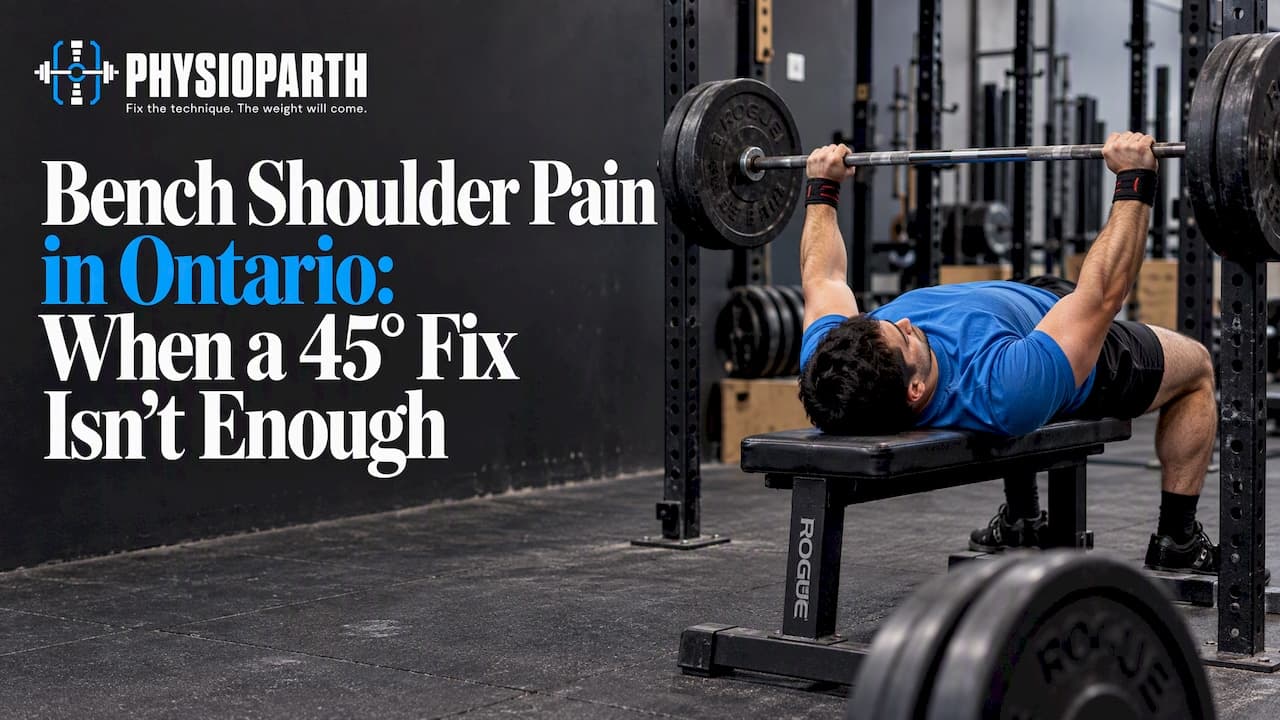
If bench pressing hurts your shoulder, the most useful first change is a grip near shoulder width and an elbow tuck of about 45°, with your shoulder blades pulled back and down. Bench shoulder pain may indicate technique-driven tissue irritation or a load that has outrun what the tissue tolerates. If you feel a sudden pop with severe weakness, or pain at night, stop and get assessed in person.
TL;DR:
- For pain atop the shoulder, stop short of chest contact or use paused reps to avoid the provocative end range.
- Use a floor press to limit shoulder extension, neutral grip dumbbells for a freer arm path, or landmine presses to reduce arm elevation.
- Move from floor presses to pin presses and narrow grip benching only when next day pain does not worsen and control improves.
- Stop pressing and seek medical assessment after a sudden pop with severe weakness, persistent night pain, fever, visible deformity, or major loss of function.
- For suspected rotator cuff tendinopathy, active exercise is first line, and the 2025 guideline advises against routine early imaging to confirm it.
Table of Contents
- What causes shoulder pain on the bench press?
- Which shoulder structures hurt from benching, and how do you tell them apart?
- How should you change your bench technique to reduce shoulder pain?
- Which press alternatives keep you training, and how do you progress back?
- What does evidence-backed rehab and load management look like?
- When is bench shoulder pain a red flag?
- A clinician-lifter's view: why the plan beats the rest day
- Get a tissue-level plan for your bench
- FAQ
- Sources
What causes shoulder pain on the bench press?
Technique and programming are two separate problems, and fixing the wrong one wastes weeks. Sort your symptoms into the right bucket first.
Technique causes:
- A wide grip that pushes the shoulder into high abduction at the bottom
- Elbows flared well past 45–60°, which raises shoulder joint stress
- A bar path that drifts toward the throat instead of a gentle J-curve to the lower sternum
- Shoulder blades that lose their set once the bar leaves the rack
- A bounce or sink at the chest that you cannot control
Load-management causes:
- A sudden jump in volume or intensity, such as adding a heavy block after a light month
- Grinding sets to failure week after week
- Frequency that leaves no recovery between pressing days
- Fatigue carried in from other training
The two interact inside a single session. A 2024 narrative review links muscular fatigue and shoulder biomechanics to bench press injury, and it points to velocity-based training, RPE/RIR and autoregulation as ways to avoid overexertion. In practice, the final reps of a hard set are where your elbows may creep out and your scapulae slide forward. A small technique fault gets amplified exactly when the tissue is the least able to cope.
Which shoulder structures hurt from benching, and how do you tell them apart?
You cannot diagnose yourself from a blog post, and I will not pretend to diagnose you here. What you can do is notice patterns that may indicate which structure is irritated, then bring that information to an assessment.
- AC joint: pain on top of the shoulder, often a small, pointable spot. It may indicate AC irritation if it flares with cross-body reaching and with a full chest touch, and it tends to worsen at high abduction angles.
- Rotator cuff and subacromial space: pain at the front or side of the shoulder, often with a painful arc when you raise your arm overhead. Reaching behind your back or lifting with the arm turned in may provoke it, and it commonly links to high abduction at the bottom of the bench. The Cleveland Clinic describes this pinching under the acromion as often overuse-related.
- Anterior capsule and pec minor area: a deeper ache at the front of the shoulder that may indicate excessive humeral extension, usually when the elbows flare and the bar sinks low.
Overlap is common. A clinician can use history, movement testing and resisted tests to separate them properly.
How should you change your bench technique to reduce shoulder pain?
Make these changes in order, and change one at a time so you can tell what helped.
- Narrow the grip. Aim for shoulder width or slightly inside, under 1.5 times bi-acromial width. A 2024 biomechanical comparison of 21 bench press variations found that narrower grips and scapular retraction decreased AC compression, glenohumeral posterior shear and rotator cuff activity.
- Tuck the elbows to about 45°. Avoid extreme flare, but do not pin them to your ribs either.
- Set the scapulae and keep them set. Retract and depress them before you unrack, then hold that position for the whole set.
- Fix the bar path. Lower to the lower sternum or xiphoid with a gentle J-curve back up.
- Shorten the range if the AC joint is angry. Stop short of the chest, or use a paused rep or pin to skip the provocative end range.
Sticking points matter too. Research on sticking-region mechanics suggests grip width and bar path can shift demand between the shoulder and triceps, so a narrower grip is not only a pain tool but can also change where the lift is hard.
Pro Tip: Film your set from the side and from the foot end. Pause the footage at the bottom and check elbow angle and shoulder blade position before you touch the weight.

Which press alternatives keep you training, and how do you progress back?
Resting completely is rarely the best answer. Swap in variations that lower the provocative position, and keep the pressing pattern alive.
- Floor press: the floor limits humeral extension, so the deep anterior position is removed.
- Neutral-grip dumbbell press: reduces internal rotation and lets the arms find a comfortable path.
- Landmine press: lower abduction angles with a pressing arc that many painful shoulders tolerate.
- Incline press at about 30°, plus pin or board work: trims the bottom range where irritation tends to start.
- Machine or cable presses: a controlled arc. Kinematic work on chest exercises shows cable and barbell pressing load the joints differently, so stabilise well and avoid overloading.
Progress by criteria, not calendar dates. Start with pain-limited isometrics and limited-range pressing. Move forward when pain is no worse the next day and strength or control is improving. A common sequence is tempo floor press, then paused pin press, then paused narrow-grip bench, then your usual bench. If a step flares symptoms the next day, step back one level.
What does evidence-backed rehab and load management look like?
For rotator cuff tendinopathy and related irritation, active exercise therapy is the first-line approach; see more at Rotator Cuff Tendinopathy: Causes, Symptoms, and Treatment. The 2025 JOSPT clinical practice guideline recommends thorough assessment and active rehabilitation, and it advises against routine early imaging to confirm tendinopathy. A JOSPT review found structured exercise can produce outcomes equivalent to surgery for many patients.
- Begin with submaximal isometrics and supported external rotation.
- Progress to eccentric and concentric resistance work for the cuff and scapular muscles.
- Reintroduce pressing variations from the progression above.
- Monitor symptoms: some protocols allow moderate pain if it returns to baseline by the next exercise session. If next-day pain is worse, reduce load.
- Track objective measures where possible. An inclinometer or handheld dynamometer gives a clinician more reliable numbers than guesswork.
Those same programmes ranged from about 6 to 19 formal sessions in the cited studies, so expect rehab to be a process you build, not a quick fix.
When is bench shoulder pain a red flag?
Some patterns need an in-person or medical assessment, not self-management. Clinical reports list these warning signs.
- A sudden loud pop under heavy load followed by immediate severe weakness, which may indicate a full-thickness tear
- Persistent night pain that does not settle with position changes
- Fever, visible deformity or major loss of function
- Severe, persistent pain or disability despite appropriate nonsurgical care warrants further assessment.
If any of these apply, stop pressing and get examined before anything else.
A clinician-lifter's view: why the plan beats the rest day
I am a registered physiotherapist and a competitive powerlifter, and I see the same mistake often: lifters either push through pain unchanged or stop training entirely. Neither works. When I watch a lifter's actual sets, I look at bar path, elbow angle, scapular control and how all three break down as fatigue builds. Then I choose the variation that keeps the shoulder quiet and the bench pattern alive, and I advance it only when pain and control meet set criteria. Timelines are a guess. Criteria are a decision.
— Parth
Get a tissue-level plan for your bench

You do not have to guess which structure is irritated or which variation to run next. Our initial assessment ($130) and follow-up session ($100) include video analysis of your real lifts and a criteria-based return-to-lifting plan. Start with the free 15-minute consult.
- Free 15-minute consult to see whether virtual care fits
- Initial assessment with movement analysis of your bench
- A criteria-based plan, plus our bench guide and free audit
This article is general information, not a substitute for advice from a qualified doctor. Consult a qualified healthcare professional about your own circumstances before acting on anything here.
FAQ
Is a narrower grip better for bench press shoulder pain?
Often, yes. A grip near shoulder width, under 1.5 times bi-acromial width, may reduce AC compression and posterior shear forces at the shoulder, according to a 2024 biomechanical study. It is a practical short-term option that keeps you pressing.
Should I stop benching if my shoulder hurts?
Not always. If there are no red flags, modifying grip, elbow angle, range and exercise selection can often keep you training. Stop and seek assessment if you have a sudden pop with weakness, night pain or visible deformity.
How do I tell if it is the AC joint or the rotator cuff?
AC pain tends to sit on top of the shoulder and flare with cross-body reaching and a full chest touch. Rotator cuff or subacromial pain tends to sit at the front or side with a painful arc overhead. These patterns may indicate which structure is involved, but a clinician needs to confirm it.
Can a shoulder problem like this be managed without surgery?
Many cases of rotator cuff tendinopathy respond to active exercise therapy, and the JOSPT guideline prioritises it. Imaging and surgical opinions come into play when appropriate care does not improve things or when red flags appear.
Sources
- Pmc
- Effects of bench press technique variations on musculoskeletal shoulder loads and potential injury risk
- The Contribution of Muscular Fatigue and Shoulder Biomechanics to Shoulder Injury Incidence During the Bench Press Exercise: A Narrative Review
Recommended
This article is general education for strength athletes and is not a substitute for an individual assessment. Pain that is severe, worsening, or accompanied by numbness, weakness or loss of function needs prompt in-person or medical assessment. Author: Parth Suthar, Registered Physiotherapist (Ontario).